On this page
Most circle questions in JEE Main come down to the centre, the radius and one comparison: a distance against that radius.
What does the JEE Main syllabus say about circles?
The NTA's Syllabus for JEE (Main) - 2027 puts circles in Unit 10, Co-ordinate Geometry: the standard and general forms, radius and centre, the circle on given diameter endpoints, and the points where a line meets a circle centred at the origin.
The textbook match is section 10.3 of the Conic Sections chapter in NCERT Class 11 Mathematics, Reprint 2026-27. It derives (x − h)² + (y − k)² = r² and finds centre and radius by completing the square.
NCERT's section also works a circle through two points with its centre on a line, but it does not cover the diameter form or line-circle intersection, so learn those from elsewhere. Tangents are named in neither, but a tangent is just the touching case of intersection, so learn it. The point-to-line distance comes from our Straight Lines preparation guide.
How do you find the centre and radius from the general form?
For x² + y² + 2gx + 2fy + c = 0, the centre is (−g, −f) and the radius is √(g² + f² − c).
Take x² + y² − 6x + 4y − 12 = 0.
Complete the square. (x − 3)² + (y + 2)² = 12 + 9 + 4 = 25. Centre (3, −2), radius 5.
Check by formula. g = −3, f = 2, c = −12, so g² + f² − c = 9 + 4 + 12 = 25.
Now x² + y² + 4x − 6y + 15 = 0: g² + f² − c = 4 + 9 − 15 = −2. Completing the square gives (x + 2)² + (y − 3)² = −2: no real points.
How do you find a circle through three points?
Take A(6, 2), B(−1, 1) and C(0, −6).
Substitute into the general form: 12g + 4f + c = −40, −2g + 2f + c = −2, −12f + c = −36.
Solve: g = −3, f = 2, c = −12, the same circle.
Check: BA · BC = 7 × 1 + 1 × (−7) = 0, so the angle at B is 90° and AC is a diameter. Its midpoint is (3, −2) and its length √(36 + 64) = 10.
The diameter form agrees: (x − 6)x + (y − 2)(y + 6) = 0 expands to the same equation.
When does a line cut, touch or miss a circle?
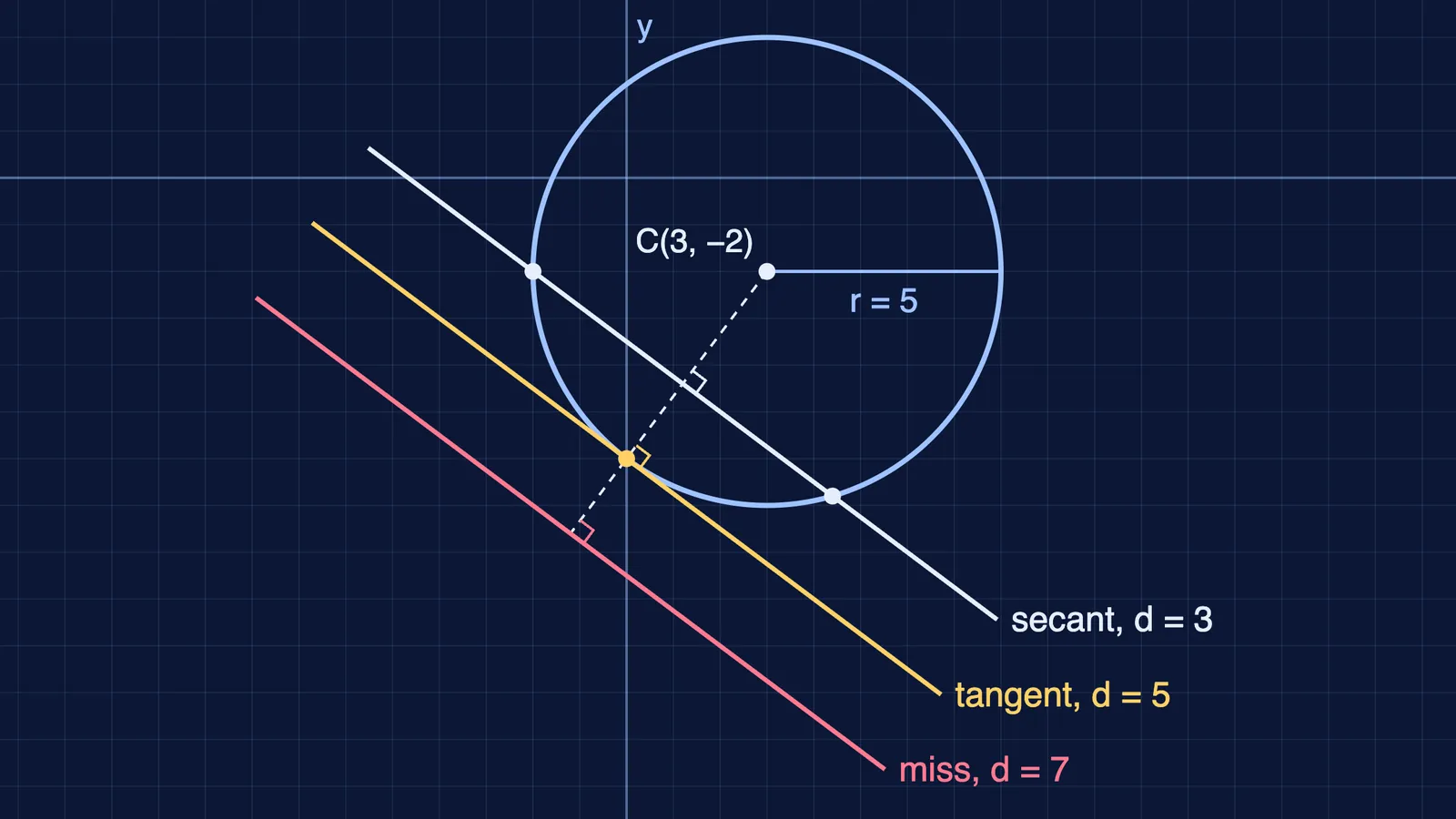
Compare d, the perpendicular distance from the centre to the line, with r: d < r is a secant, d = r a tangent, d > r a miss. The diagram shows three lines 3x + 4y + k = 0.
k = 14: d = |9 − 8 + 14|/5 = 3, secant. Check: substitution gives (−2, −2) and (22/5, −34/5).
k = 24: d = 5, tangent. Check: the quadratic's discriminant is 0, root (0, −6).
k = 34: d = 7, miss. Check: the discriminant is negative.
Tangent at a point. Replace x² by xx₁, y² by yy₁, x by (x + x₁)/2 and y by (y + y₁)/2. At (0, −6) this gives 3x + 4y + 24 = 0, the k = 24 line.
Tangent condition. y = mx + c touches x² + y² = a² when c² = a²(1 + m²). With a = 5, m = −3/4: c = ±25/4. Check: c = 25/4 gives a double root at (3, 4).
Chord length. The secant's chord is 2√(25 − 9) = 8. Check: the distance between its two points is √(1024 + 576)/5 = 8. For the reverse problem, see the length of a chord cut off by a line.
Which traps cost marks in circle questions?
Reading the centre as (g, f), not (−g, −f).
Not dividing through when x² and y² have a coefficient other than 1.
Dropping the modulus in the distance formula.
Using c² = a²(1 + m²) for a circle not centred at the origin. Use d = r.
Quoting a radius without testing g² + f² − c.
If one mistake keeps returning, the Fermi Problem Library has a step-by-step solver that explains the reasoning rather than printing an answer.
What is a good two-week practice plan for circles?
Days 1-3: convert ten equations between forms, testing g² + f² − c.
Days 4-6: three-point and diameter circles, each checked by a right angle or bisector.
Days 7-10: for every line, find d, call it secant, tangent or miss, then confirm by substitution.
Days 11-12: tangents and chords, by T = 0 and by d = r.
Days 13-14: a timed mixed set from past JEE Main papers, logging each error with its step.