On this page
JEE Main tests practical chemistry through questions: you never hold a burette, but you must know which reagent gives which colour, and why. Physics has its own lab unit, covered in our guide to experimental skills in the JEE Main physics syllabus.
What does Unit 20 of the JEE Main chemistry syllabus include?
Unit 20 of the official Syllabus for JEE (Main) - 2027, linked as "Syllabus" on jeemain.nta.nic.in, lists:
Detection of nitrogen, sulphur and halogens; tests for hydroxyl (alcoholic, phenolic), carbonyl, carboxyl and amino groups.
Preparations: Mohr's salt, potash alum, acetanilide, p-nitroacetanilide, aniline yellow, iodoform.
Titrations: acids and bases with indicators; oxalic acid and Mohr's salt against KMnO4.
Salt analysis: Pb2+, Cu2+, Al3+, Fe3+, Zn2+, Ni2+, Ca2+, Ba2+, Mg2+, NH4+; CO3 2−, S2−, SO4 2−, NO3−, NO2−, Cl−, Br−, I−.
Enthalpy of solution of CuSO4, enthalpy of neutralisation, lyophilic and lyophobic sols, and iodide-hydrogen peroxide kinetics.
How do you remember the cation groups and their reagents?
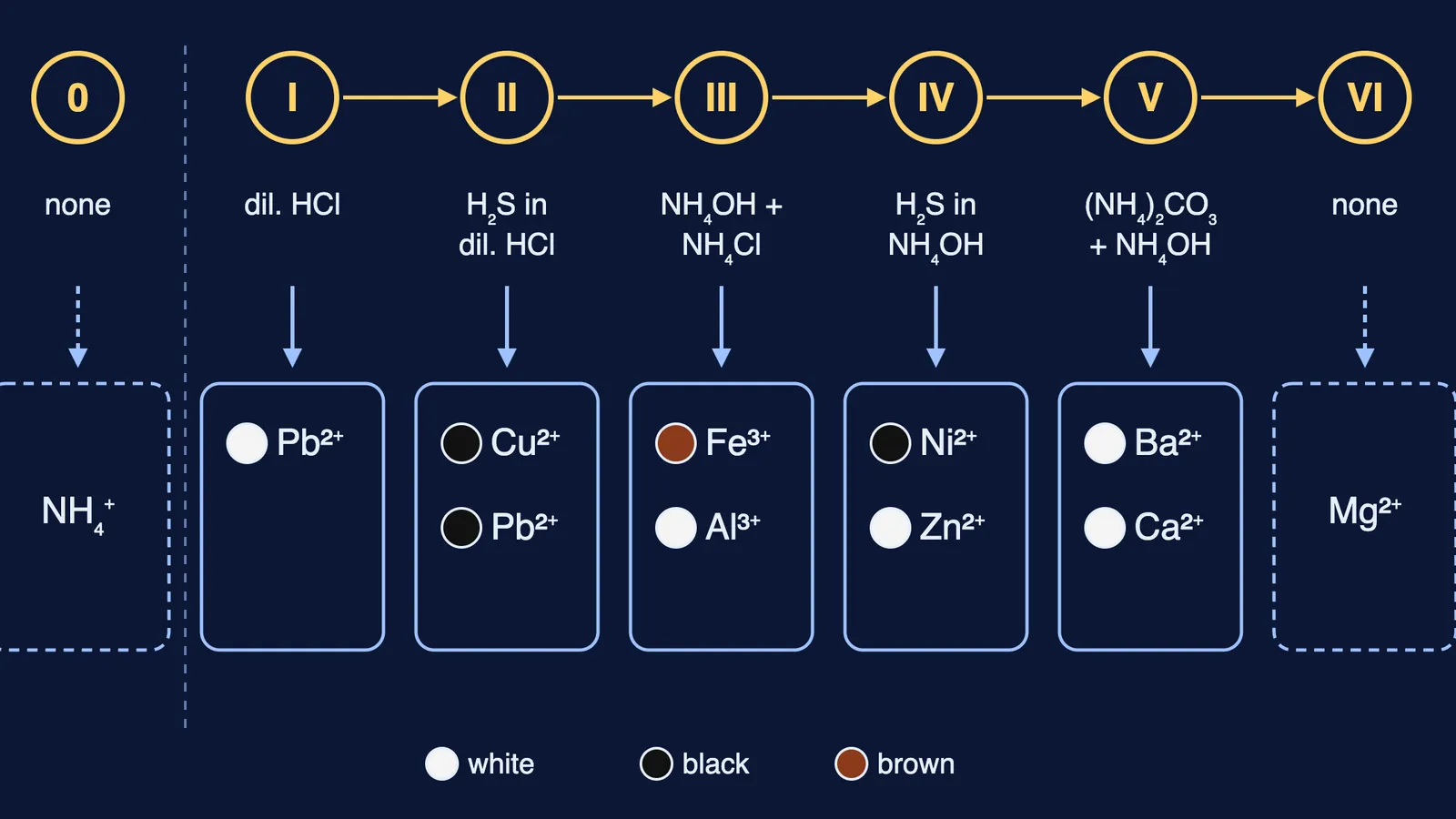
Table 7.11 of the NCERT Class 12 lab manual's qualitative analysis unit gives the sequence:
Group zero, NH4+: no group reagent. With NaOH the salt releases ammonia, which gives brown Nessler's precipitate.
Group I, Pb2+: dilute HCl. PbCl2 dissolves in hot water; KI gives yellow PbI2.
Group II, Cu2+ (and leftover Pb2+): H2S in dilute HCl, black sulphides. Cu2+ gives chocolate brown with potassium ferrocyanide.
Group III, Fe3+, Al3+: NH4OH with NH4Cl. Brown Fe(OH)3, dissolved in dilute HCl, gives blood red with KSCN; white gelatinous Al(OH)3 gives a blue floating lake with blue litmus and NH4OH.
Group IV, Zn2+, Ni2+: H2S in NH4OH. ZnS is white; black NiS, dissolved in aqua regia, gives bright red with dimethylglyoxime in ammonia.
Group V, Ba2+, Ca2+: (NH4)2CO3 with NH4OH. Barium gives a grassy green flame, calcium brick red.
Group VI, Mg2+: no group reagent; disodium hydrogen phosphate gives white magnesium ammonium phosphate.
Why this order? Acidic H2S supplies little sulphide, so only Group II sulphides fall; in ammonia, Group IV follows. NH4Cl holds back hydroxide so only Group III precipitates.
Which anion tests should you know?
From the same NCERT unit:
CO3 2−: dilute H2SO4 gives effervescence; CO2 turns lime water milky.
S2−: H2S blackens lead acetate paper; sodium nitroprusside turns purple.
NO2−: brown fumes; acidified KI with starch turns blue.
Cl−, Br−, I−: silver nitrate gives curdy white (soluble in NH4OH), pale yellow (sparingly soluble) and yellow (insoluble).
NO3−: FeSO4 with conc. H2SO4 forms a dark brown ring.
SO4 2−: BaCl2 gives white precipitate insoluble in conc. HCl.
Which organic tests and preparations matter?
In Lassaigne's test (NCERT Class 11, section 8.9.2), the sodium fusion extract gives Prussian blue for nitrogen, black PbS for sulphur, and blood red when both are present.
The functional group unit pairs groups with tests: ceric ammonium nitrate turns red with alcohols; neutral FeCl3 turns violet with phenol; 2,4-DNP gives a yellow to orange-red precipitate with carbonyls; Tollens' silver mirror and Fehling's brick red (aliphatic only) mark aldehydes; NaHCO3 effervescence marks carboxylic acids; carbylamine marks primary amines; a scarlet azo dye, aromatic ones.
When preparing Mohr's salt and potash alum, dilute sulphuric acid stops Fe2+ and Al3+ hydrolysing.
Which indicator, and why is KMnO4 its own indicator?
The Class 11 lab manual explains that phenolphthalein, a weak acid, is colourless unionised, pink in alkali, and changes sharply at the pH a weak acid vs strong base end point reaches. Methyl orange suits strong acid vs weak base; for strong vs strong, either works. See why pH is above 7 at the acetic acid equivalence point.
In redox titrations, KMnO4 is a self-indicator: the first permanent light pink, from a slight excess, is the end point. Use dilute H2SO4, not HNO3 (an oxidant) or HCl (oxidised to chlorine). Warm oxalic acid to 50-60 °C; the Mn2+ formed catalyses the reaction, so the colour fades slowly at first, then faster. Never heat Mohr's salt: it reacts fast at room temperature, and air oxidises hot Fe2+.
Worked example: 20.0 mL of Mohr's salt solution needs 16.0 mL of 0.020 M KMnO4. Find the molarity and strength in g/L of Mohr's salt (392 g/mol).
Method 1, moles. MnO4− + 5Fe2+ + 8H+ → Mn2+ + 5Fe3+ + 4H2O. MnO4− = 0.020 × 0.0160 = 3.2 × 10^−4 mol, so Fe2+ = 1.6 × 10^−3 mol. Molarity = 1.6 × 10^−3 ÷ 0.0200 = 0.080 M; strength = 0.080 × 392 = 31.4 g/L.
Method 2, electrons. MnO4− gains 5, Fe2+ loses 1: 5 × 0.020 × 16.0 = 1 × M × 20.0, so M = 0.080 M and 0.080 × 392 = 31.4 g/L.
How should you practise practical chemistry?
Days 1-3: write the cation table from memory, error-free.
Days 4-6: anion, Lassaigne's and functional group tests as reagent-observation-inference triples.
Days 7-9: indicators and ten KMnO4 numericals, each solved both ways.
Days 10-11: preparations, the iodide-hydrogen peroxide clock reaction, calorimeter constant, sols.
Days 12-14: mixed questions; log every wrong colour.
If a titration answer is off, the Fermi Problem Library has worked problems with a step-by-step solver that explains the reasoning rather than printing an answer.