

On this page
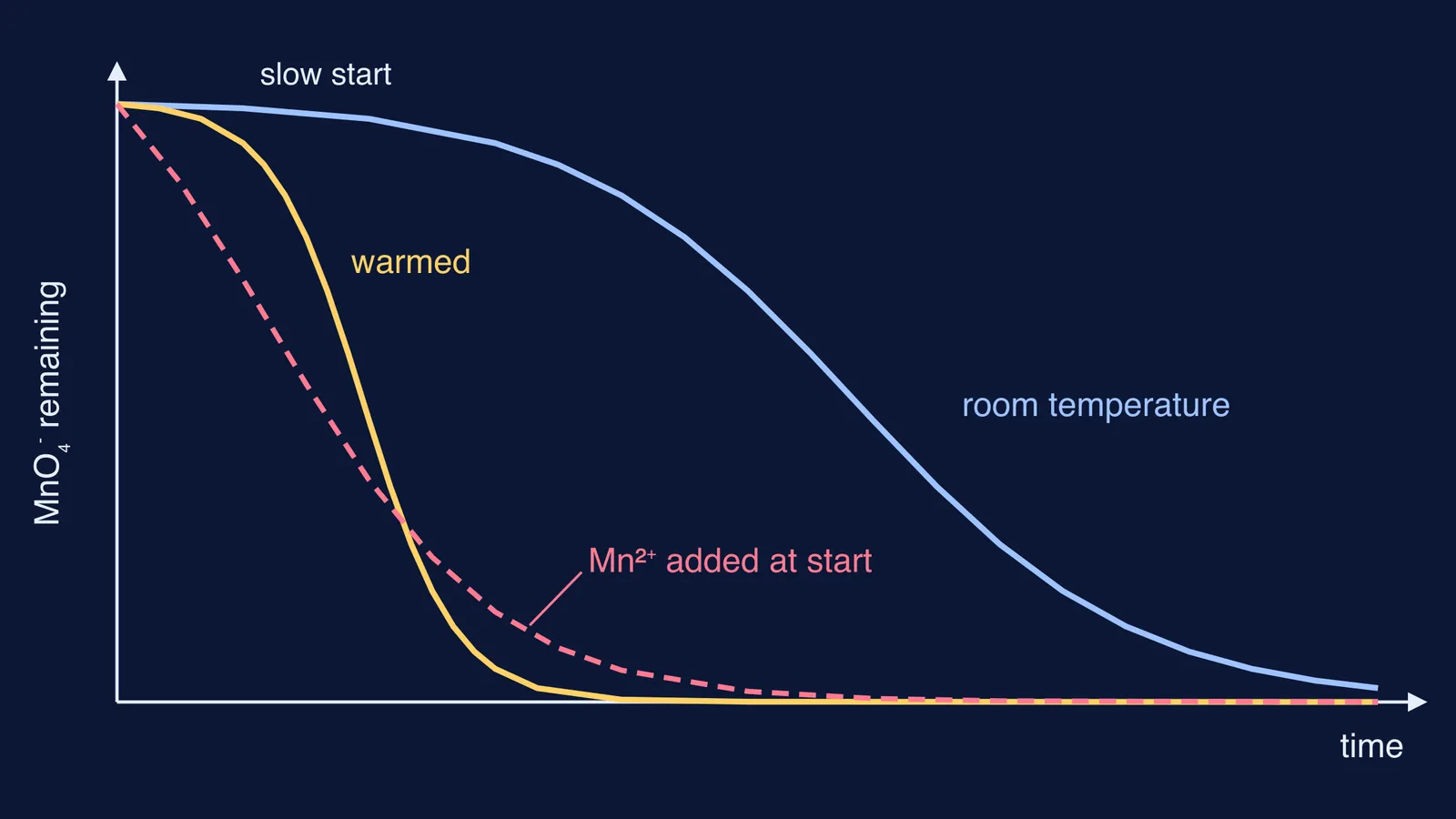
You add the first few drops of purple KMnO₄ to warm oxalic acid, swirl, and the colour just sits there. A little later the purple vanishes almost as fast as it lands. Nothing is wrong with your solution: you are watching a reaction speed itself up.
This titration is a set Class XII practical: the CBSE Chemistry curriculum for 2025-26 lists determining the molarity of KMnO₄ by titrating it against a standard solution of oxalic acid. The full procedure is in our step-by-step guide to the KMnO4–oxalic acid titration.
Why does KMnO4 decolourise slowly at first in oxalic acid titration?
The overall reaction is 2MnO₄⁻ + 5C₂O₄²⁻ + 16H⁺ → 2Mn²⁺ + 10CO₂ + 8H₂O, as written in NCERT's Manual of Microscale Chemistry Laboratory Kit. It hides how the reaction happens. The fast route runs through Mn²⁺ ions, and Mn²⁺ is one of the products.
So at the very start the flask holds almost no Mn²⁺, and the first drops react slowly. As they react they make Mn²⁺, which makes the next drops react faster, which makes still more Mn²⁺. The NCERT manual puts it plainly: "During the titration, Mn²⁺ ions are formed, which act as a catalyst for the reduction of KMnO₄ by Oxalic acid."
What is autocatalysis, and how does Mn2+ do it?
Autocatalysis is when a product of a reaction catalyses that same reaction, so the rate rises as the reaction goes on.
A physical chemistry lab handout from Eötvös Loránd University sketches the route: Mn²⁺ reacts with permanganate and oxalate to form an unstable manganese(III) oxalate complex, and the breakdown of that complex is the rate-determining step. It calls the process autocatalytic "because the Mn²⁺ product participates in the formation of the Mn(III) complex compound." The same handout says the full multistep mechanism has not yet been worked out, so treat the Mn(III) picture as the outline, not the whole story.
Why is the flask warmed to 60–70 °C?
Warming fixes the slow start. NCERT's manual says warming the oxalic acid with dilute H₂SO₄ "is essential because the reaction is very slow at room temperature", and that heating is needed "only in the initial stage", because once Mn²⁺ has built up it keeps the reaction fast.
Manuals differ slightly on the number. The HBCSE (TIFR) experiment module on this reaction tells students to heat each solution to 60–70 °C, while the NCERT microscale manual, which uses very small volumes, says 50–60 °C. Use the range your school's manual gives, and do not boil the flask.
NCERT also notes that heating "may be avoided by adding 4–5 drops of Manganese sulphate solution in the beginning", because the added Mn²⁺ catalyses the reaction from the first drop. Only do this if your teacher allows it. The acid matters too; see why H2SO4 and not HCl is used in KMnO4 titrations.
How do you keep your first readings from going wrong?
Warm the acidified oxalic acid to your manual's range before you begin, using a thermometer if one is available.
Add the first millilitre drop by drop, swirling, and wait for each drop's colour to go before adding the next. The wait shortens as Mn²⁺ builds up.
Once the colour clears in a second or two, add faster, then slow down again near the end.
Read the upper meniscus: NCERT's precautions say to read "the upper meniscus for coloured solutions", and KMnO₄ is too dark to see the lower one.
Stop at the first light pink that stays. The HBCSE module counts its titration complete only when a stable pink lasts more than 2 minutes.
Treat the first run as a rough titration, then repeat until readings agree; our guide to concordant titration readings and common errors shows how.
What does a rushed reading do to your answer?
The slow start does not change how much KMnO₄ the oxalic acid needs; it only changes how fast the two react. Errors come from two misreadings: taking the lingering pink of a cold flask in the first minute as the end point, or adding more while slow-fading pink is still in the flask near the end, and overshooting.
NCERT gives the relation 2M₁V₁ = 5M₂V₂, since oxalic acid loses 2 electrons per formula unit and permanganate gains 5. Here is a worked example with 10.0 mL of 0.05 M oxalic acid:
True end point at 10.0 mL of KMnO₄: M₂ = (2 × 0.05 × 10.0) ÷ (5 × 10.0) = 0.020 M.
Overshoot to 10.3 mL: M₂ = 1.0 ÷ 51.5 = 0.0194 M, about 3% too low.
If the calculation steps are fine but the electron-counting logic feels shaky, the Fermi Problem Library has worked problems with a step-by-step solver that explains the reasoning rather than printing an answer. For catalysis and reaction rates as ideas, the Fermi Concept Library gives each concept its own lesson and its place in the map.
Next time the first drops linger, swirl, wait, and let the Mn²⁺ build up: the reaction is getting started, not failing.


