

On this page
In the CBSE Class 12 chemistry practical for 2026-27, volumetric analysis carries 8 of the 30 marks, and the practical syllabus lists finding the molarity of KMnO4 by titrating it against standard oxalic acid and against Mohr's salt (CBSE Chemistry curriculum 2026-27). Those marks rest on a few numbers in one table.
How do you read a burette meniscus correctly?
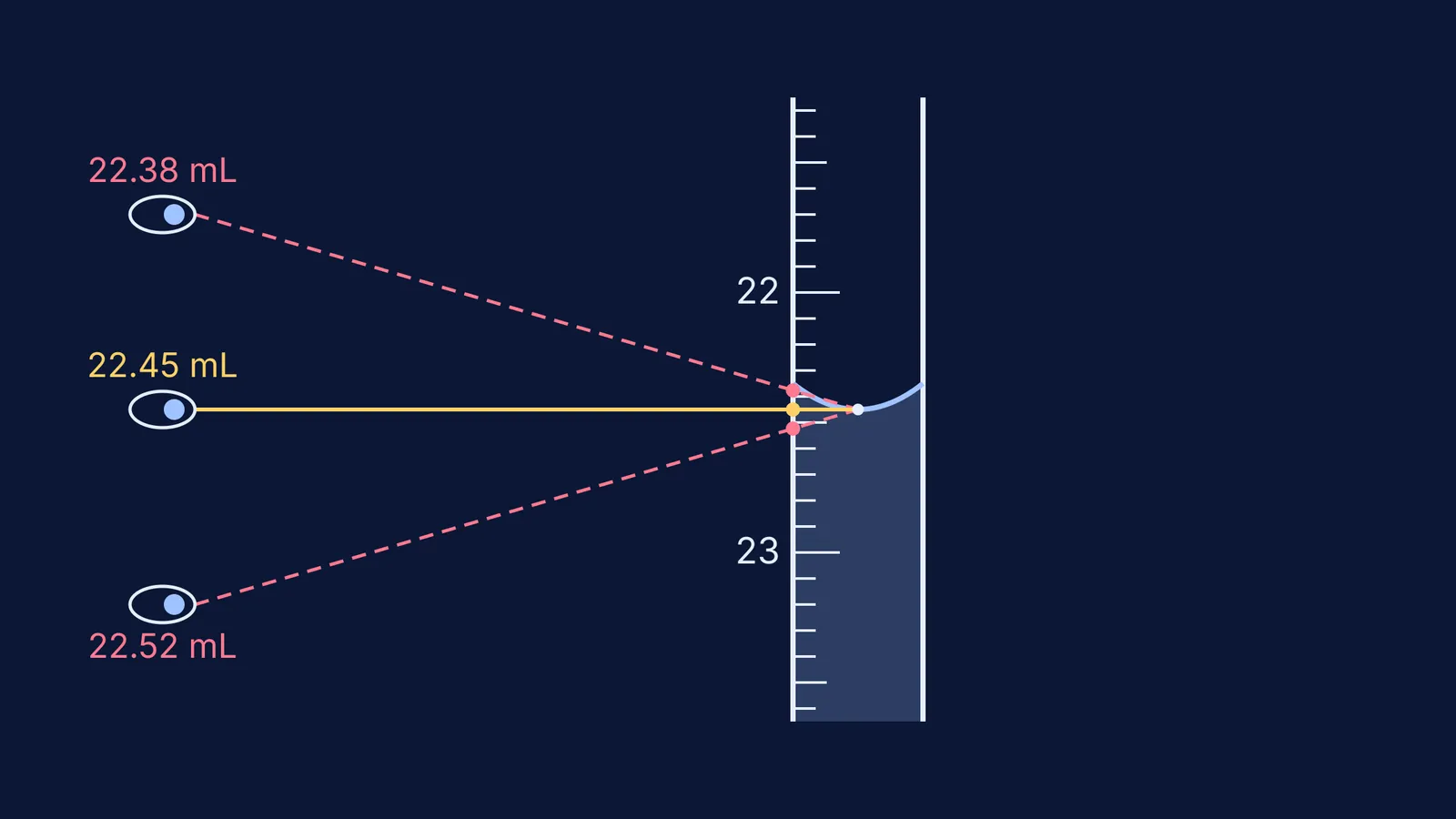
The NCERT Class 11 lab manual tells you to note each reading "by keeping the eye exactly at the same level as the meniscus of the solution" (NCERT Laboratory Manual Chemistry, Class 11, Unit 6). The same manual says to read the lower meniscus for all transparent solutions and the upper meniscus for coloured ones.
That matters in Class 12: KMnO4 is so dark that the Class 12 manual says the upper meniscus should be used for noting burette readings (NCERT Laboratory Manual Chemistry, Class 12, Unit 6).
Eye level matters because of parallax: the scale is on the outside of the tube, the liquid inside. Eye too high, and you read too small a number; too low, too big. NCERT's Class 11 titration figure shows an antiparallax card on the burette, which helps you line your eye up.
How many decimals? Each burette reading has an accuracy of ±0.05 cm³, according to the Royal Society of Chemistry. So write every reading to two decimal places, ending in 0 or 5: 9.65 mL, not 9.6 or 9.653.
What counts as concordant readings in a titration?
A titre is the volume you used: final reading minus initial reading. Concordant readings are titres that agree closely with each other. NCERT asks for three of them but does not print a cut-off. A widely used rule, from Royal Society of Chemistry teacher guidance, is that concordant results are "generally those within 0.10 cm³ of each other" (RSC Education, How to teach titration post-16). One cm³ is one mL. Check which rule your school's chemistry teacher uses.
Teachers often start you with a rough titration. In careful runs, NCERT's Class 11 procedure says to add titrant in small amounts, then dropwise.
How should you record the observation table?
NCERT's Class 12 table has these columns: serial number, volume of oxalic acid in mL, burette readings (initial x and final y), and volume of KMnO4 used, V = (y − x) mL (NCERT Class 12 manual). The Class 11 version adds a final column for the concordant reading.
A worked example with made-up readings, pipetting 10.0 mL of 0.05 M oxalic acid each time:
Rough: 0.00 to 9.90, titre 9.90 mL (a guide only)
Trial 1: 0.00 to 9.80, titre 9.80 mL
Trial 2: 10.00 to 19.60, titre 9.60 mL
Trial 3: 20.00 to 29.65, titre 9.65 mL
Trial 4: 30.00 to 39.60, titre 9.60 mL
Trials 2, 3 and 4 lie within 0.05 mL of each other, so they are concordant. Trial 1 is 0.15 to 0.20 mL above them, so it is left out, and so is the rough titre. The mean of the concordant titres is (9.60 + 9.65 + 9.60) ÷ 3 = 9.62 mL.
NCERT's equation for this titration is 2M1V1 = 5M2V2, because each oxalic acid unit loses 2 electrons and each permanganate gains 5. So M2 = (2 × 0.05 × 10.0) ÷ (5 × 9.62) = 0.0208 M. The manual asks for the result to the fourth decimal place.
If the a1M1V1 = a2M2V2 step is where you lose marks, the Fermi Problem Library has worked problems with a step-by-step solver that explains the reasoning rather than printing an answer.
Which titration mistakes cost the most marks?
Most of these come straight from the precautions in the NCERT Class 12 manual:
Leaving the funnel in the burette, so it drips after your initial reading.
An air gap in the nozzle, which fills during the titration and inflates your titre.
A drop hanging from the tip when you note the reading.
Reading the lower meniscus on KMnO4 in one trial and the upper in another.
Not rinsing the burette and pipette with their own solutions, or rinsing the conical flask with the experimental solution, which NCERT says never to do. Our guide to burette and pipette rinsing rules explains why.
Forgetting to heat the oxalic acid and H2SO4 mixture to 50–60 °C before titrating with KMnO4. See why KMnO4 titrations use H2SO4 and not HCl.
Overshooting the end point, which NCERT describes as the appearance of a permanent light pink colour.
Averaging every trial, including the rough one.
If the five-electron change in permanganate still feels hazy, the Fermi Concept Library covers every concept in chemistry, each with its own lesson and its place in the map.
Once your table is clean, copy it neatly into your record book. Our guide to the Class 12 practical file and project covers the rest.


