

On this page
The investigatory project often has to fit around pre-board revision. Pick a small project, plan it properly, and you can finish it in three focused sittings.
How much is the Class 12 investigatory project worth?
In CBSE's 2026-27 curriculum, the practical exam is worth 30 marks in physics, chemistry and biology. The project is a small part of that:
Physics: the investigatory project carries 3 marks, and a separate 5-mark viva covers experiments, activities and the project (CBSE Physics curriculum 2026-27).
Chemistry: project work carries 4 marks, with another 4 for class record and viva (CBSE Chemistry curriculum 2026-27).
Biology: the investigatory project, its record and its viva together carry 5 marks (CBSE Biology curriculum 2026-27).
The chemistry syllabus says any other investigatory project “which involves about 10 periods of work” can be chosen with the approval of the teacher. That gives you a sense of scale: a short investigation, not a research paper.
How do you choose a project you can finish quickly?
Start from the board's own list. The physics curriculum suggests projects such as studying how the current through an LDR (light-dependent resistor) changes with the distance of a lamp. The chemistry curriculum lists ideas such as the casein content of different milk samples, or how pH and temperature affect the digestion of starch by salivary amylase. Then test each idea against four checks:
Your school lab has the apparatus, or it costs very little to buy.
You change one thing and measure one thing.
You can take all the readings in one lab session.
Your results end up as a table and a graph that you can explain.
To design your own question instead, our guide to turning a good question into a fair experiment covers variables and controls.
How do you plan it in three sittings?
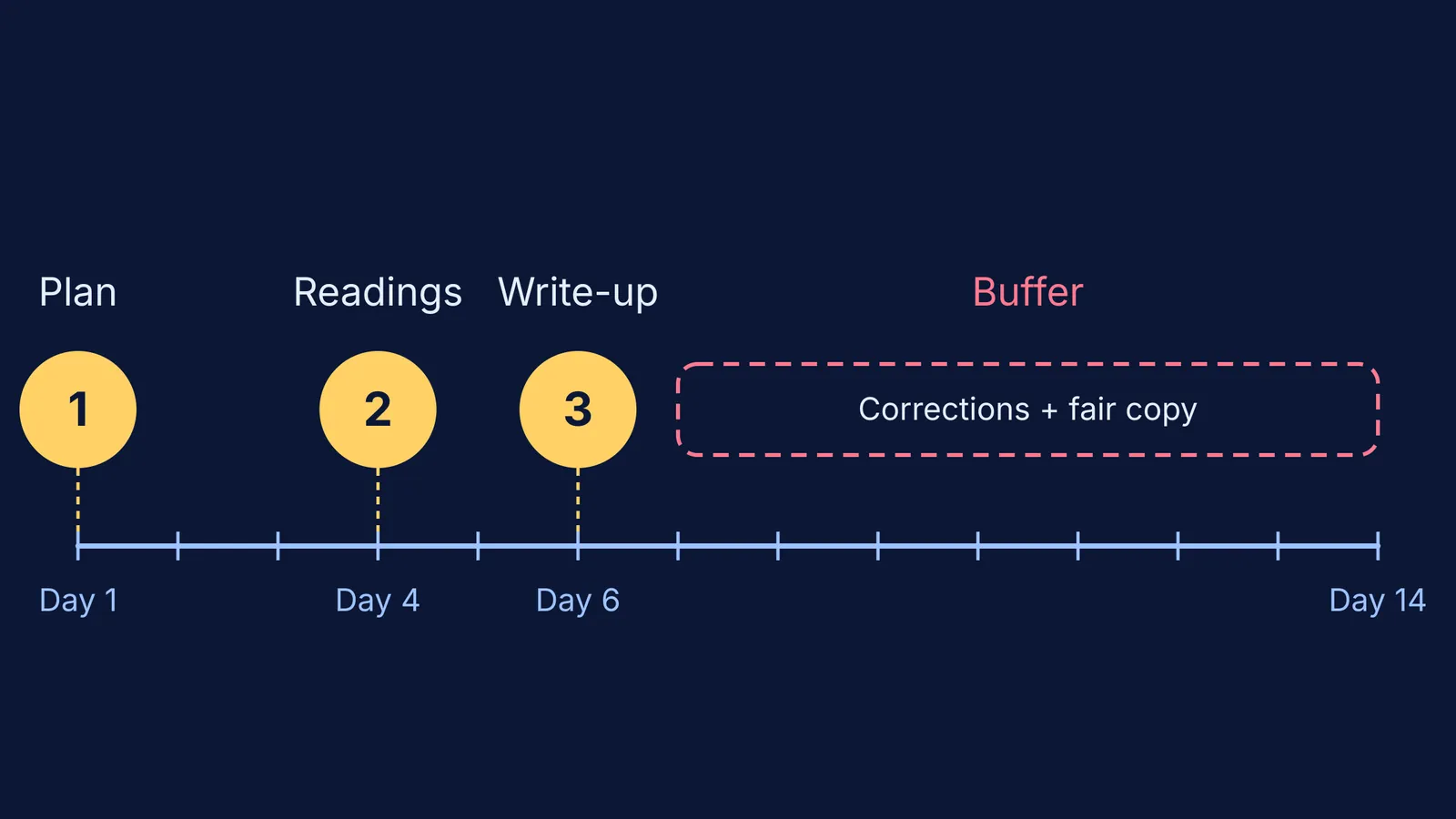
People often underestimate how long their own projects will take. In a 1994 study by Roger Buehler, Dale Griffin and Michael Ross, psychology students writing an honours thesis predicted, on average, that they would finish in 33.9 days. They actually took 55.5 days, and only 29.7% finished by the date they predicted (Buehler, Griffin and Ross, 1994). So plan fixed sittings with room to slip, not one heroic night. Fit the three sittings into one week and keep the second week free for corrections. Here is the plan, with the LDR project as a worked example.
Sitting 1: choose and plan (one evening).
Run your idea through the four checks and get your teacher's approval.
Write the aim in one sentence: “To study how the current through an LDR changes with the distance of a lamp of fixed power.”
Name the variables. You change the distance, you measure the current in mA, and you keep the lamp, the battery and the room lighting the same.
Read the theory in NCERT, list the apparatus, and draw a blank observation table with columns for distance (cm), reading 1, reading 2 and mean current (mA).
Book a lab period with your teacher.
If you sit down and do not know where to start, Fermi's AI tutor can work out what you already know and build a plan for the session.
Sitting 2: collect the readings (one lab period).
Set up under supervision. The lamp gets hot, and only your teacher should handle anything connected to the mains.
Take each reading twice, write the numbers in pen as you go, and photograph the set-up for your file.
Sitting 3: write it up (one long afternoon).
Plot the graph, work out the means, and write your result in one sentence.
Draft the whole file in rough. Give it to your teacher within the week, then make the fair copy once you have their corrections.
What is the standard format for a project file?
CBSE's physics curriculum (in its guidelines for visually impaired students) says an experiment in the practical file should include the aim, apparatus required, simple theory, procedure, related practical skills and precautions (CBSE Physics curriculum 2026-27). A project report usually adds a few pages. A common order, which your teacher may adjust:
Certificate signed by your teacher, then an acknowledgement
Index
Aim
Introduction and theory
Apparatus or materials
Circuit or set-up diagram
Procedure
Observation table, with units
Graph and calculations
Result and conclusion
Precautions and sources of error
Bibliography
Write the theory in your own words, because the examiner can ask you to explain it. If the idea feels shaky, the Fermi Concept Library has a lesson for every concept in physics, chemistry, biology, mathematics and computing, so you understand it before you write it.
What if you keep putting it off?
If you cannot make yourself start Sitting 1, read why procrastination is about feelings, not laziness, then book a lab period today. When the file is done, use our guide to Class 12 physics practicals and the viva to get ready for exam day.


