

On this page
Why is a burette rinsed with the titrant instead of water?
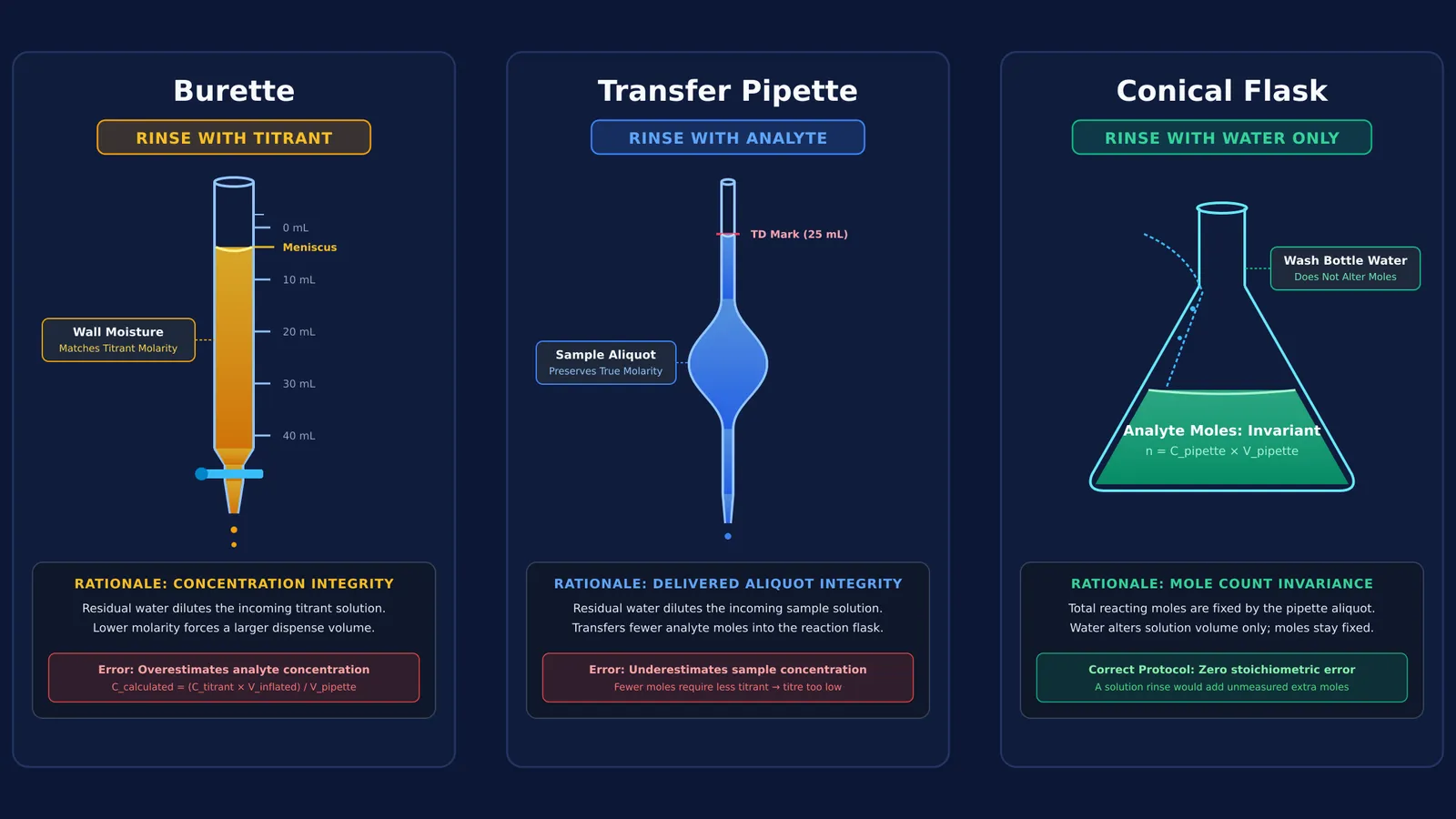
Cleaning a 50 mL burette with detergent and distilled water removes chemical contaminants, but gravity drainage leaves droplets clinging to the inner glass wall. Under ASTM E287, a Class A 50 mL burette has a strict volume tolerance of ±0.05 mL at 20 °C. If two droplets of residual water totalling 0.10 mL remain inside before you add 25.00 mL of standard titrant, that unevaporated moisture dilutes the solution by 0.40%.
This dilution reduces the titrant's actual concentration below its standardized value. Because each delivered drop now contains fewer reagent molecules, you must dispense a larger volume of solution to reach the equivalence point. Substituting this inflated volume into your calculation yields an erroneously high analyte concentration.
To prevent this positive systematic error, standard protocols described by Arthur I. Vogel (Hall, 1952) require conditioning the burette two or three times with 5 mL to 10 mL portions of the titrant. Rolling the tube coats the barrel, and draining through the stopcock purges the delivery tip.
Why must a volumetric pipette be rinsed with the solution it delivers?
A transfer pipette is calibrated "To Deliver" (TD) an exact aliquot at 20 °C. Under ASTM E969, a Class A 25 mL pipette has a tolerance of ±0.03 mL. If you clean the pipette with distilled water and draw sample directly into the damp tube, residual droplets dilute the incoming liquid.
When the calibrated 25.00 mL volume is transferred to the receiving flask, fewer moles of analyte enter the vessel than intended. Because fewer analyte molecules are present, less titrant is needed to trigger the indicator colour change. The resulting low titre causes a systematic underestimation of the sample concentration.
Educational research (Accettone et al., 2023) shows that failing to condition transfer tools is a leading cause of negative determinate errors. Rinsing the pipette twice with small portions of the sample ensures that adhering moisture matches the true liquid composition. We already know how mixing and diluting solutions alters molarity, and the same dilution occurs inside unconditioned glassware.
Why is the conical flask rinsed only with distilled water?
While burettes and pipettes require solution conditioning, the conical (Erlenmeyer) flask follows the opposite rule: rinse it with distilled water only. Many students assume every vessel should be rinsed with its reagent or dried completely, but doing so in the titration flask introduces severe errors.
Rinsing the conical flask with analyte leaves unmeasured droplets on the glass walls. When the 25.00 mL aliquot is pipetted into the vessel, those droplets introduce extra moles of analyte, causing an overestimation of the result. Titration stoichiometry depends entirely on the absolute number of moles delivered by the pipette, not on the liquid volume in the flask. In standard quantitative procedures (Crossno et al., 1996), adding 20 mL or 50 mL of neutral distilled water to the flask alters the volume of the solution, but the total moles of reacting analyte remain strictly unchanged.
Washing down the flask walls with a distilled water squirt bottle during titration is standard practice (Broekaert, 2015). It returns splashed titrant into the bulk solution without altering the equivalence point. Understanding that moles remain invariant while concentration changes is equally essential when designing back titrations for insoluble samples or tracking temperature-dependent pH equilibria.
How does improper rinsing distort titration calculations?
Consider an acid-base titration evaluated under ASTM E287 Class A specifications, where 25.00 mL of 0.1000 M hydrochloric acid reacts with 0.1000 M sodium hydroxide. At equivalence, moles of acid equal moles of base: 0.1000 M × 25.00 mL = 2.500 millimoles. The expected burette volume is 25.00 mL.
Suppose the burette was rinsed with water alone, leaving 0.15 mL of residual water before filling with 30.00 mL of 0.1000 M sodium hydroxide. The actual titrant concentration becomes:
C_actual = (0.1000 M × 30.00 mL) / 30.15 mL = 0.0995 M
To neutralise 2.500 millimoles of acid, the delivered volume must increase:
V_titre = 2.500 millimoles / 0.0995 M = 25.13 mL
Using the nominal 0.1000 M value in the standard formula gives:
C_calculated = (0.1000 M × 25.13 mL) / 25.00 mL = 0.1005 M
A moisture film caused a +0.50% systematic error, shifting the required volume by +0.13 mL and exceeding the ±0.05 mL limit defined by ASTM E287. The Fermi Problem Library provides worked problems with a step-by-step solver that explains the reasoning rather than printing an answer, helping students analyze these error pathways. To see how molecular totals stay fixed while concentration shifts, the Fermi Simulation Lab offers interactive simulations for ideas that are easier to see than to read.
How should glassware be prepared for quantitative titrations?
Standard quantitative protocols established in analytical training (Hall, 1952; Accettone et al., 2023) follow a consistent five-step sequence before starting any titration:
Clean all glassware with laboratory detergent, rinse with tap water, and finish with two distilled water rinses.
Condition the burette with two 5 mL portions of titrant, rolling horizontally and draining through the tip.
Condition the pipette with two 5 mL portions of analyte, rotating to wet above the graduation mark.
Rinse the conical flask with distilled water only; do not dry with paper towels.
During titration, use a distilled water squirt bottle to wash down any droplets on the flask walls.


