

On this page
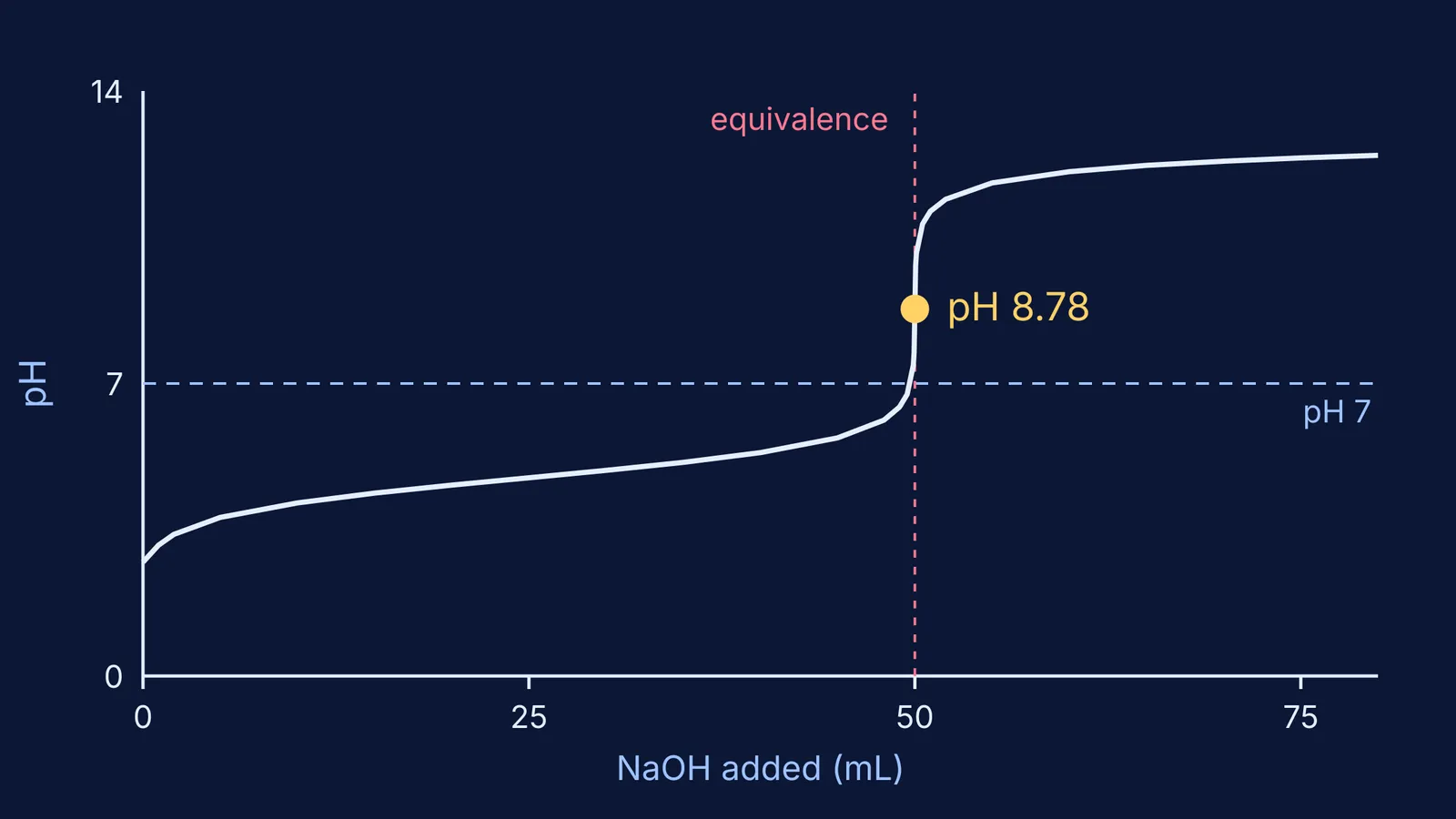
Add NaOH to acetic acid until the moles match, and many students expect pH 7. The real answer is closer to 9. No acid and no extra base are left, only sodium acetate in water, and that salt is not neutral.
Why is the pH above 7 at the equivalence point?
The neutralisation goes to completion: CH3COOH + OH− → CH3COO− + H2O. At the equivalence point, every acetic acid molecule has become an acetate ion. The sodium ions do not change the pH, because they come from a strong base. Acetate is different. It is the conjugate base of a weak acid, so it takes a proton from water:
CH3COO− + H2O ⇌ CH3COOH + OH−
This is salt hydrolysis, and the OH− it makes pushes the pH above 7. OpenStax Chemistry 2e, section 14.7 writes the reaction the same way and notes that the equivalence pH is "significantly greater than 7, as expected when titrating a weak acid with a strong base."
The reaction goes only a tiny way, because acetate is a weak base. To see how weak, use Kb = Kw/Ka. The OpenStax titration example uses Ka = 1.8 × 10⁻⁵ for acetic acid and Kw = 1.0 × 10⁻¹⁴, which gives Kb = 5.6 × 10⁻¹⁰ for acetate (OpenStax). If the Kb = Kw/Ka step is hazy, our post on how Ka, Kb and Kw connect for conjugate pairs walks through it.
How do you calculate the pH at the equivalence point?
Here is a slightly harder version of the usual board and JEE Main question. 25.0 mL of 0.200 M acetic acid is titrated with 0.100 M NaOH. Find the pH at the equivalence point, using Ka = 1.8 × 10⁻⁵ and Kw = 1.0 × 10⁻¹⁴, the values in OpenStax Chemistry 2e.
Moles of acid: 0.0250 L × 0.200 M = 5.00 × 10⁻³ mol.
Volume of NaOH needed: 5.00 × 10⁻³ mol ÷ 0.100 M = 0.0500 L, which is 50.0 mL.
Total volume at equivalence: 25.0 mL + 50.0 mL = 75.0 mL.
Acetate concentration: 5.00 × 10⁻³ mol ÷ 0.0750 L = 0.0667 M.
Kb = 1.0 × 10⁻¹⁴ ÷ 1.8 × 10⁻⁵ = 5.56 × 10⁻¹⁰.
[OH−] = √(Kb × C) = √(5.56 × 10⁻¹⁰ × 0.0667) = 6.09 × 10⁻⁶ M.
pOH = 5.22, so pH = 14.00 − 5.22 = 8.78.
Step 6 drops the tiny OH− from the denominator of the Kb expression, the usual weak-base shortcut. In one line, the same algebra gives pH = 7 + ½pKa + ½log C, where pKa = 4.74 and C is the diluted salt concentration: 7 + 2.37 − 0.59 = 8.78.
Why must you use the diluted concentration?
The most common slip is to use 0.200 M, the acid's starting concentration, as the acetate concentration. That ignores the 50.0 mL of NaOH solution that was poured in. With 0.200 M you get [OH−] = 1.05 × 10⁻⁵ M and pH 9.02. That is about a quarter of a pH unit too high, enough to lose the mark.
The fix is to think in moles first: moles of acetate equal the moles of acid you started with. Divide by the total volume, acid plus base, and only then use Kb. At the halfway point the moles of acid and acetate are equal, which is why pH equals pKa at half-equivalence.
Which indicator works for acetic acid and NaOH?
Because the steep jump in pH sits above 7, the indicator must change colour above 7 as well. OpenStax gives phenolphthalein a range of pH 8.0 to 10, colourless to pink, which brackets the steep rise in a weak acid titration. Methyl orange changes colour at a much lower pH, so in this titration it completes its colour change "well before the equivalence point (25 mL) has been reached", according to the same section. The gap between where the indicator changes and where the moles match is covered in our post on equivalence point vs end point.
A four-step check for any weak acid and strong base question
Write the reaction and find the moles of conjugate base formed. They equal the moles of weak acid at the start.
Add the two volumes and divide to get the salt concentration.
Get Kb from Kw/Ka, then treat the salt as a weak base: [OH−] = √(Kb × C).
Sanity check the answer. A weak acid titrated with a strong base must give a pH above 7 at equivalence. A weak base titrated with a strong acid gives a pH below 7.
If your answer keeps landing on 9.02 instead of 8.78, the Fermi Problem Library has worked problems with a step-by-step solver that explains the reasoning rather than printing an answer, so you can compare each step with your own working. If hydrolysis itself feels shaky, the Fermi Concept Library gives each chemistry concept its own lesson and its place in the map.
Try the four steps on the next titration question you meet, and write the total volume down before anything else.


