

On this page
If you have ever stood at a lab bench carefully twisting the stopcock of a burette, waiting for that single drop to turn your solution a permanent pale pink, you know the tension of a titration. You are looking for the exact moment when the acid and base have neutralised each other. But the moment the reaction is mathematically complete and the moment you actually stop adding drops from the burette are rarely exactly the same.
Understanding the difference between the equivalence point and the end point is crucial for practical chemistry, and it is a classic concept tested in exams like JEE Main and NEET-UG.
What is the equivalence point?
The equivalence point is a theoretical concept. It is the point during a titration when the amount of titrant you have added is exactly stoichiometrically equal to the amount of analyte in your flask (Wikipedia).
If you are neutralising hydrochloric acid (HCl) with sodium hydroxide (NaOH), the equivalence point occurs when every single molecule of HCl has reacted with a molecule of NaOH. For a strong acid and a strong base, this happens at a pH of exactly 7.0 (Wikipedia).
Because it is a theoretical moment based on moles and balanced chemical equations, there is usually no visible sign in the flask that you have reached the equivalence point. You cannot see it happen with the naked eye unless you are monitoring the pH continuously with an electronic meter. If you need to revise the theory of how pH changes as moles react, you can explore these topics in the Fermi Concept Library, where Fermi works out what you already know, builds a plan for the session, and teaches through it.
What is the end point?
The end point is a practical, experimental observation. It is the moment in the lab when you actually stop the titration.
Usually, you know it is time to stop because a chemical indicator has changed colour. For example, if you add a few drops of phenolphthalein to an acidic solution, it remains colourless. As you add base and the solution becomes alkaline, the phenolphthalein will turn a pale pink. The first drop that makes that pale pink colour persist is your end point.
Why are they different?
The equivalence point is when the reaction is over; the end point is when the indicator tells you it is over. The difference in volume between these two points is known as the titration error.
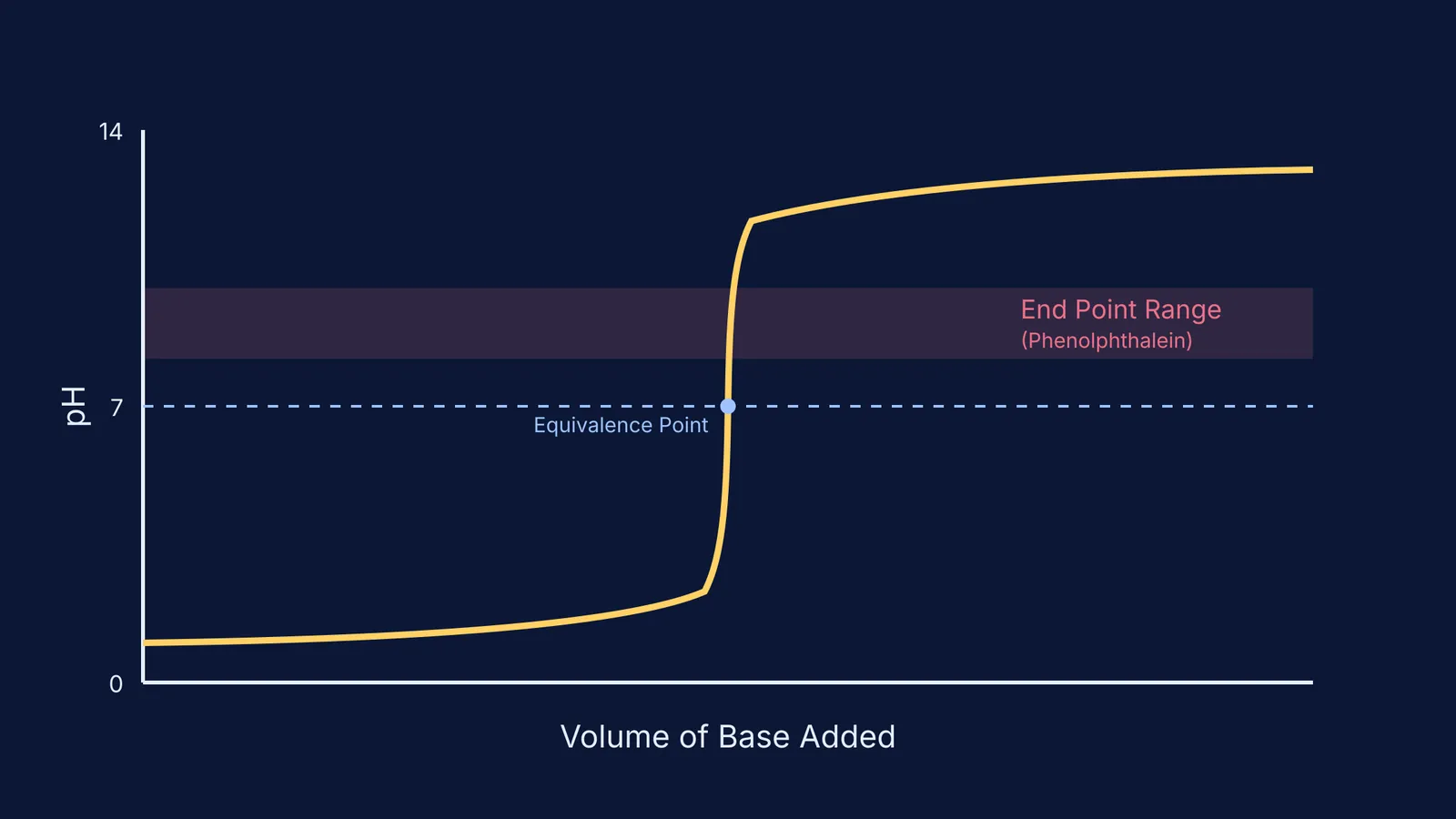
Indicators change colour over a specific pH range, not at a single, exact pH value. According to standard chemical data, phenolphthalein transitions from colourless to pink between pH 8.2 and 10.0 (Wikipedia). This means it changes colour slightly after a strong acid–strong base mixture has passed the pH 7.0 equivalence point (Wikipedia).
However, if you look at acid-base titration curves, you will notice that near the equivalence point, the pH shoots up almost vertically. A single drop of base can cause a massive pH jump. Because this vertical jump covers the entire 8.2 to 10.0 range of phenolphthalein, the colour change happens at practically the same volume of titrant as the true equivalence point. The titration error is just a fraction of a drop, which is small enough to ignore.
For visualising how a single drop causes such a massive shift in ion concentration, the Fermi Simulation Lab provides interactive simulations for the ideas that are easier to see than to read.
What happens if you pick the wrong indicator?
Imagine you are titrating acetic acid (a weak acid found in vinegar) with sodium hydroxide. The equivalence point happens in the basic region, typically between pH 8 and 10 (Wikipedia).
If you mistakenly use methyl orange as your indicator, the solution will change from red to yellow between pH 3.1 and 4.4 (Wikipedia). This colour change will happen long before you have added enough sodium hydroxide to neutralise all the acetic acid. You will record your end point volume too early.
When you sit down to calculate the concentration of your acid, your result will be completely wrong because the volume gap between your recorded end point and the true equivalence point—the titration error—is massive. The salt formed at the equivalence point dictates the final pH, and that pH dictates your choice of indicator.
How do you choose the right indicator?
To keep your titration error as small as possible, you must match the indicator to the nature of the acid and base you are mixing. Here is a simple checklist for making the right choice:
Strong Acid + Strong Base (e.g., HCl + NaOH): The equivalence point is at pH 7 (Wikipedia). The curve has a massive vertical section. You can use almost any standard indicator, including phenolphthalein (8.2–10.0; Wikipedia) or methyl orange (3.1–4.4; Wikipedia).
Weak Acid + Strong Base (e.g., Acetic acid + NaOH): The salt formed (sodium acetate) is slightly basic, so the equivalence point is above pH 7. Phenolphthalein is the standard choice here because its colour change matches this basic range perfectly. Methyl orange would change colour much too early.
Strong Acid + Weak Base (e.g., HCl + Ammonia): The salt formed is slightly acidic, bringing the equivalence point below pH 7. Methyl orange is ideal because it changes colour in the acidic range. Phenolphthalein would change too late.
Weak Acid + Weak Base: There is no steep vertical section on the titration curve. A simple colour indicator will not give a sharp end point. In these cases, you often have to rely on a pH meter or use techniques like back titration.
If you are preparing for exams and need to solve numericals on titration volumes and pH curves, the Fermi Problem Library has worked problems with a step-by-step solver that explains the reasoning rather than printing an answer.


