

On this page
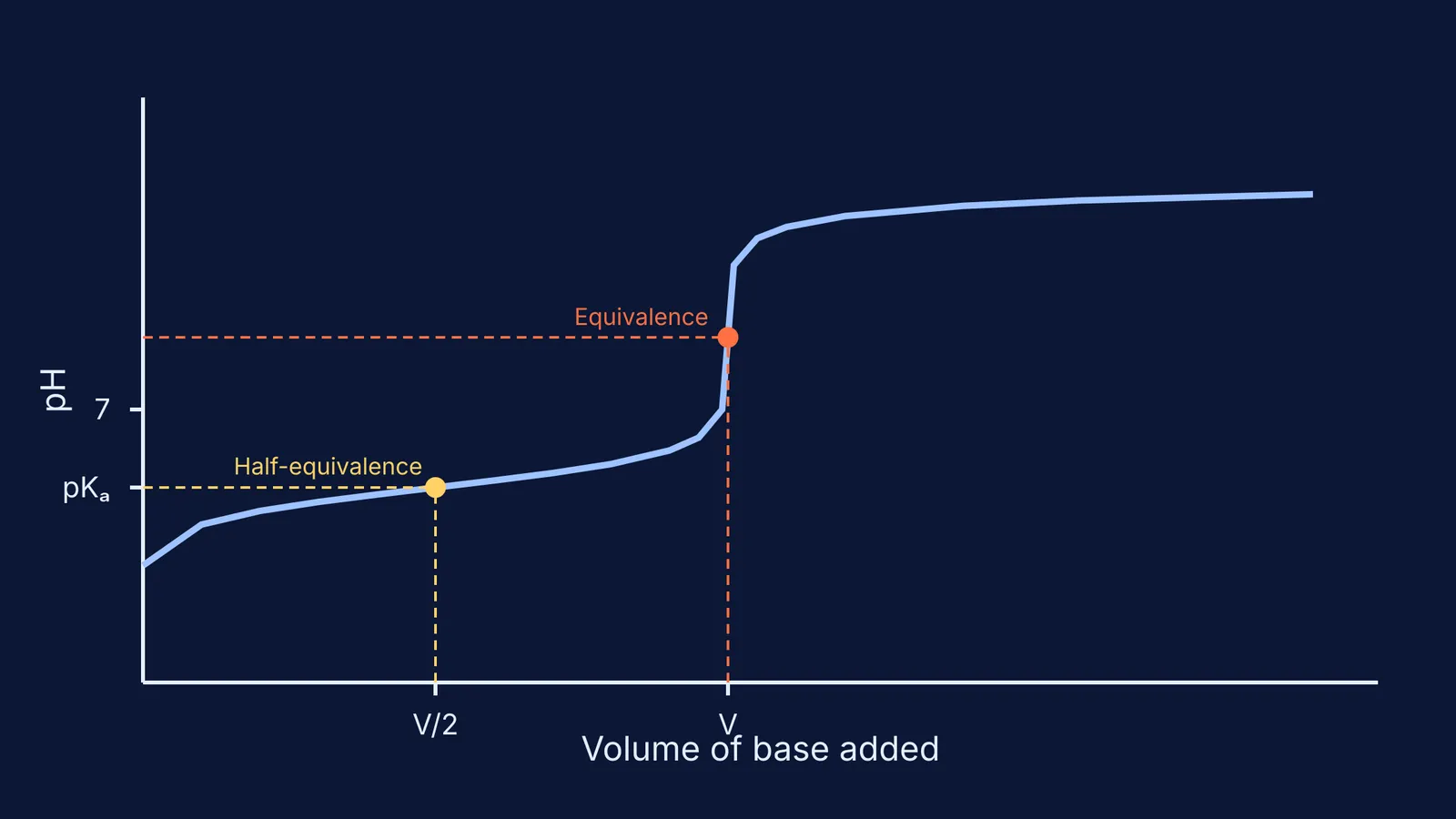
When you titrate a weak acid with a strong base, the most useful part of the titration curve is not the steep equivalence point where the colour changes. It is the flat, shallow region exactly halfway there. At this half-equivalence point, the pH of the solution equals the pKa of the weak acid. This simple mathematical relationship helps chemists design buffer solutions, determine the strength of unknown acids, and understand biological systems like the blood's bicarbonate buffer, which maintains human blood pH between 7.35 and 7.45 (Buffer solution).
What happens at the half-equivalence point?
When a strong base like sodium hydroxide (NaOH) is gradually added to a weak acid like acetic acid (CH3COOH), it strips protons (H+) from the acid molecules, converting them into their conjugate base (CH3COO-). At the very start of the experiment, the flask contains only the weak acid in water. If you keep adding base, you eventually reach the equivalence point, which is the exact moment when enough base has been added to neutralise every single molecule of the original acid.
The half-equivalence point occurs exactly midway through this neutralisation journey. If it takes 20 mL of a base to reach the equivalence point, the half-equivalence point is reached at precisely 10 mL. At this moment, exactly half of the initial weak acid has reacted with the base. The result is a solution where the concentration of the remaining, unreacted weak acid exactly equals the concentration of the newly formed conjugate base. This 1:1 ratio is the secret behind the unique properties of the half-equivalence point.
Why does pH equal pKa?
The relationship between the pH of a solution and the pKa of its acid is described by the Henderson-Hasselbalch equation, a fundamental formula in biochemistry used to estimate the pH of a buffer solution.
The equation is written as: pH = pKa + log([A-] / [HA])
Here, [A-] represents the molar concentration of the conjugate base, and [HA] represents the molar concentration of the weak acid. Because exactly half of the acid has been converted into the conjugate base at the half-equivalence point, the concentration of the acid equals the concentration of the conjugate base ([HA] = [A-]).
When you plug these equal concentrations into the equation, the ratio [A-] / [HA] simplifies to exactly 1.
The logarithm of 1 is zero. Therefore, the equation simplifies to: pH = pKa + 0 pH = pKa
This elegant mathematical cancellation is why, at the half-equivalence point, the pH of the solution is precisely equal to the pKa of the weak acid (Henderson-Hasselbalch equation).
How do you find pKa from a titration curve?
In chemistry exams such as JEE and NEET, or during laboratory experiments, you are often asked to determine the dissociation constant (Ka) of an unknown weak acid by analysing its titration curve. The half-equivalence point is the fastest way to find it.
Find the equivalence point: Look at the titration curve graph and find the steepest vertical section, where the pH changes rapidly. Find the exact midpoint of this steep drop and read the volume on the x-axis.
Halve the volume: Divide that equivalence volume by two. This gives you the volume of the half-equivalence point.
Read the pH: Go to this halved volume on the x-axis, trace a line straight up to where it meets the curve, and read the corresponding pH value on the y-axis.
Calculate Ka: Because you know that pH = pKa at this point, and pKa is the negative logarithm of Ka (pKa = -log(Ka)), you can calculate the dissociation constant by taking 10 to the power of the negative pH (Ka = 10^(-pH)).
If you find it hard to picture how the concentrations of acid and base change during a titration, the Fermi Simulation Lab has interactive simulations for the ideas that are easier to see than to read. You can add base drop by drop and watch the pH and concentration graphs update in real time. If you keep losing marks on acid-base numericals because of wrong-method mistakes, the Fermi Problem Library has worked problems with a step-by-step solver that explains the reasoning rather than printing an answer.
Why does this matter for buffer solutions?
A buffer solution is designed to resist sudden changes in pH when small amounts of acid or base are added to it. This resistance, known as buffer capacity, is at its absolute highest when the pH of the solution is exactly equal to the pKa of the buffering agent (Buffer solution).
Because the half-equivalence point is exactly where pH equals pKa, it represents the ideal state of a buffer. It is the centre of the useful buffering range, which typically spans one pH unit in either direction (pH = pKa ± 1) (Buffer solution). For example, acetic acid has a pKa of 4.76, making an acetic acid and sodium acetate mixture an excellent buffer for solutions needing a pH between 3.8 and 5.8 (Buffer solution).
This is not just a laboratory trick. Biological systems rely on this exact mechanism. The bicarbonate buffer system in human blood uses a similar equilibrium to maintain blood pH strictly between 7.35 and 7.45, which is vital for enzymes to function properly and for human survival (Buffer solution).
To explore these concepts further, you can test your predictions in a buffer solution simulation. Keep in mind that temperature also shifts these chemical equilibriums, which is why pH 7 is not always neutral at higher temperatures. Finally, to review the full map of ionic equilibrium, the Fermi Concept Library has every concept in physics, chemistry, biology, mathematics and computing, each with its own lesson and its place in the map.


