On this page
Knowing the integration formulas is only half the job. The other half is spotting which method turns an unfamiliar integrand into one you know.
What does the JEE Main syllabus say about indefinite integrals?
Unit 8 of the NTA Syllabus for JEE (Main) - 2027, linked as "Syllabus" on the JEE Main website, lists integral as an anti-derivative, fundamental integrals, integration by substitution, by parts and by partial fractions, and integration using trigonometric identities.
It also names ten standard types: ∫ dx/(x² + a²), ∫ dx/√(x² ± a²), ∫ dx/(a² − x²), ∫ dx/√(a² − x²), ∫ dx/(ax² + bx + c), ∫ dx/√(ax² + bx + c), ∫ (px + q) dx/(ax² + bx + c), ∫ (px + q) dx/√(ax² + bx + c), ∫ √(a² ± x²) dx and ∫ √(x² − a²) dx.
In NCERT this is Chapter 7, Integrals, of Class 12 Mathematics Part II (Reprint 2026-27). Sections 7.2 to 7.6 cover everything above, including ∫ eˣ[f(x) + f′(x)] dx. Sections 7.7 onward are definite integrals, covered in our guide to definite integrals and area for JEE Main.
Which standard forms must you know by heart?
With a > 0:
∫ dx/(x² + a²) = (1/a) tan⁻¹(x/a) + C
∫ dx/(a² − x²) = (1/2a) log|(a + x)/(a − x)| + C
∫ dx/√(a² − x²) = sin⁻¹(x/a) + C
∫ dx/√(x² ± a²) = log|x + √(x² ± a²)| + C
∫ √(a² − x²) dx = (x/2)√(a² − x²) + (a²/2) sin⁻¹(x/a) + C
∫ √(x² ± a²) dx = (x/2)√(x² ± a²) ± (a²/2) log|x + √(x² ± a²)| + C
The quadratic types reduce to these: complete the square, and split any (px + q) on top into a multiple of the denominator's derivative plus a constant.
Example: ∫ (3x + 1)/(x² + 2x + 5) dx. Write 3x + 1 = (3/2)(2x + 2) − 2. The first part gives (3/2) log(x² + 2x + 5). Since x² + 2x + 5 = (x + 1)² + 2², the second gives −tan⁻¹((x + 1)/2). Answer: (3/2) log(x² + 2x + 5) − tan⁻¹((x + 1)/2) + C.
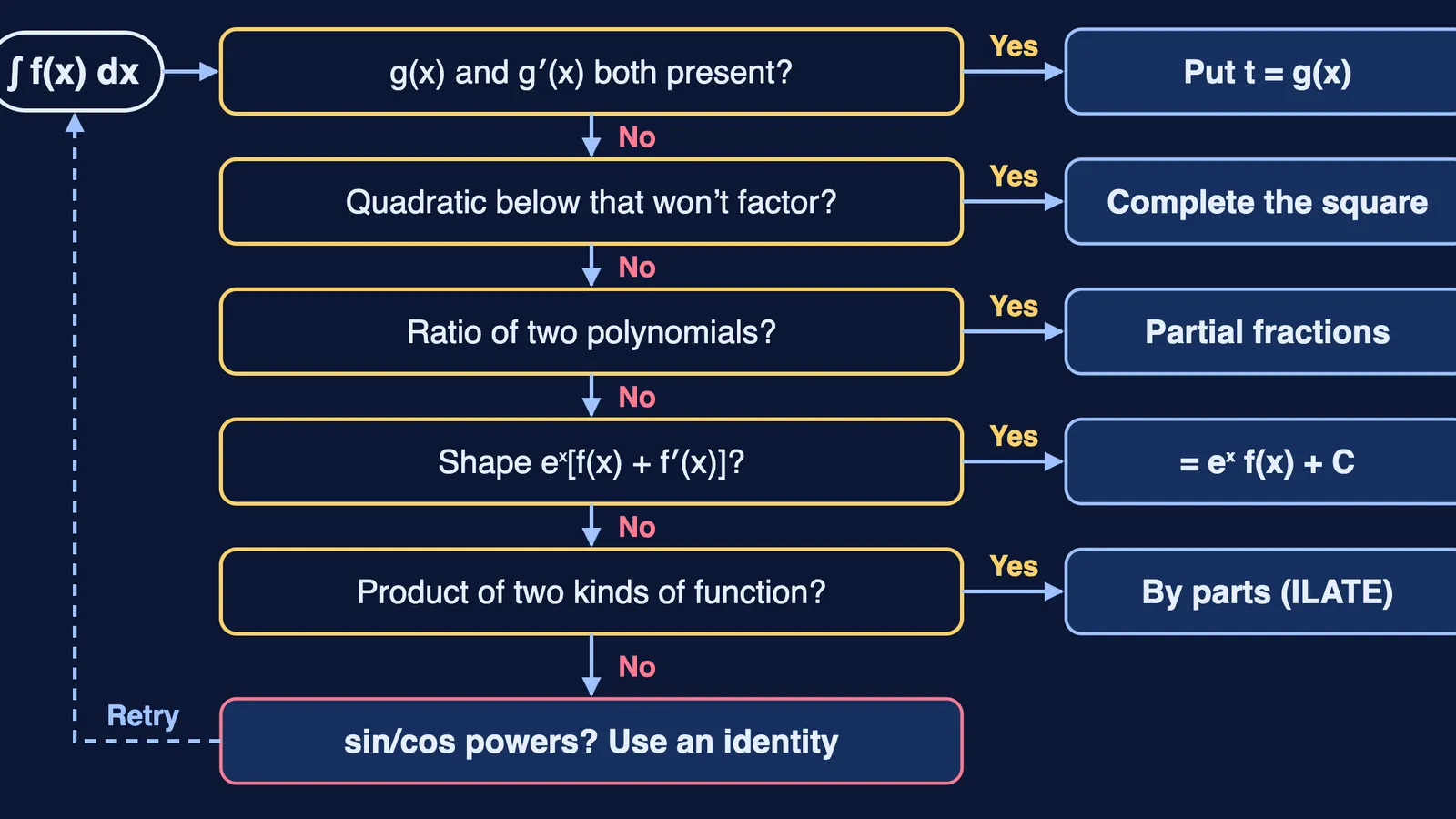
How do you choose between substitution, parts and partial fractions?
Stop at the first yes:
g(x) and g′(x) both appear: substitute t = g(x).
A quadratic below (or its square root) that will not factorise: complete the square.
A ratio of polynomials: divide if the top's degree is not lower, then partial fractions.
The shape eˣ[f(x) + f′(x)]: the answer is eˣ f(x) + C.
A product of two kinds of function: by parts.
Powers or products of sin and cos: rewrite with an identity, then ask again.
Example: ∫ sec²x/(tan²x + 4 tan x + 5) dx. Since sec²x is the derivative of tan x, put t = tan x to get ∫ dt/((t + 2)² + 1) = tan⁻¹(t + 2). Answer: tan⁻¹(tan x + 2) + C.
How do integration by parts and the eˣ(f + f′) shortcut work?
By parts: ∫ u v dx = u ∫ v dx − ∫ (u′ ∫ v dx) dx. NCERT advises taking a polynomial as the first function, unless the other is inverse trigonometric or logarithmic. The common mnemonic ILATE (inverse trig, log, algebraic, trig, exponential) stretches this into a full order of preference for the first function.
Take ∫ x³ e^(x²) dx. ILATE makes e^(x²) the second function, but it has no elementary integral. Instead take x² as the first function and x e^(x²), whose integral is (1/2) e^(x²), as the second. Then I = (x²/2) e^(x²) − ∫ x e^(x²) dx = (1/2)(x² − 1) e^(x²) + C.
The shortcut works because d/dx [eˣ f(x)] = eˣ[f(x) + f′(x)]. For ∫ eˣ (x + 1)/(x + 2)² dx, write (x + 1)/(x + 2)² = 1/(x + 2) − 1/(x + 2)². With f(x) = 1/(x + 2), the second term is f′(x), so the answer is eˣ/(x + 2) + C.
How do you handle a repeated factor in partial fractions?
A squared factor needs a fraction for each power:
(x + 5)/((x − 1)²(x + 2)) = A/(x − 1) + B/(x − 1)² + C/(x + 2)
So x + 5 = A(x − 1)(x + 2) + B(x + 2) + C(x − 1)². Put x = 1: B = 2. Put x = −2: C = 1/3. Comparing x² terms, A = −C = −1/3. Integrating: (1/3) log|(x + 2)/(x − 1)| − 2/(x − 1) + K, where K is the constant of integration (C is already taken).
The usual slip is dropping A/(x − 1). If the degree on top is not lower, divide first, then split.
How should you practise indefinite integrals?
Write the standard forms from memory weekly.
Check every answer by differentiating it.
Name the method before writing a line.
Our four-week integration practice plan sets out the schedule and mixed sets. When you keep picking the wrong method, the Fermi Problem Library has worked problems with a step-by-step solver that explains the reasoning rather than printing an answer.