

On this page
Partial fractions has one entry condition that is easy to miss under exam pressure: compare degrees before you write a single A or B.
When is a rational function improper?
NCERT's Class 12 Mathematics textbook (Part II, Chapter 7, Section 7.5) calls P(x)/Q(x) proper if the degree of P(x) is less than the degree of Q(x), and improper otherwise (NCERT, Integrals chapter). The same section says an improper function can be reduced by long division to T(x) + P₁(x)/Q(x), where T(x) is a polynomial and P₁(x)/Q(x) is proper.
OpenStax's Calculus Volume 2 puts it as a rule: partial fraction decomposition applies only when deg P(x) < deg Q(x), and when deg P(x) ≥ deg Q(x), "we must first perform long division" (OpenStax, Section 3.4).
Here is why. Every partial-fraction piece, such as A/(x − 1), shrinks towards zero as x grows, so a sum of them can never grow like x or x². If your function does, the polynomial part has to come out first.
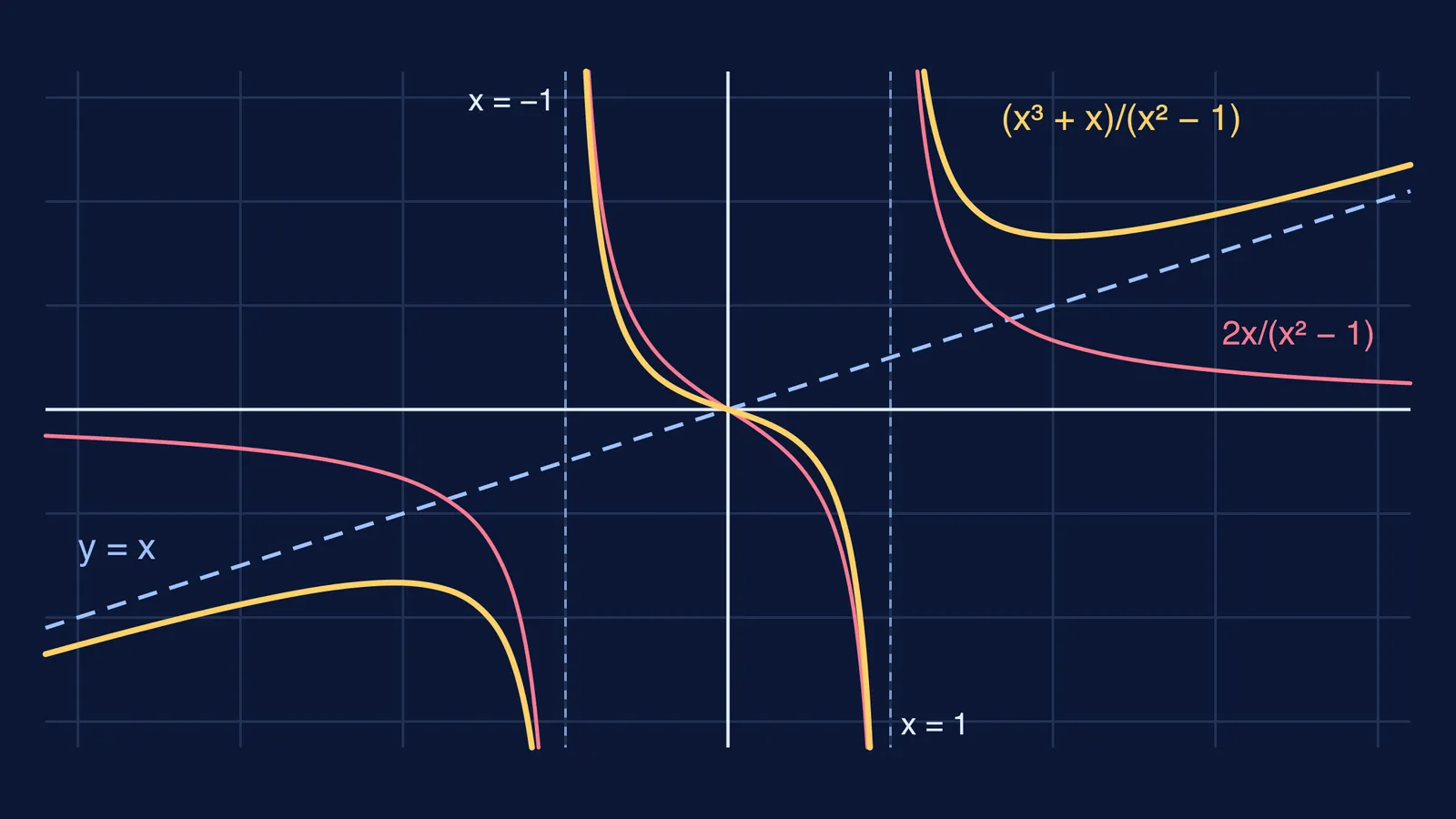
How do you integrate (x³ + x)/(x² − 1)?
The numerator has degree 3 and the denominator has degree 2. Since 3 ≥ 2, the function is improper. Divide.
Divide: x³ + x = x(x² − 1) + 2x. The quotient is x and the remainder is 2x. If the layout is rusty, our step-by-step guide to polynomial long division walks through it.
Rewrite: (x³ + x)/(x² − 1) = x + 2x/(x² − 1). The leftover fraction is proper, degree 1 over degree 2.
Split the remainder: x² − 1 = (x − 1)(x + 1), so write 2x/(x² − 1) = A/(x − 1) + B/(x + 1). Then 2x = A(x + 1) + B(x − 1). Put x = 1: 2 = 2A, so A = 1. Put x = −1: −2 = −2B, so B = 1.
Integrate each piece: x gives x²/2, 1/(x − 1) gives log|x − 1|, and 1/(x + 1) gives log|x + 1|.
Combine: x²/2 + log|x − 1| + log|x + 1| + C, which is x²/2 + log|x² − 1| + C.
Here log is the natural logarithm, as NCERT writes it. To check, differentiate: you get back x + 2x/(x² − 1), the line in step 2. (Since 2x is the derivative of x² − 1, you could also integrate the remainder in one go.)
What goes wrong if you skip the division?
The cover-up shortcut is where this bites. Suppose you set up A/(x − 1) + B/(x + 1) directly on (x³ + x)/(x² − 1). Cover up x − 1 and put x = 1: A = (1 + 1)/(1 + 1) = 1. Cover up x + 1 and put x = −1: B = (−1 − 1)/(−1 − 1) = 1. Clean numbers, nothing looks broken.
But 1/(x − 1) + 1/(x + 1) adds up to 2x/(x² − 1), only the remainder. Test x = 2: the original gives (8 + 2)/(4 − 1) = 10/3, the wrong split gives 1 + 1/3 = 4/3. The missing 2 is the quotient x at x = 2. Your integral comes out short by x²/2, yet looks reasonable on paper.
Comparing coefficients would have caught it, since A(x + 1) + B(x − 1) has no x³ term. Cover-up skips that comparison, so it fails silently.
What should you check before any partial fractions question?
Compare degrees. If the degree on top is greater than or equal to the degree below, divide.
Write the result as polynomial plus proper fraction, and carry the polynomial all the way to the end.
Factor the denominator fully, then choose the partial-fraction form. NCERT's Table 7.2 lists the forms for distinct linear, repeated linear and irreducible quadratic factors (NCERT, Section 7.5).
Find the constants, then spot-check by putting in one value of x, as we did with x = 2.
Differentiate your final answer and compare it with the integrand.
Equal degrees count as improper too. NCERT's Example 12, (x² + 1)/(x² − 5x + 6), is degree 2 over degree 2, and the book divides first to get 1 + (5x − 5)/(x² − 5x + 6) before splitting (NCERT, Integrals chapter).
For practice, try NCERT Exercise 7.5, Question 12: (x³ + x + 1)/(x² − 1). It differs from our example by a single 1. Division gives x + (2x + 1)/(x² − 1), and you should end with x²/2 + (3/2)log|x − 1| + (1/2)log|x + 1| + C.
If the split itself is shaky, start with our guide to partial fractions in integration, then fold this topic into a weekly integration practice plan. If you keep choosing the wrong first step, the Fermi Problem Library has worked problems with a step-by-step solver that explains the reasoning rather than printing an answer, so you can see where the division belongs.
Next time you meet a rational integral, compare the degrees before anything else.


