On this page
Polynomial long division works like the long division you learnt for numbers: divide, multiply, subtract, bring down, repeat. The steps below are based on the free textbook OpenStax College Algebra 2e, section 5.4 on dividing polynomials, with one fully worked example and a way to check every answer.
What are the steps of polynomial long division?
Before you start, write both polynomials in descending powers of x, and fill any gap with a zero term. Then:
Divide the leading term of what you have left by the leading term of the divisor to get the next quotient term.
Multiply the whole divisor by that quotient term.
Write the product under the matching powers and subtract every term, not just the first.
Bring down the next term of the dividend.
Repeat from step 1 with the new leading term.
Stop when what is left has a lower degree than the divisor. That is the remainder.
OpenStax states that the remainder "is either equal to zero or has degree strictly less than d(x)", the divisor. So when you divide by a quadratic, stop once the leftover is linear or a constant.
Why do you need placeholder zeros for missing powers?
Long division only works when like powers sit in the same column. The dividend 2x⁴ − 3x³ + 4x − 5 has no x² term. Skip it, and the x² terms from step 2 get subtracted from the x terms instead.
The fix is to rewrite the dividend as 2x⁴ − 3x³ + 0x² + 4x − 5 before you begin. OpenStax does the same in a worked example with a missing x-term: "We will use a zero as the coefficient for that term."
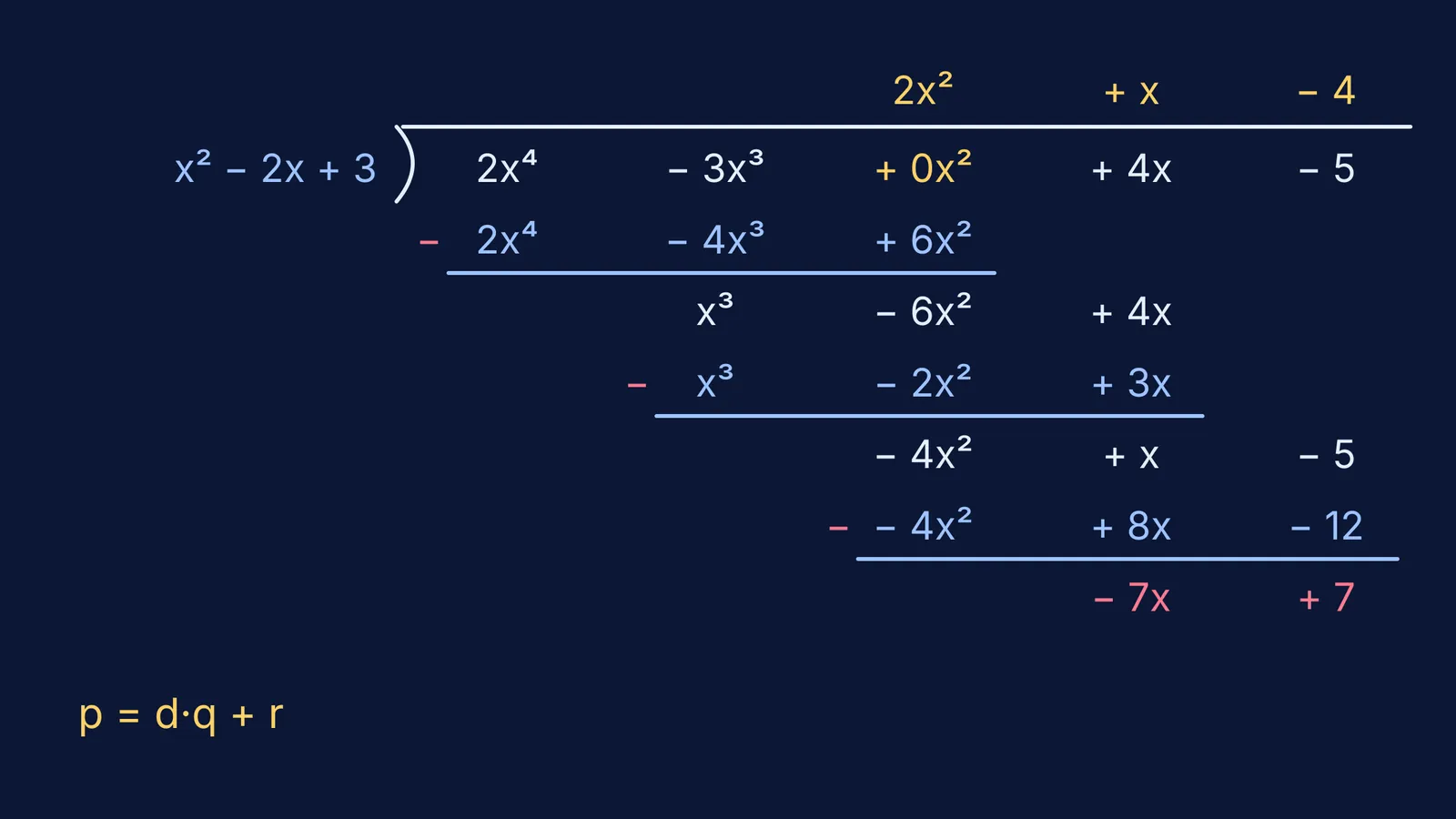
Worked example: divide 2x⁴ − 3x³ + 4x − 5 by x² − 2x + 3
Round 1. Divide the leading terms: 2x⁴ ÷ x² = 2x². Multiply back: 2x²(x² − 2x + 3) = 2x⁴ − 4x³ + 6x². Subtract: −3x³ − (−4x³) = x³, and 0x² − 6x² = −6x². Bring down 4x. You now have x³ − 6x² + 4x.
Round 2. x³ ÷ x² = x. Multiply back: x(x² − 2x + 3) = x³ − 2x² + 3x. Subtract: −6x² − (−2x²) = −4x², and 4x − 3x = x. Bring down −5. You now have −4x² + x − 5.
Round 3. −4x² ÷ x² = −4. Multiply back: −4(x² − 2x + 3) = −4x² + 8x − 12. Subtract: x − 8x = −7x, and −5 − (−12) = 7.
The leftover −7x + 7 has degree 1, lower than the divisor's degree 2, so you stop. The quotient is 2x² + x − 4 and the remainder is −7x + 7. Watch the signs: subtracting −4x³ and −12 both turn into additions.
How do you check the answer with p = dq + r?
The division algorithm in OpenStax College Algebra 2e says that for a dividend p(x) and a non-zero divisor d(x) of equal or lower degree, there are unique polynomials q(x) and r(x) with p(x) = d(x)q(x) + r(x). So multiply back and see if you get the dividend.
For the example: (x² − 2x + 3)(2x² + x − 4) = 2x⁴ + x³ − 4x² − 4x³ − 2x² + 8x + 6x² + 3x − 12, which collects to 2x⁴ − 3x³ + 0x² + 11x − 12. Add the remainder −7x + 7 and you get 2x⁴ − 3x³ + 4x − 5. It matches.
A faster spot check is to put in a small number. At x = 1: p(1) = 2 − 3 + 4 − 5 = −2. On the other side, d(1) = 2, q(1) = −1 and r(1) = 0, so dq + r = −2. One number can miss an error by luck, so try x = 2 too when the marks are large.
Which mistakes should you check for?
Every power from the top down is present, with zeros where needed.
Each product row multiplies the whole divisor, not just its first term.
Each subtraction changes the sign of every term in the row.
You stopped only when the leftover degree dropped below the divisor's degree.
When the divisor is linear, of the form x − a, there is a shorter route: see our guide to synthetic division of polynomials, step by step. The same division also comes up in factorising a cubic with the factor theorem and in finding the remainder when a polynomial is divided by a quadratic or cubic.
If your answer keeps failing the check, the Fermi Problem Library has worked problems with a step-by-step solver that explains the reasoning rather than printing an answer, so you can find the row where your subtraction went wrong.