

On this page
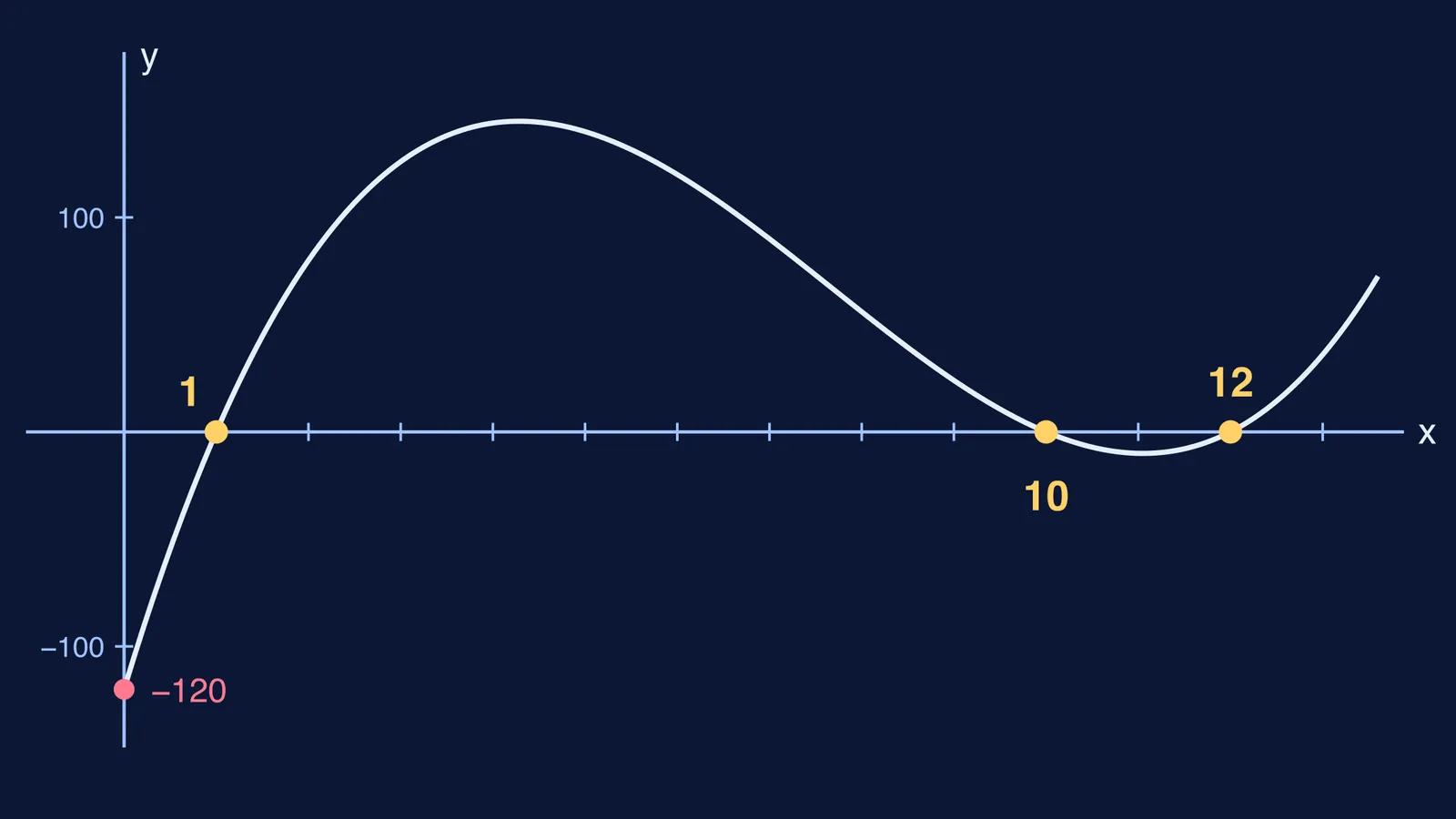
A cubic like x³ − 23x² + 142x − 120 needs no special formula, just three moves: find one root by testing a short list of numbers, divide that factor out, and factorise the quadratic that is left.
What does the factor theorem say?
The factor theorem says that k is a zero of f(x) if and only if (x − k) is a factor of f(x), as stated in OpenStax's College Algebra 2e, section 5.5.
It comes from the remainder theorem on the same page: if a polynomial f(x) is divided by x − k, the remainder is f(k). So when f(k) = 0, the division leaves nothing over and (x − k) goes in exactly.
So you don't need all three roots at once. You need one number that makes the cubic zero.
Which numbers should you test first?
The rational zero theorem tells you where to look. For a polynomial with integer coefficients, every rational zero has the form p/q, where p is a factor of the constant term and q is a factor of the leading coefficient (OpenStax College Algebra 2e). When the leading coefficient is 1, q is 1, so any rational root is a whole number that divides the constant term.
For x³ − 23x² + 142x − 120, the constant term is −120. Its divisors are ±1, ±2, ±3, ±4, ±5, ±6, ±8, ±10, ±12, ±15, ±20, ±24, ±30, ±40, ±60 and ±120. That is 32 candidates, so narrow the list first:
Try 1 first. f(1) is just the sum of the coefficients: 1 − 23 + 142 − 120.
Then −1. Flip the signs of the x³ and x terms and add: −1 − 23 − 142 − 120.
Use the signs. Here the coefficients go +, −, +, −. Any negative x makes every term negative, so no negative candidate can be a root.
Worked example: x³ − 23x² + 142x − 120
Step 1: test. f(1) = 1 − 23 + 142 − 120 = 0. By the factor theorem, (x − 1) is a factor.
Step 2: divide. Use synthetic division with 1 on the coefficients 1, −23, 142, −120:
Bring down the 1.
Multiply by 1 to get 1, and add it to −23 to get −22.
Multiply −22 by 1 to get −22, and add it to 142 to get 120.
Multiply 120 by 1 to get 120, and add it to −120 to get 0.
The last number is the remainder, and 0 confirms the factor. The other numbers, 1, −22 and 120, give the quotient x² − 22x + 120. New to the layout? See synthetic division of polynomials, step by step.
Step 3: finish with the quadratic. You need two numbers that multiply to 120 and add to −22. They are −10 and −12, so x² − 22x + 120 = (x − 10)(x − 12). For the sign rules, see how to factorise by splitting the middle term.
Answer: x³ − 23x² + 142x − 120 = (x − 1)(x − 10)(x − 12).
What if 1 and −1 don't work?
Take x³ + 2x² − 5x − 6. f(1) = 1 + 2 − 5 − 6 = −8, so 1 is not a root. f(−1) = −1 + 2 + 5 − 6 = 0, so (x + 1) is a factor. Watch the sign here: a root of −1 gives the factor x + 1.
Synthetic division with −1 on 1, 2, −5, −6 gives 1, 1, −6 and a remainder of 0. The quotient is x² + x − 6 = (x + 3)(x − 2), so the cubic is (x + 1)(x + 3)(x − 2).
If neither works, move on to ±2, ±3 and so on. If the leading coefficient isn't 1, add the fractions p/q. If the leftover quadratic won't factorise, the answer is the linear factor times that quadratic.
A checklist for your next exam question
Write the coefficients in order, with 0 for any missing power. For x³ − 7x + 6, that is 1, 0, −7, 6.
List the divisors of the constant term.
Test 1 and −1 first, using the quick sums.
Use the signs to cross out candidates that can't work.
Divide out the factor you find. The remainder must be 0.
Factorise the quadratic quotient.
Check by expanding, or put one of the new roots back into the cubic.
Try it on x³ − 7x + 6. You should get (x − 1)(x + 3)(x − 2).
If the division keeps going wrong, the Fermi Problem Library has worked problems with a step-by-step solver that explains the reasoning rather than printing an answer. If the gap is in remainders or zeros of a polynomial, the Fermi Concept Library gives each concept its own lesson. For more checks like step 7, see common algebra mistakes in JEE and boards.


