

On this page
You know the method, yet the answer is wrong because of one line in the middle. In JEE Main, JEE Advanced and the CBSE boards these slips cost marks as surely as a gap in a chapter. Most are the same handful of errors, and each has a quick check.
What algebra mistakes cost the most marks in JEE and boards?
These seven also turn up in calculus, coordinate geometry and physics numericals.
Cancelling terms instead of factors. (x + 3)/(x + 5) is not 3/5. You can cancel only what multiplies the whole top and the whole bottom.
Dropping a minus sign across a bracket. 5 − (2x − 3) is 5 − 2x + 3, not 5 − 2x − 3.
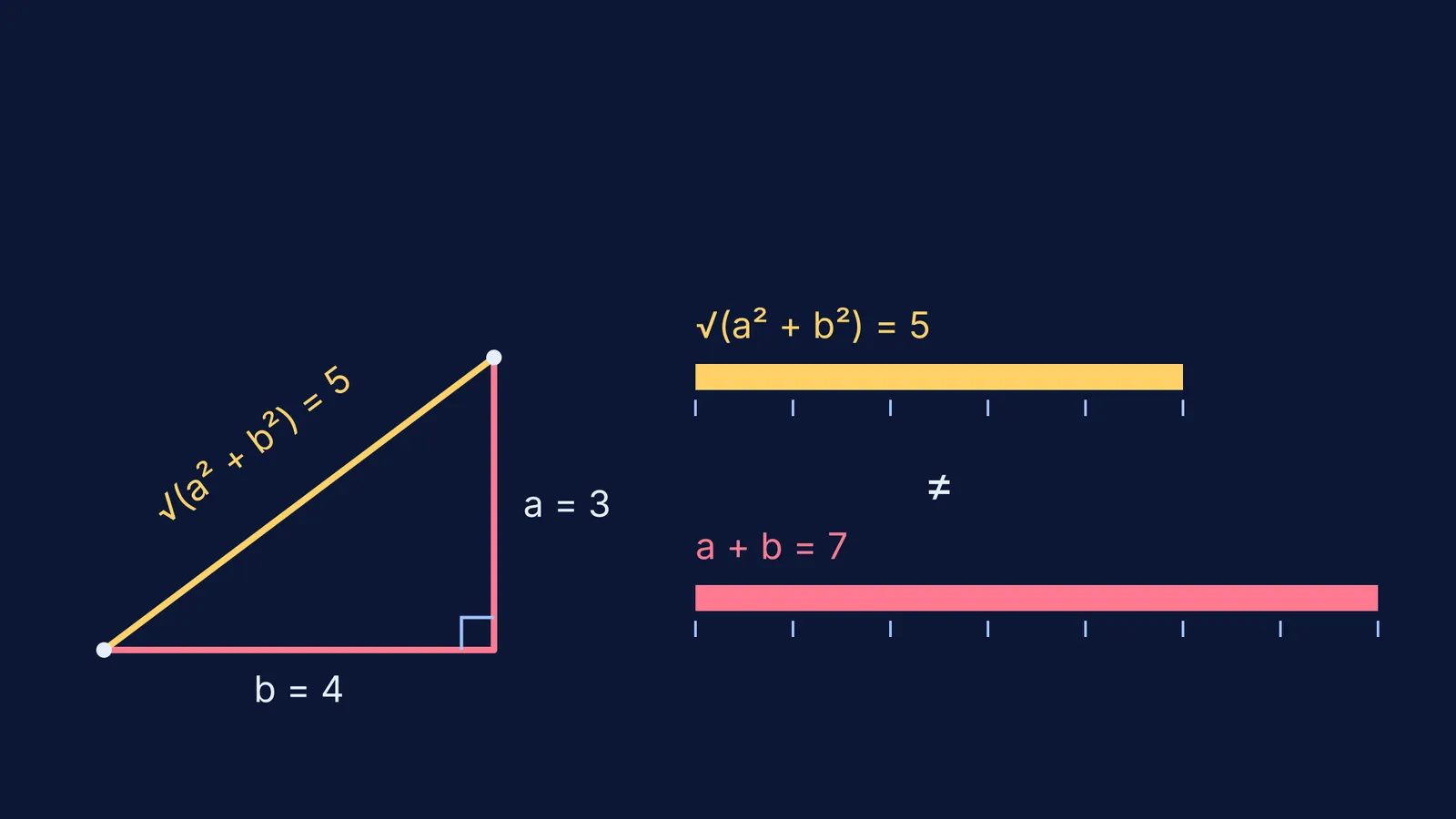
Splitting a root or a square. √(a² + b²) is not a + b, and (a + b)² is not a² + b².
Adding fractions by adding bottoms. 1/a + 1/b is not 1/(a + b), a trap in parallel resistors and the lens formula.
Dividing by something that could be zero. From x² = 3x, dividing by x gives x = 3 and quietly loses x = 0.
Forgetting to flip an inequality. From −2x > 6 you get x < −3. Multiplying or dividing by a negative number reverses the sign.
Writing √(x²) = x. It equals |x|. For x = −2, √4 is 2, not −2.
Why does the same algebra mistake keep coming back?
A 2014 error analysis by Julie Booth and colleagues looked at algebra students' problem solving at different points in the school year and found that certain types of error were indicative of difficulty on standardised maths test items (Booth et al., The Journal of Problem Solving).
In interviews with twelve students at Class 8 level, Joëlle Vlassis found that handling negatives in algebra involved a real change in how students understood the minus sign, not just a memorised rule (Learning and Instruction, 2004). A slip that keeps returning often points to a shaky rule, and that is fixable.
How do you catch an algebra mistake in ten seconds?
Put a small number into the line before and the line after. If the values differ, the step is wrong.
Cancellation: at x = 2, (x + 3)/(x + 5) is 5/7, not 3/5.
Brackets: at x = 0, 5 − (2x − 3) is 8, while 5 − 2x − 3 is 2.
Roots and squares: with a = 3 and b = 4, √(9 + 16) is 5, while a + b is 7.
Fractions: with a = b = 1, 1/a + 1/b is 2, while 1/(a + b) is 1/2.
Dividing by a variable: ask "can this be zero?" Better, move everything to one side and factor: x(x − 3) = 0 gives both roots.
Inequalities: test one number from your answer in the original. For x < −3, try x = −4: −2(−4) = 8, which is greater than 6.
Roots of squares: try x = −2.
A matching value does not prove a step right, since two expressions can agree at one point; try a second value if unsure.
What does the check look like on a real problem?
Simplify (x² − 9)/(x² + 3x).
A common wrong line is to "cancel the x²" and write −9/(3x) = −3/x. Check at x = 2. The original gives (4 − 9)/(4 + 6) = −5/10 = −1/2. The answer −3/x gives −3/2. They differ, so a step is wrong.
The correct route factorises first: (x − 3)(x + 3) on top and x(x + 3) below, so the answer is (x − 3)/x, for x not equal to 0 or −3. At x = 2 this is −1/2, which matches.
How should you practise so these errors stop?
Study wrong working too. In two classroom experiments, Booth, Lange, Koedinger and Newton found that incorrect examples, alone or alongside correct ones, with prompts to explain them, may be especially helpful for conceptual understanding in algebra (Learning and Instruction, 2013).
A simple weekly routine:
Keep an error log: for each lost mark, the wrong line, the correct line and which of the seven mistakes it was.
Weekly, cover the correct lines and explain in one sentence why each wrong line fails.
Use the matching ten-second check in your next mock. Our guide on how to analyse a mock test shows where this fits in a full review.
To see where a step went wrong in a longer problem, the Fermi Problem Library has worked problems with a step-by-step solver that explains the reasoning rather than printing an answer. When the same slip keeps returning, the Fermi Concept Library has a lesson on each mathematics concept, so you can rebuild the rule behind it.
Next, plan for checking your answers in the last 10 minutes and see why fast thinking causes careless exam errors.


