

On this page
If you know the remainder theorem for x − a, you have most of what you need for quadratics and cubics: stop dividing and start substituting.
What is the remainder when a polynomial is divided by a quadratic?
The polynomial division theorem says that for any polynomials A and B, with B not zero, there is exactly one quotient Q and one remainder R with A = BQ + R, where R = 0 or the degree of R is less than the degree of B.
So when you divide by a quadratic, the remainder is at most linear: R(x) = px + q. When you divide by a cubic, it is at most quadratic: R(x) = ax² + bx + c. The number of unknowns always equals the degree of the divisor.
The familiar remainder theorem is the special case B = x − r: the remainder is a constant, and it equals f(r). The general idea is the same. Write f(x) = B(x)·Q(x) + R(x), then put x equal to a root of B. The B(x)·Q(x) term vanishes, leaving f(root) = R(root). You never need to know Q.
How do you find the remainder without long division?
Use this four-step method.
Factor the divisor and list its roots, real or complex.
Write the remainder with unknown coefficients: px + q for a quadratic, ax² + bx + c for a cubic.
Substitute each root into f(x) = R(x). For a repeated root, also differentiate both sides and substitute again.
Solve the small linear system, then check your answer at each root.
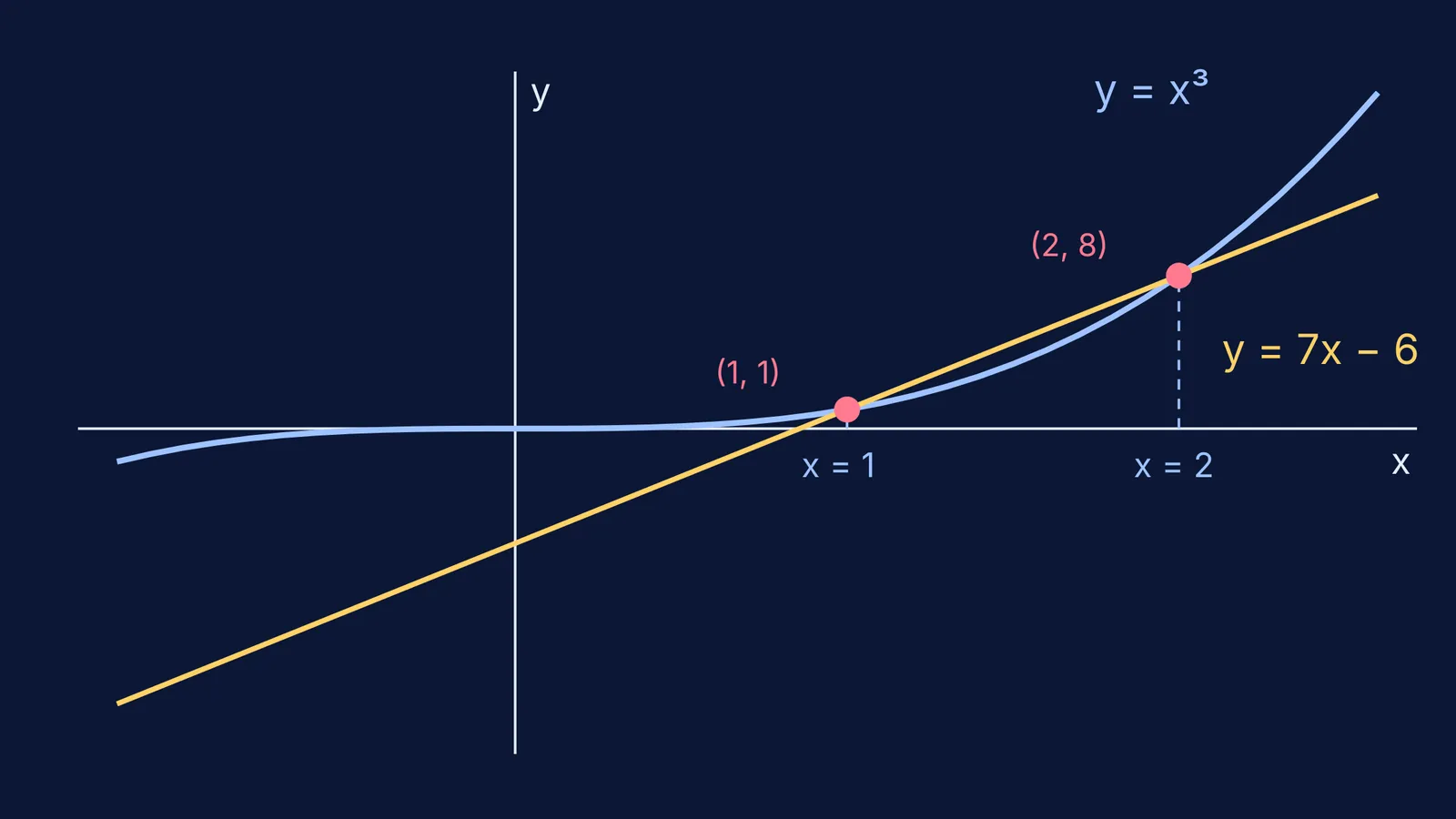
The repeated-root rule in step 3 works because if (x − a)² divides B, the derivative of B(x)·Q(x) also vanishes at x = a. The Wikipedia article on polynomial long division uses the same idea to find tangent lines: the remainder on dividing by (x − r)² is the tangent at x = r.
JEE-style questions, solved
These are JEE-style practice questions written for this guide. Try each one before reading the solution.
Question 1, two distinct roots: find the remainder when x¹⁰⁰ is divided by x² − 3x + 2.
Since x² − 3x + 2 = (x − 1)(x − 2), write R = px + q.
x = 1 gives 1 = p + q
x = 2 gives 2¹⁰⁰ = 2p + q
Subtracting, p = 2¹⁰⁰ − 1 and q = 2 − 2¹⁰⁰. The remainder is (2¹⁰⁰ − 1)x + 2 − 2¹⁰⁰.
Question 2, a repeated root: find the remainder when xⁿ is divided by (x − 1)².
Write R = px + q. At x = 1, 1 = p + q. Differentiating xⁿ = (x − 1)²Q(x) + px + q gives nxⁿ⁻¹ = (terms containing x − 1) + p, so at x = 1, p = n. The remainder is nx + 1 − n.
Question 3, complex roots: find the remainder when x²⁰²⁶ is divided by x² + x + 1.
The roots are ω and ω², the non-real cube roots of unity, with ω³ = 1. Since 2026 = 3 × 675 + 1, ω²⁰²⁶ = ω. So pω + q = ω, and because p and q are real while ω is not, p = 1 and q = 0. The remainder is x.
Check: x²⁰²⁶ − x = x(x²⁰²⁵ − 1), and x³ − 1, which contains the factor x² + x + 1, divides x²⁰²⁵ − 1.
Question 4, a cubic divisor: find the remainder when x⁵⁰ is divided by x³ − x.
Since x³ − x = x(x − 1)(x + 1), write R = ax² + bx + c.
x = 0 gives 0 = c
x = 1 gives 1 = a + b + c
x = −1 gives 1 = a − b + c
So c = 0, a = 1 and b = 0. The remainder is x². Check: x⁵⁰ − x² = x²(x⁴⁸ − 1), and both x and x² − 1 divide it.
Where do students lose marks?
Writing a constant remainder for a quadratic divisor. That applies only to linear divisors.
Forgetting the derivative condition for a repeated factor, leaving two unknowns and one equation.
Avoiding complex roots. For x² + 1, use x = i; for x² + x + 1, use ω, as in our guide to cube roots of unity and their JEE problem types.
Skipping the check at every root.
For remainders of large numbers rather than polynomials, see remainder and divisibility problems with binomial expansion.
If you keep setting up the equations wrongly, the Fermi Problem Library has worked problems with a step-by-step solver that explains the reasoning rather than printing an answer, so you can see where your method went off track.
One to try now: find the remainder when x²⁰²⁶ is divided by x² + 1. (Put x = i. Since i²⁰²⁶ = −1, pi + q = −1, so the remainder is −1.)


