On this page
Many errors in this unit come down to one skipped check: an unlisted element, a pair that breaks transitivity, a codomain value nothing reaches. Every example below was checked case by case.
What does the JEE Main syllabus include for Sets, Relations and Functions?
The Syllabus for JEE (Main) 2027 from NTA lists Unit 1 of mathematics as sets, their operations and algebraic properties, power set, types of relations, equivalence relations, one-one, into and onto functions, and composition.
NCERT chapters (2026-27 reprint):
Class 11, Chapter 1, Sets: representation, subsets, Venn diagrams, operations, complements, De Morgan's laws.
Class 11, Chapter 2, Relations and Functions: Cartesian products, relations, functions, domain, codomain and range.
Class 12, Chapter 1, Relations and Functions: types of relations, equivalence relations, one-one and onto functions, composition.
The current Class 11 reprint has no section on power sets or on counting with n(A ∪ B) = n(A) + n(B) − n(A ∩ B), so learn both separately. A set with n elements has 2ⁿ subsets.
How do you practise set operations and counting?
Take U = {1, 2, …, 10}, A = {2, 4, 6, 8, 10} (even numbers) and B = {3, 6, 9} (multiples of 3).
A ∪ B = {2, 3, 4, 6, 8, 9, 10}, so (A ∪ B)′ = {1, 5, 7}.
A′ = {1, 3, 5, 7, 9} and B′ = {1, 2, 4, 5, 7, 8, 10}, so A′ ∩ B′ = {1, 5, 7}. They match, as De Morgan's law says.
A ∩ B = {6}, so (A ∩ B)′ and A′ ∪ B′ are both everything except 6.
How many of 1 to 100 are divisible by 4 or 6? There are 25 multiples of 4 and 16 of 6, but the 8 multiples of 12 were counted twice: 25 + 16 − 8 = 33. The trap is subtracting multiples of 24 instead of the LCM, 12. This inclusion-exclusion Venn diagram walkthrough covers three sets.
How do you check if a relation is reflexive, symmetric and transitive?
Reflexive needs (a, a) for every a. Symmetric needs (b, a) whenever (a, b) is present. Transitive needs (a, c) whenever (a, b) and (b, c) are present.
Take X = {1, 2, 3, 4} and R = {(1, 1), (1, 3), (3, 1), (3, 3)}.
Symmetric: (1, 3) and (3, 1) are both there.
Transitive: every chain, such as (1, 3) then (3, 1), lands in R, here on (1, 1).
Not reflexive: (2, 2) and (4, 4) are missing.
If someone claims a property, ask for the breaking pair, as in this guide to checking relations with counterexamples.
An equivalence relation passes all three. On {1, 2, …, 10}, let a R b when a − b is divisible by 4. The classes are {1, 5, 9}, {2, 6, 10}, {3, 7} and {4, 8}, and each element sits in exactly one.
How do you tell one-one from onto, and handle composition?
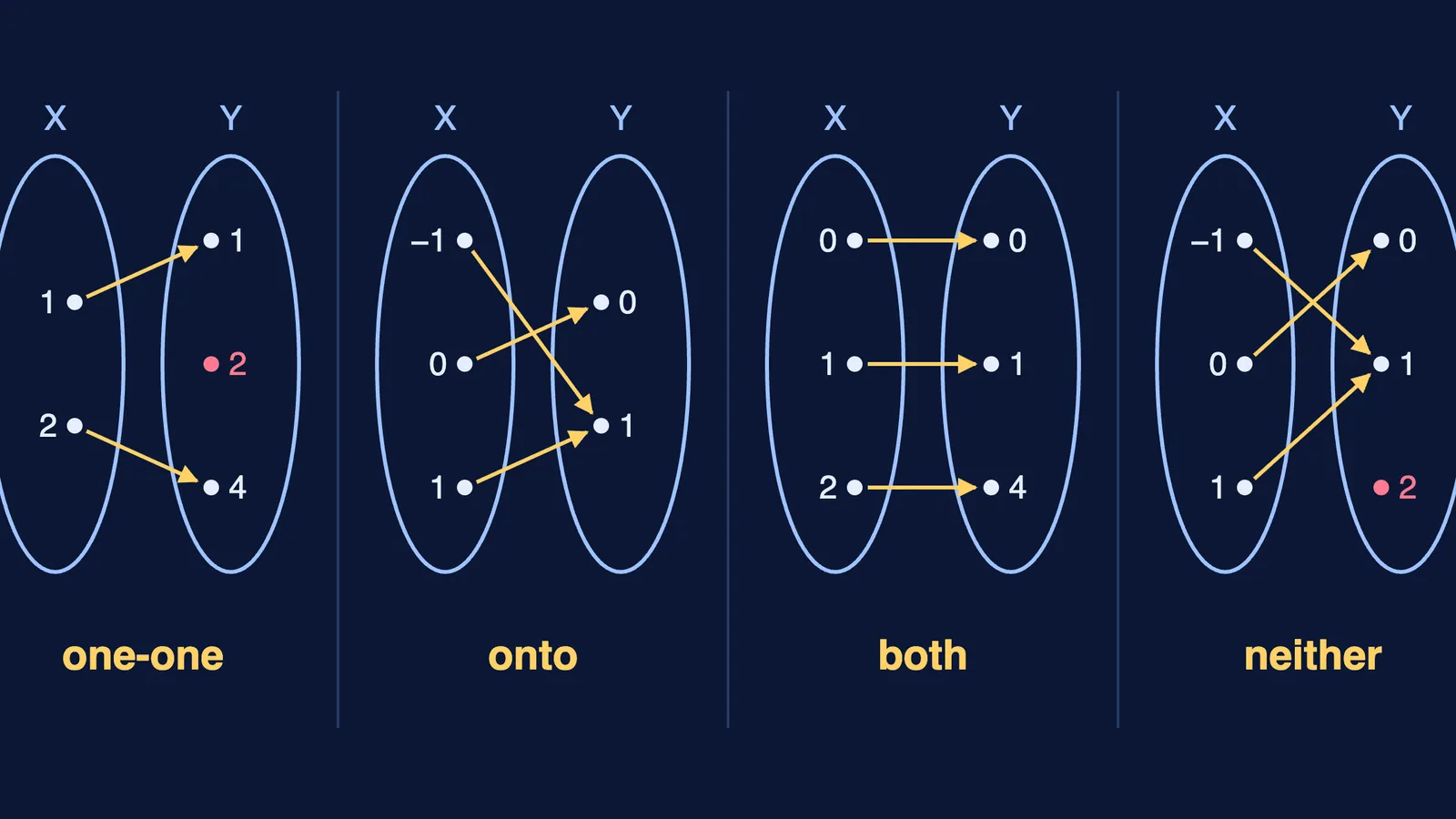
A function f: X → Y is one-one if different inputs give different outputs, and onto if its range equals Y. Domain and codomain decide it, not just the rule. With f(x) = x²:
{1, 2} → {1, 2, 4}: one-one, not onto (nothing reaches 2), so an into function.
{−1, 0, 1} → {0, 1}: onto, not one-one (−1 and 1 both give 1).
{0, 1, 2} → {0, 1, 4}: both, so bijective.
{−1, 0, 1} → {0, 1, 2}: neither.
On the reals, x² from R to R is neither, while from 0, ∞) to [0, ∞) it is bijective. To count such functions, see [number of functions from set A to B.
Order matters in composition. With f(x) = x² and g(x) = x + 3, (f ∘ g)(x) = (x + 3)² but (g ∘ f)(x) = x² + 3. At x = 1 they give 16 and 4. In f ∘ g, g acts first.
What is the domain and range trap?
Take h(x) = (x² − 9)/(x − 3). The domain excludes 3. Cancelling gives x + 3, tempting you to say the range is all reals, but x = 3 is gone, so the range is all reals except 6.
What is a good 10-day practice plan?
Days 1-2: Class 11 Chapters 1 and 2; redo the checks above with your own sets.
Day 3: power sets and three-set counting.
Days 4-5: relations. For every property that fails, write the breaking pair.
Days 6-7: one-one and onto. State domain and codomain before judging.
Day 8: composition and the domain trap.
Days 9-10: timed previous-year questions, then sort each mistake into "missed a case" or "wrong definition".
If a mistake comes from the wrong method rather than a slip, the Fermi Problem Library has worked problems with a step-by-step solver that explains the reasoning rather than printing an answer.