On this page
A survey problem gives you a class, three clubs, some totals and a question like “how many joined none?” The formula looks like a row of plus and minus signs. Below, we fill the diagram one region at a time and watch where the final plus sign comes from.
What does the inclusion-exclusion formula say for three sets?
Wolfram MathWorld's entry on the inclusion-exclusion principle gives the general rule: add the sizes of the single sets, subtract the pairwise overlaps, add the triple overlaps, and keep alternating. For three sets it reads n(A ∪ B ∪ C) = n(A) + n(B) + n(C) − n(A ∩ B) − n(A ∩ C) − n(B ∩ C) + n(A ∩ B ∩ C).
The NCERT Class 11 Mathematics chapter on sets introduces Venn diagrams, named after the English logician John Venn (1834-1883), with the universal set usually drawn as a rectangle and its subsets as circles. For the story behind the circles, read our piece on John Venn and the logic behind the diagrams.
Why is the triple overlap added back?
Follow one person through the formula. Count how often the single totals count them, then how often the pair totals take them away.
In exactly one set: counted once by the singles, never by the pairs. Net 1.
In exactly two sets: counted twice by the singles, subtracted once for their one pair. Net 1.
In all three sets: counted 3 times by the singles, subtracted 3 times, because they sit in A ∩ B, A ∩ C and B ∩ C. Net 0.
That last line is the whole reason. After the pairs are subtracted, people in the centre have dropped out, so the formula adds n(A ∩ B ∩ C) once to bring them back. Now everyone in the union is counted exactly once.
How do you solve a three-set Venn diagram word problem?
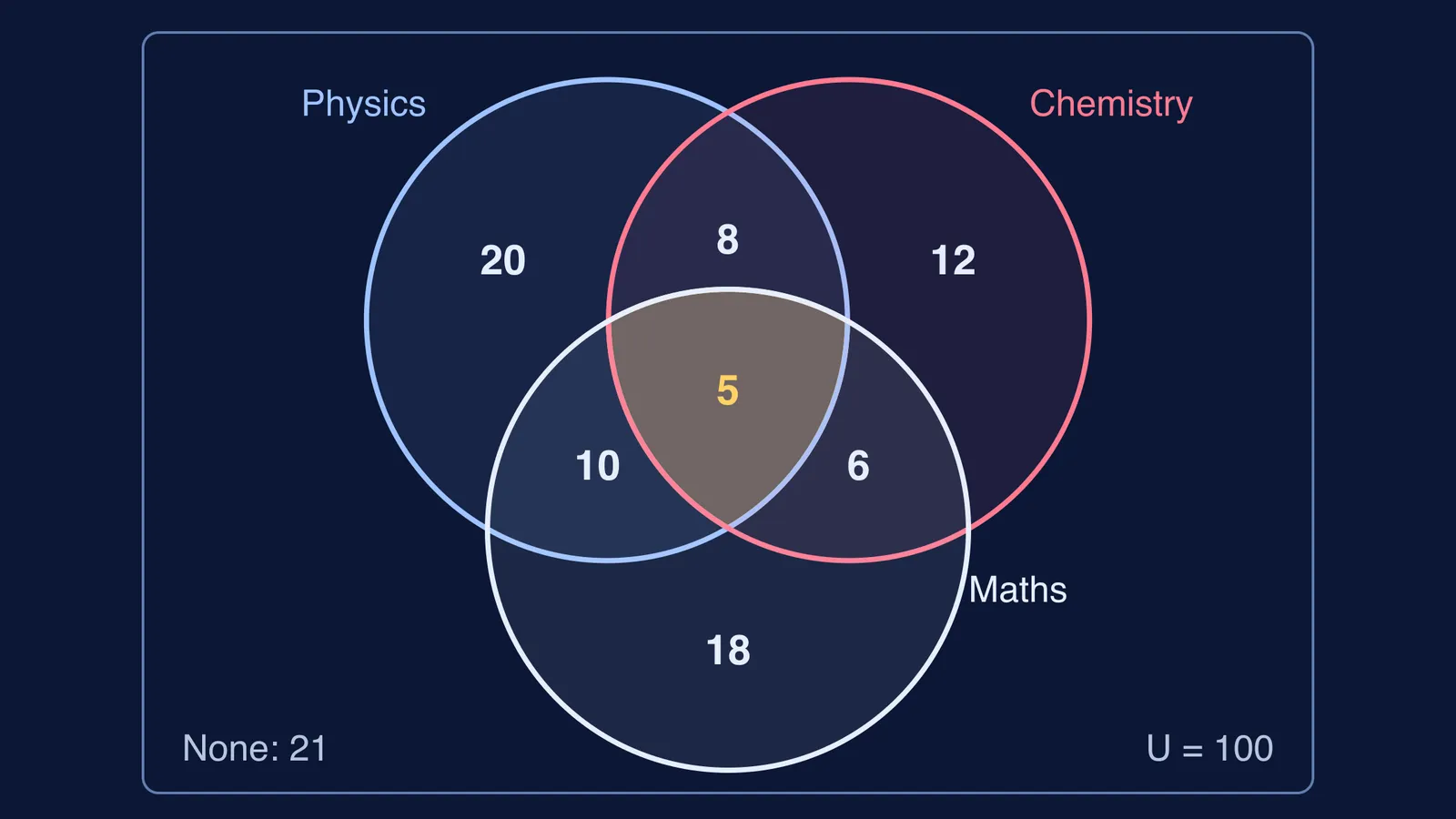
Here is a made-up survey to practise on. In a class of 100, 43 joined the Physics club (P), 31 the Chemistry club (C) and 39 the Maths club (M). 13 are in both P and C, 15 in P and M, 11 in C and M, and 5 in all three. How many joined no club, and how many joined exactly one?
Fill the diagram from the centre outwards:
Centre, all three: 5.
Pairs only: P and C only = 13 − 5 = 8; P and M only = 15 − 5 = 10; C and M only = 11 − 5 = 6.
Singles only: P only = 43 − 8 − 10 − 5 = 20; C only = 31 − 8 − 6 − 5 = 12; M only = 39 − 10 − 6 − 5 = 18.
Union: 20 + 12 + 18 + 8 + 10 + 6 + 5 = 79.
None: 100 − 79 = 21. Exactly one club: 20 + 12 + 18 = 50.
Check with the formula: 43 + 31 + 39 − 13 − 15 − 11 + 5 = 79. Two routes, one answer. For the two-set version, see our guide to n(A ∪ B) word problems, and for more practice, three-set Venn counting with inclusion-exclusion.
What happens when you change one region of a Venn diagram?
Treat each of the seven regions as a slider: raise one by 1 and leave the rest alone. Paper works, or a spreadsheet with seven input cells.
Raise “P only”: n(P) rises by 1, no pair changes, and the union rises by 1.
Raise “P and C only”: n(P) and n(C) each rise, so the singles add 2; n(P ∩ C) rises, so the pairs take away 1. The union rises by 1.
Raise the centre: all three singles rise, adding 3, and all three pairs rise, taking away 3. The union still rises by 1, and only the triple term records it. Drop that term and the formula says nothing changed.
Watching three totals jump while the union moves by one is easier to see than to read. The Fermi Simulation Lab has interactive simulations for the ideas that are easier to see than to read.
Which mistakes cost marks in Venn diagram problems?
Reading “in P and C” as “in P and C only”. Pair totals usually include the centre; subtract it before you write the region.
Subtracting full pair totals from a single total. 43 − 13 − 15 takes the centre away twice and gives 15, not 20; work from the centre outwards instead.
Forgetting the region outside the circles. The union is not the class size.
Accepting a negative region. If one comes out below zero, recheck the data or your subtraction.
If the method keeps slipping, the Fermi Problem Library has worked problems with a step-by-step solver that explains the reasoning rather than printing an answer.
Next time a survey problem appears, draw the circles, fill the centre first, and run the one-line test before you write the answer.