On this page
A chatbot can sound sure when it says a relation is transitive. That's a yes-or-no claim, so you can check it. Ask the AI to show you every ordered pair its answer depends on, then check each one against the set. If a single required pair is missing, the claim is false, however confident the explanation sounded.
What do reflexive, symmetric and transitive mean?
These definitions come from Chapter 1, Relations and Functions, of the NCERT Class 12 Mathematics textbook (Definition 3).
Reflexive: a relation R in a set A is reflexive if (a, a) is in R for every a in A.
Symmetric: R is symmetric if (a₁, a₂) in R implies (a₂, a₁) is in R.
Transitive: R is transitive if (a₁, a₂) in R and (a₂, a₃) in R together imply (a₁, a₃) is in R.
Equivalence relation: the same chapter (Definition 4) calls R an equivalence relation if it is reflexive, symmetric and transitive.
Read the transitive definition carefully: nothing says a₁, a₂ and a₃ must be different. That's where the trap is.
Where does R = {(1, 2), (2, 1)} break?
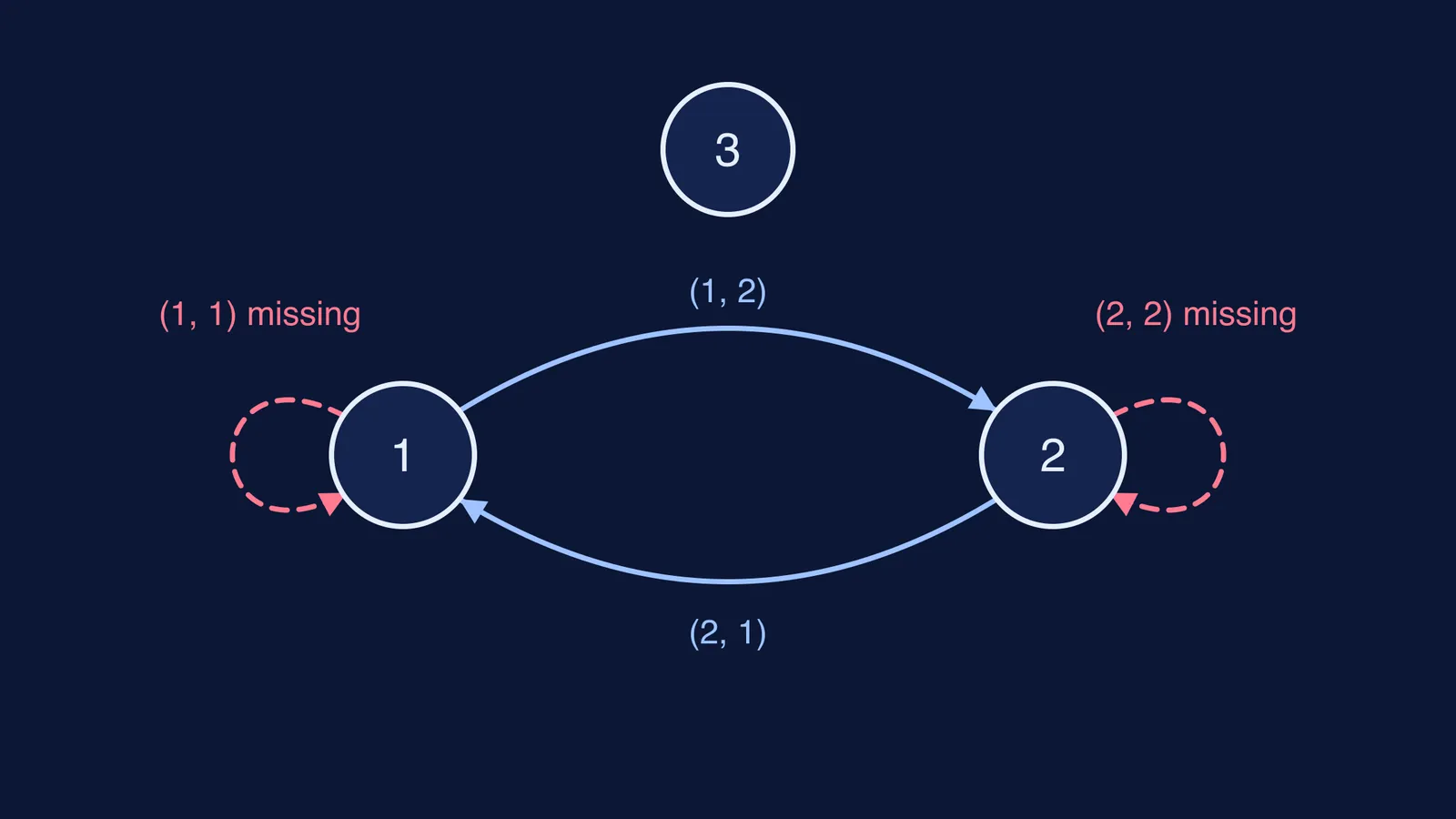
This is Question 6 of Exercise 1.1 in the NCERT chapter: show that R = {(1, 2), (2, 1)} in the set {1, 2, 3} is symmetric but neither reflexive nor transitive.
Suppose an AI answers like this: "R is symmetric because (1, 2) and (2, 1) are both present. R is transitive because there are no elements a, b, c with (a, b) and (b, c) in R where we would need (a, c)." The first sentence is right. The second sounds tidy, but it's wrong.
Here is the pair audit, done by hand:
List every pair that starts where another pair ends. (1, 2) ends at 2, and (2, 1) starts at 2. (2, 1) ends at 1, and (1, 2) starts at 1. So there are two chains.
Chain one: (1, 2) and (2, 1). Transitivity demands (1, 1). Is (1, 1) in R? No.
Chain two: (2, 1) and (1, 2). Transitivity demands (2, 2). Is (2, 2) in R? No.
One failure is enough. (1, 2) and (2, 1) are in R but (1, 1) is not, so R is not transitive.
The AI only looked for chains through three different elements. Here, a₁ = a₃ = 1, which the definition allows. The same missing (1, 1) also shows R is not reflexive, and 3 is related to nothing at all.
For a second example, NCERT's Example 4 takes R = {(1, 1), (2, 2), (3, 3), (1, 2), (2, 3)} on {1, 2, 3}. It is reflexive but neither symmetric nor transitive: (1, 2) is in R but (2, 1) is not, and (1, 2) and (2, 3) are in R while (1, 3) is not. Again, one missing pair decides each property.
How do you check an AI's answer on reflexive, symmetric and transitive?
Use this four-step check on any finite relation, from AI or your own rough work.
Reflexive: write out every (a, a) for the whole set A, not just the elements that appear in R.
Symmetric: for each pair (a, b), find (b, a). Pairs like (1, 1) count as their own reverse.
Transitive: for each pair (a, b), list every pair that starts with b. For each chain, name the pair (a, c) that must exist, including when c = a.
Verdict: a "yes" needs every check to pass. A "no" needs one named missing pair, written as a counterexample.
On infinite sets you can't list every pair, so ask for a general argument instead, as NCERT's Example 5 does for "2 divides a − b".
What should you type to make the AI show its pairs?
Don't just ask "is it transitive?". Ask for evidence you can check:
"List every pair of ordered pairs (a, b), (b, c) in R, including cases where a = c. For each, say which pair (a, c) is required and whether it is in R."
"You said R is transitive. Give me the full list of chains you checked. If any required pair is missing, change your answer."
"Before answering, list all (a, a) for every element of the set and mark which are in R."
What if the AI's pairs all check out?
Then you have a verified answer and a method you can reuse. Practise it on counting reflexive and symmetric relations on an n-element set and on whether "parallel to" is an equivalence relation. The same habit works for functions: prove a function is one-one and onto, then let AI attack it.
The Fermi Problem Library has worked problems with a step-by-step solver that explains the reasoning rather than printing an answer. If the definitions still feel shaky, the Fermi Concept Library gives each mathematics concept its own lesson.