

On this page
In mathematics, relations are rules that group elements of a set together. One of the most important classes of relations is the equivalence relation, which is frequently tested in Class 12 board exams and JEE.
What makes a relation an equivalence relation?
An equivalence relation on a set is a relation that groups elements sharing a common property. According to the NCERT Class 12 mathematics textbook, a relation R in a set A is an equivalence relation if it satisfies three conditions simultaneously:
Reflexive: Every element is related to itself. For every a in A, (a, a) belongs to R.
Symmetric: If one element is related to another, the reverse is true. If (a, b) belongs to R, then (b, a) belongs to R.
Transitive: If the first is related to the second, and the second to the third, the first is related to the third. If (a, b) and (b, c) belong to R, then (a, c) belongs to R.
If you find it difficult to recall the definitions of relations and want to revise them before an exam, you can search for them in the Concept Library, which covers every concept in physics, chemistry, biology, mathematics and computing.
Is parallel to an equivalence relation?
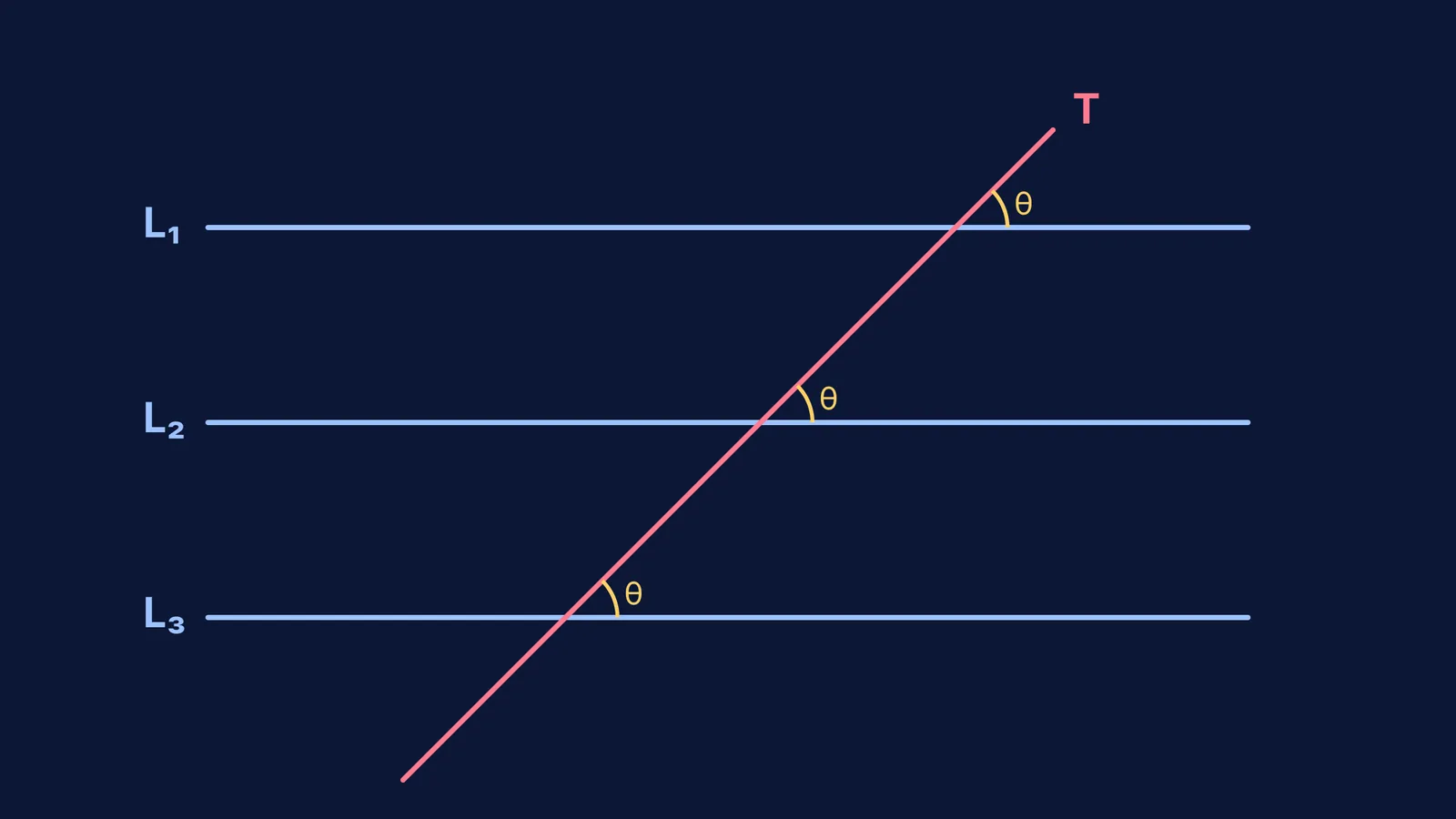
Yes, the relation "is parallel to" is a classic equivalence relation. Let us test it against the three rules for a set of straight lines in a plane:
Reflexive: A line L₁ is parallel to itself. This is mathematically defined as true, so (L₁, L₁) belongs to the relation.
Symmetric: If line L₁ is parallel to line L₂, then L₂ is parallel to L₁. The relation works both ways.
Transitive: If L₁ is parallel to L₂, and L₂ is parallel to L₃, then L₁ must be parallel to L₃.
Because all three properties hold, "is parallel to" forms an equivalence relation.
Is perpendicular to an equivalence relation?
Let us check the relation "is perpendicular to" (L₁ ⊥ L₂) for the same set of lines.
Reflexive: A line cannot be perpendicular to itself. Therefore, it is not reflexive.
Symmetric: If L₁ is perpendicular to L₂, then L₂ is perpendicular to L₁. It is symmetric.
Transitive: If L₁ is perpendicular to L₂, and L₂ is perpendicular to L₃, L₁ is actually parallel to L₃, not perpendicular. It fails transitivity.
Since it fails the reflexive and transitive tests, "is perpendicular to" is not an equivalence relation. When you hit a block trying to figure out these properties in a homework question, you can run the question through the Fermi Problem Library, where a step-by-step solver explains the reasoning rather than printing an answer.
Are similar triangles and congruent triangles equivalence relations?
Geometry provides many sets where equivalence relations apply. If we take the set of all triangles in a plane:
Similarity: The relation "is similar to" is an equivalence relation. Every triangle is similar to itself (reflexive). If triangle A is similar to triangle B, B is similar to A (symmetric). If A is similar to B, and B to C, then A is similar to C (transitive).
Congruence: The relation "is congruent to" also passes all three tests for the same reasons. The NCERT syllabus often tests this property in board exams.
How to check relations in the exam hall
When a question asks you to prove whether a relation is an equivalence relation, do not just answer "yes" or "no". Write down the three properties as sub-headings and test them one by one with a counter-example if it fails, or general variables (like a, b, c) if it passes.
Assume a is related to a. Is it logically true?
Assume a is related to b. Does it force b to be related to a?
Assume a is related to b, and b to c. Does it guarantee a is related to c?
Practising with this framework will help you avoid the common pitfalls in relation problems. For more insights on exam topics, see our guides on the Condition for a complex number to be purely real or imaginary or When Does an LPP Have Infinitely Many Solutions?.


