On this page
Complex Numbers and Quadratic Equations opens Unit II (Algebra) in CBSE Class 11 Mathematics. Here is what the 2026-27 exam tests, with solved examples.
How many marks is complex numbers in Class 11 for 2026-27?
There is no separate figure for this chapter. In the CBSE 2026-27 Mathematics curriculum, Unit II, Algebra, carries 25 of the 80 theory marks, shared by five chapters: this one, Linear Inequalities, Permutations and Combinations, Binomial Theorem, and Sequence and Series. The curriculum adds: "No chapter/unit-wise weightage."
Its paper design gives remembering and understanding together 44 marks (55%), applying 20 marks (25%), and analysing, evaluating and creating together 16 marks (20%).
What is in the syllabus, and what is assessed only formatively?
The curriculum examines three things here: the need for complex numbers, especially √−1, algebraic properties of complex numbers, and the Argand plane.
A separate Class XI table moves other parts out. Its note reads: "The following topics are included in the syllabus but will be assessed only formatively to reinforce understanding without adding to summative assessments." For this chapter it lists polar representation, the statement of the Fundamental Theorem of Algebra, and solving quadratic equations (with real coefficients) in the complex number system. They do not count in the year-end paper.
The current NCERT chapter (Reprint 2026-27) matches: its main text covers the four operations, powers of i, square roots of negative numbers, identities, modulus and conjugate, and the Argand plane. For the formative part, see our post on solving x² + x + 1 = 0 with complex roots.
What are the key ideas in the chapter?
Every complex number can be written z = a + ib with a and b real; here i = √−1, so i² = −1.
Powers of i cycle with period four (i, −1, −i, 1), so iⁿ depends only on the remainder when n is divided by 4.
The modulus is |z| = √(a² + b²) and the conjugate is z̄ = a − ib. Also z z̄ = |z|².
To divide, multiply top and bottom by the conjugate of the denominator.
On the Argand plane, z = x + iy is the point (x, y), |z| is its distance from the origin, and z̄ is its mirror image in the real axis.
Worked examples with our own numbers
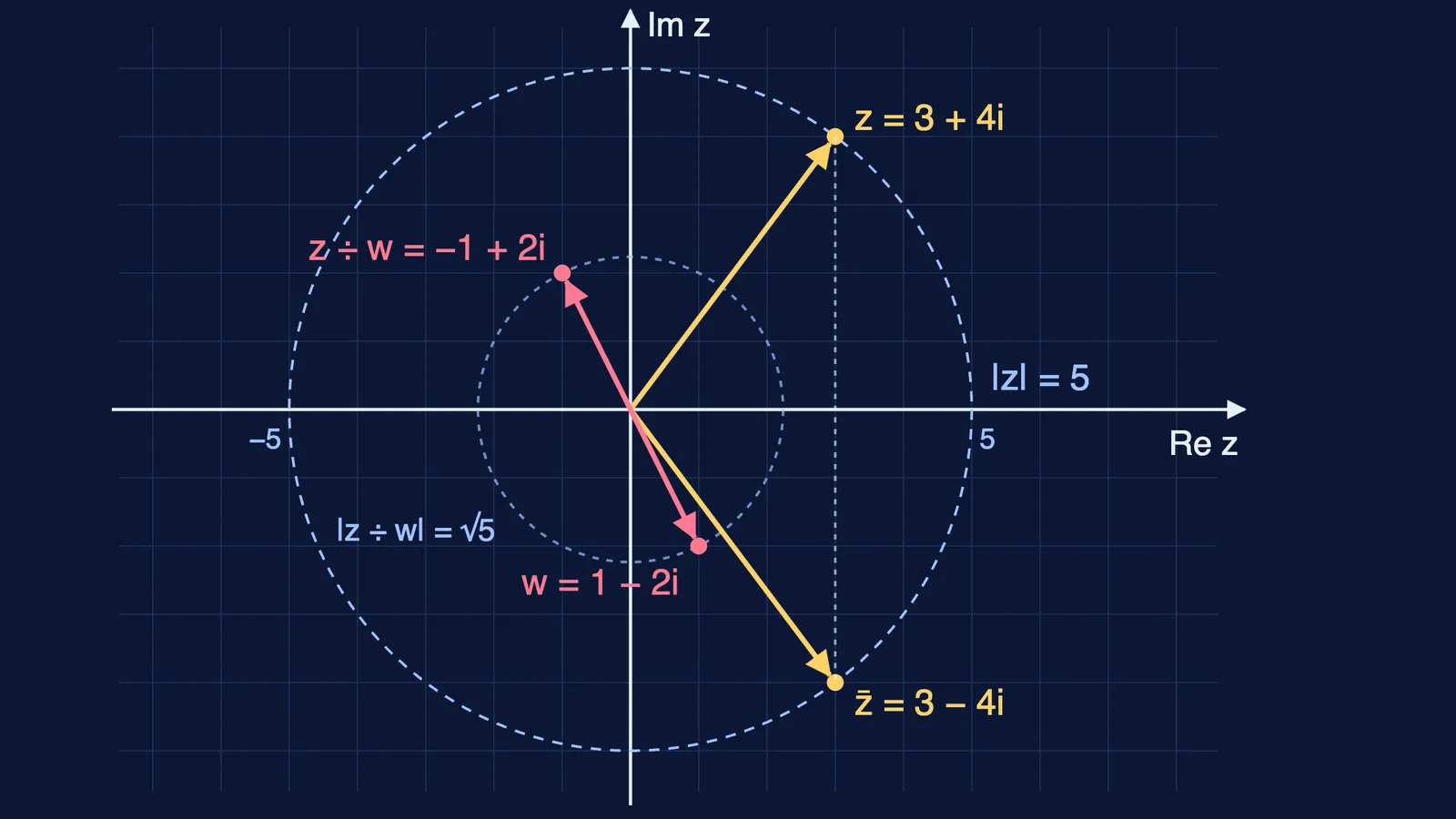
Example 1. Let z = 3 + 4i and w = 1 − 2i. Find z w, z ÷ w and their moduli.
z w = 3 − 6i + 4i − 8i² = 3 + 8 − 2i = 11 − 2i.
z ÷ w = (3 + 4i)(1 + 2i) ÷ ((1 − 2i)(1 + 2i)) = (3 + 6i + 4i + 8i²) ÷ 5 = (−5 + 10i) ÷ 5 = −1 + 2i.
Check: (−1 + 2i)(1 − 2i) = −1 + 2i + 2i − 4i² = 3 + 4i. Correct.
|z| = 5 and |w| = √5, so |z ÷ w| = √5; indeed |−1 + 2i| = √(1 + 4) = √5.
The diagram at the top plots these points: z and z̄ = 3 − 4i are mirror images on the circle of radius 5.
Example 2. Find real x and y if (x + iy)(2 − i) = 7 + 4i.
Expand: 2x − ix + 2iy − i²y = (2x + y) + i(2y − x).
Equate parts: 2x + y = 7 and 2y − x = 4.
From the first, y = 7 − 2x. Substitute: 14 − 4x − x = 4, so x = 2 and y = 3.
Check: (2 + 3i)(2 − i) = 4 − 2i + 6i − 3i² = 7 + 4i. Correct.
Both examples were checked by hand and in Python.
Practice questions for the school exam
The mark labels are our suggestion, not CBSE's; CBSE publishes no per-chapter split for Class 11.
(1 mark) Write i¹⁰³ in the form a + ib.
(2 marks) Find the multiplicative inverse of 1 + 3i.
(2 marks) Express (2 + i) ÷ (1 − i) in the form a + ib.
(3 marks) Find real x and y if (x + iy)(1 + 2i) = 1 + 7i.
(3 marks) For z = 2 − i, show z z̄ = |z|², plot z and z̄, and find the distance between them.
Answers: 1. −i. 2. (1 − 3i) ÷ 10. 3. (1 + 3i) ÷ 2. 4. x = 3, y = 1. 5. z z̄ = 5 = |z|², and the distance is 2.
How should you revise this chapter?
Do one division and one powers-of-i question daily for a week, and after dividing, multiply back to check. Plot answers on rough axes; sign errors show up fast. When a step keeps going wrong, Fermi's AI tutor works out what you already know and builds a plan for the session.
Preparing for JEE Main as well? Our complex numbers guide for JEE goes further, into rotations and loci.