On this page
Binomial Theorem is Chapter 7 of the current NCERT Class 11 Mathematics textbook, marked Reprint 2026-27. This guide covers what the CBSE 2026-27 curriculum keeps, how the marks work, worked examples and practice questions.
Preparing for JEE Main too? Our binomial theorem guide for JEE covers general-term and middle-term questions; this post sticks to the CBSE paper.
What is in the Binomial Theorem chapter for 2026-27?
The CBSE 2026-27 Mathematics curriculum lists the chapter as: historical perspective, statement and proof of the binomial theorem for positive integral indices, Pascal's triangle and simple applications.
The rationalised NCERT chapter matches that list:
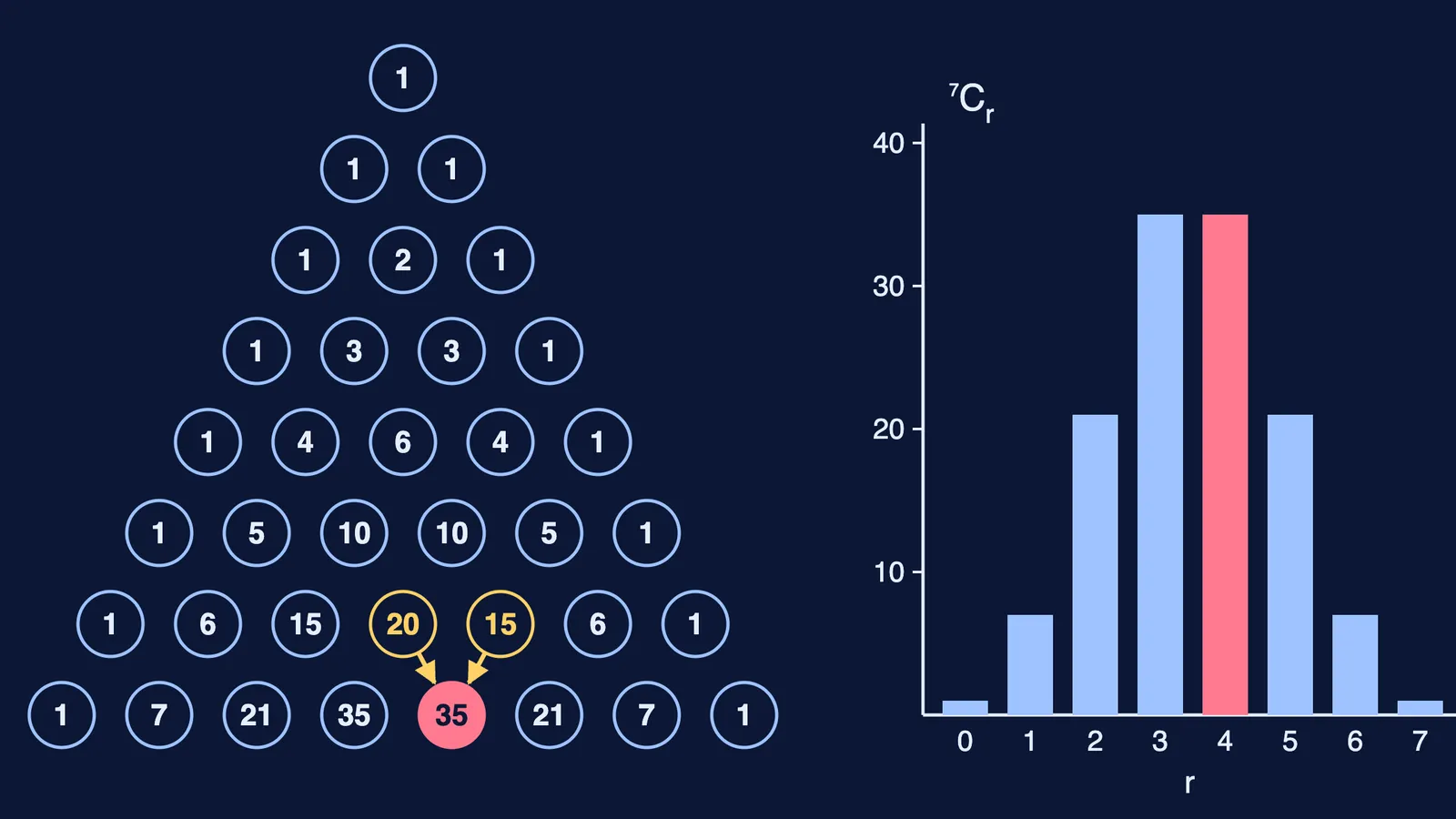
Pascal's triangle. Each row starts and ends with 1, and every inside number is the sum of the two above it. NCERT adds that Pingla's Meru Prastara is an older name for the same array.
The theorem. When n is a positive integer, (a + b)ⁿ = ⁿC₀aⁿ + ⁿC₁aⁿ⁻¹b + ⁿC₂aⁿ⁻²b² + ... + ⁿCₙbⁿ.
Observations. There are n + 1 terms, and the powers of a and b in every term add up to n.
Special cases. (x − y)ⁿ gives alternating signs, and putting x = 1 in (1 + x)ⁿ gives ⁿC₀ + ⁿC₁ + ... + ⁿCₙ = 2ⁿ.
Applications. Evaluating powers, comparing large numbers, and remainder proofs.
NCERT proves the theorem by mathematical induction, using ᵏCᵣ + ᵏCᵣ₋₁ = ᵏ⁺¹Cᵣ (the diagram above shows 20 + 15 = 35). Revise ⁿCᵣ from Permutations and Combinations first, and for the triangle's history read about Yang Hui's triangle.
How many marks does Binomial Theorem carry in Class 11?
The curriculum gives marks per unit, not per chapter. Binomial Theorem sits in Unit II, Algebra, which carries 25 of the 80 theory marks, with 20 more for internal assessment (CBSE curriculum, Class XI course structure). Those 25 marks are shared with Complex Numbers and Quadratic Equations, Linear Inequalities, Permutations and Combinations, and Sequence and Series. Under the table the curriculum adds: "No chapter/unit-wise weightage. Care to be taken to cover all the chapters."
So no official figure exists for this chapter alone.
How do you expand (a + b)ⁿ step by step?
Our own numbers, checked by program. Mark splits are our suggestion, not CBSE's.
Example 1. Expand (3x − 2)⁴.
Row 4 of Pascal's triangle: 1, 4, 6, 4, 1. Signs alternate because the second term is negative. [1 mark]
Write the terms: (3x)⁴ − 4(3x)³(2) + 6(3x)²(2)² − 4(3x)(2)³ + 2⁴. [1 mark]
Simplify: 81x⁴ − 216x³ + 216x² − 96x + 16. [1 mark]
Check with x = 1: both sides equal 1.
Example 2. Evaluate (97)⁴.
Write 97 = 100 − 3. [1 mark]
Expand: 100⁴ − 4(100³)(3) + 6(100²)(9) − 4(100)(27) + 81. [1 mark]
Add: 100000000 − 12000000 + 540000 − 10800 + 81 = 88529281. [1 mark]
Example 3. Which is larger, (1.02)⁵⁰⁰ or 10?
Write 1.02 = 1 + 0.02. The first two terms of the expansion are 1 + 500 × 0.02 = 11, and every other term is positive. So (1.02)⁵⁰⁰ > 11 > 10.
What questions can you practise for the school exam?
We wrote these ourselves. Mark labels are our suggestion; your school may differ.
How many terms are there in the expansion of (x + 2y)⁹? [1 mark]
Find the sum ⁷C₀ + ⁷C₁ + ... + ⁷C₇. [1 mark]
Expand (x/2 + 2)⁴. [2 marks]
Using the binomial theorem, show that (1.03)²⁰⁰ > 7. [3 marks]
Using the binomial theorem, show that 11¹⁰ − 1 is divisible by 100. [3 marks]
Using the binomial theorem, show that 5²ⁿ − 1 is divisible by 24 for every positive integer n. Hence find the remainder when 5⁴⁰ is divided by 24. [5 marks]
Answers: 1) 10. 2) 2⁷ = 128. 3) x⁴/16 + x³ + 6x² + 16x + 16. 4) The first two terms give 1 + 200 × 0.03 = 7, and the rest are positive. 5) 11¹⁰ − 1 = (1 + 10)¹⁰ − 1 = 10·10 + 45·10² + ..., and every term is a multiple of 100. 6) 5²ⁿ − 1 = 25ⁿ − 1 = (1 + 24)ⁿ − 1 = 24(n + ⁿC₂·24 + ... + 24ⁿ⁻¹), a multiple of 24. Since 5⁴⁰ = 25²⁰, the remainder is 1.
How should you revise it before a test?
Write Pascal's triangle to row 7 from memory.
Do one expansion with a negative term and one with a fraction; check each with x = 1.
Practise one evaluation like (97)⁴ and one remainder proof.
If you get stuck on where to begin, Fermi's AI tutor can work out what you already know and build a plan for the session, so you start with a clear next step.