

On this page
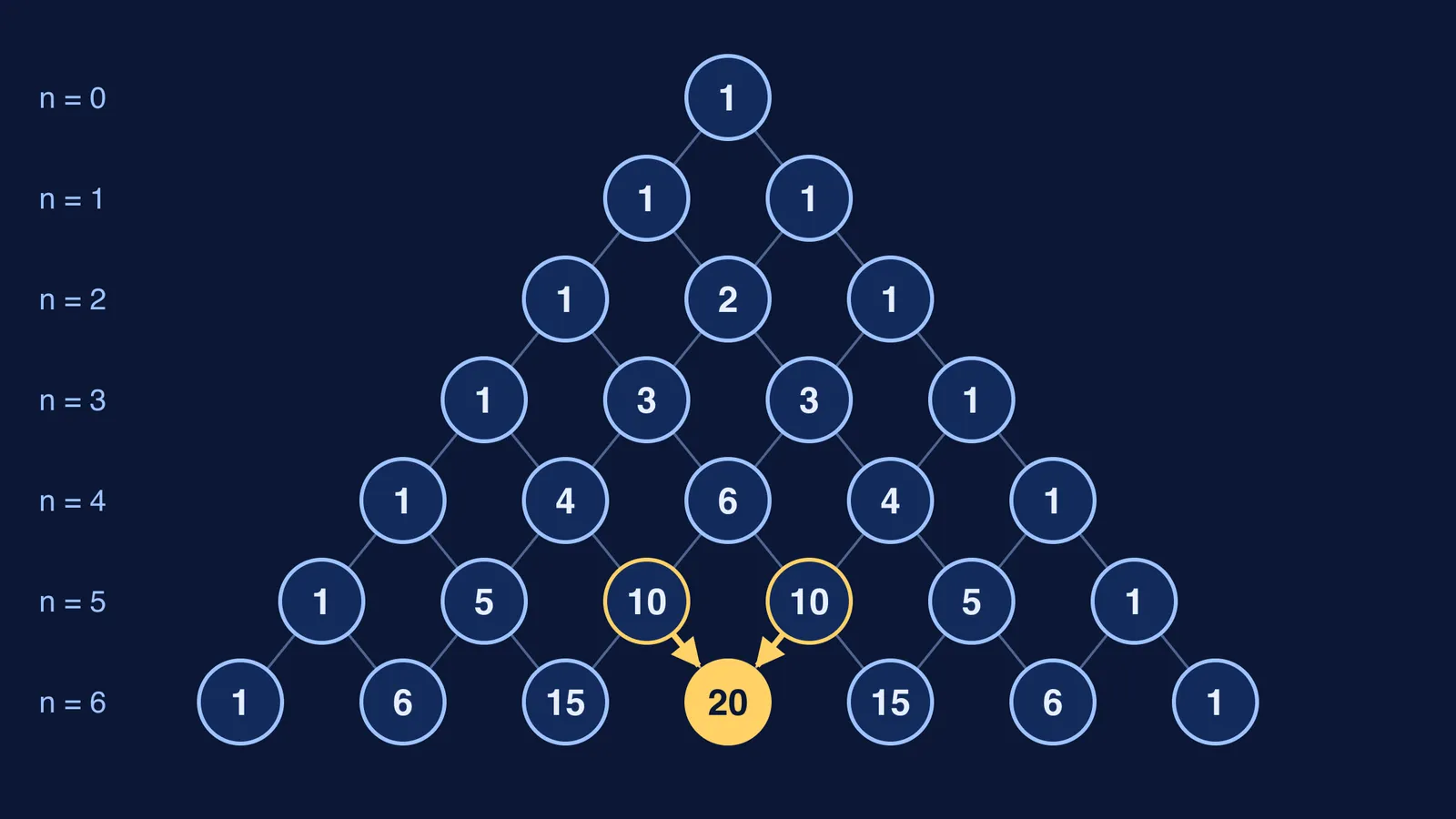
When you write the coefficients of (a + b)⁶ as 1, 6, 15, 20, 15, 6, 1, you are reading a row that Chinese mathematicians wrote down centuries before Blaise Pascal was born. In China the table is known as Yang Hui's triangle, after the man who printed it in 1261. Yang Hui was also careful to say that the idea was not his.
Who was Yang Hui, and what did he print in 1261?
Yang Hui was born about 1238 in Qiantang, now Hangzhou, and died about 1298, according to the MacTutor biography of Yang Hui from the University of St Andrews. In 1261 he wrote the Xiangjie jiuzhang suanfa, a detailed analysis of the rules in the classic Nine Chapters on the Mathematical Art.
In that book he gives what we now call Pascal's triangle, up to the sixth row, and says he learnt it from the treatise of Jia Xian (MacTutor).
Who was Jia Xian, the mathematician Yang Hui credited?
Jia Xian lived about 1010 to 1070, and his books are lost, says the MacTutor biography of Jia Xian. He appears to have worked out the binomial coefficients up to n = 6, with a table that ends in the row 1 6 15 20 15 6 1.
We know this mostly because Yang Hui's book survived and Jia Xian's did not. Yang Hui wrote to explain Jia Xian's work and make it better known, and a copy of his text has survived (MacTutor). Giving credit was not only polite. It is the reason we can trace the triangle back another two centuries.
Why is it called Pascal's triangle?
Blaise Pascal's Treatise on the Arithmetical Triangle was printed in 1654 and published in Paris in 1665, after his death, according to the notes to Richard Pulskamp's English translation. That is 393 years after Yang Hui's book.
Pascal was not the first to study the triangle, but his treatise was the most important work on it, and through John Wallis it led Isaac Newton to the general binomial theorem (MacTutor biography of Pascal). Other traditions had their own versions too: read how Halayudha described the Meru Prastara, and how Al-Karaji built a binomial table in Baghdad.
What did Jia Xian use the triangle for?
Jia Xian's other contribution was an algorithm for extracting roots that uses the triangle. He generalised a method for square and cube roots to higher roots, and his additive-multiplicative method is essentially what is now called the Ruffini-Horner method (MacTutor). The examples below are a simplified modern sketch of the idea, not his exact procedure: read a row of the triangle as a recipe.
Square root of 1764, using row 2 (1 2 1), which says (a + b)² = a² + 2ab + b²:
Take a = 40, since 40² = 1600 is the biggest square of tens that fits.
What is left is 1764 − 1600 = 164.
You need 2ab + b² = 80b + b² = 164. Try b = 2: 160 + 4 = 164.
So √1764 = 42.
Cube root of 12167, using row 3 (1 3 3 1), which says (a + b)³ = a³ + 3a²b + 3ab² + b³:
Take a = 20, since 20³ = 8000 fits and 30³ = 27000 does not.
What is left is 12167 − 8000 = 4167.
You need 3a²b + 3ab² + b³ = 1200b + 60b² + b³ = 4167. Try b = 3: 3600 + 540 + 27 = 4167.
So the cube root of 12167 is 23.
A fourth root works the same way with row 4, and a sixth root with row 6.
How to use Yang Hui's triangle in Class 11 and JEE
The same rows answer binomial theorem questions without any factorials. Try this short drill:
Write rows 0 to 6 from memory, using only the add-the-two-above rule. Check that row 6 sums to 2⁶ = 64.
Read the coefficient of x³ in (1 + x)⁶ straight off row 6: it is 20, the same as 6C3.
Build row 7 from row 6: 1, 7, 21, 35, 35, 21, 7, 1. Then check that 7C3 = 35.
Notice that each row reads the same forwards and backwards. That is nCr = nC(n − r), one of the identities in our post on the properties of nCr and Pascal's rule.
If you can expand (a + b)ⁿ but are not sure why the coefficients count combinations, the Fermi Concept Library gives each mathematics concept its own lesson and its place in the map. When a binomial question goes wrong partway through, the Fermi Problem Library has worked problems with a step-by-step solver that explains the reasoning rather than printing an answer.
Next time you write 1 4 6 4 1, you could say Jia Xian's name along with Pascal's, the way Yang Hui did in 1261.


