On this page
Structure of Atom is Unit 2 of CBSE Class 11 Chemistry. This guide covers what the school exam asks, with solved examples and board-style questions.
How many marks is Structure of Atom in CBSE Class 11?
The CBSE Chemistry curriculum for 2026-27 gives Unit 2, Structure of Atom, 9 of the 70 theory marks. That figure has its own row in the marks table; it is not shared.
It lists six topics, from the discovery of sub-atomic particles and atomic models through Bohr's model for hydrogen to the quantum mechanical model. Its question paper design puts 40% of marks on remembering and understanding, 30% on applying, and 30% on analysing, evaluating and creating, so expect numericals and reasoning, not only definitions.
The current NCERT Chemistry Part I chapter (Reprint 2026-27) covers all six in sections 2.1 to 2.6. The curriculum's note on topics assessed only formatively names s and p block elements and the gaseous state, not this unit, so prepare the whole chapter.
Which formulas and rules do you need?
In the NCERT chapter's notation:
Photoelectric effect. hν = hν₀ + ½ mₑv², where hν₀ is the work function.
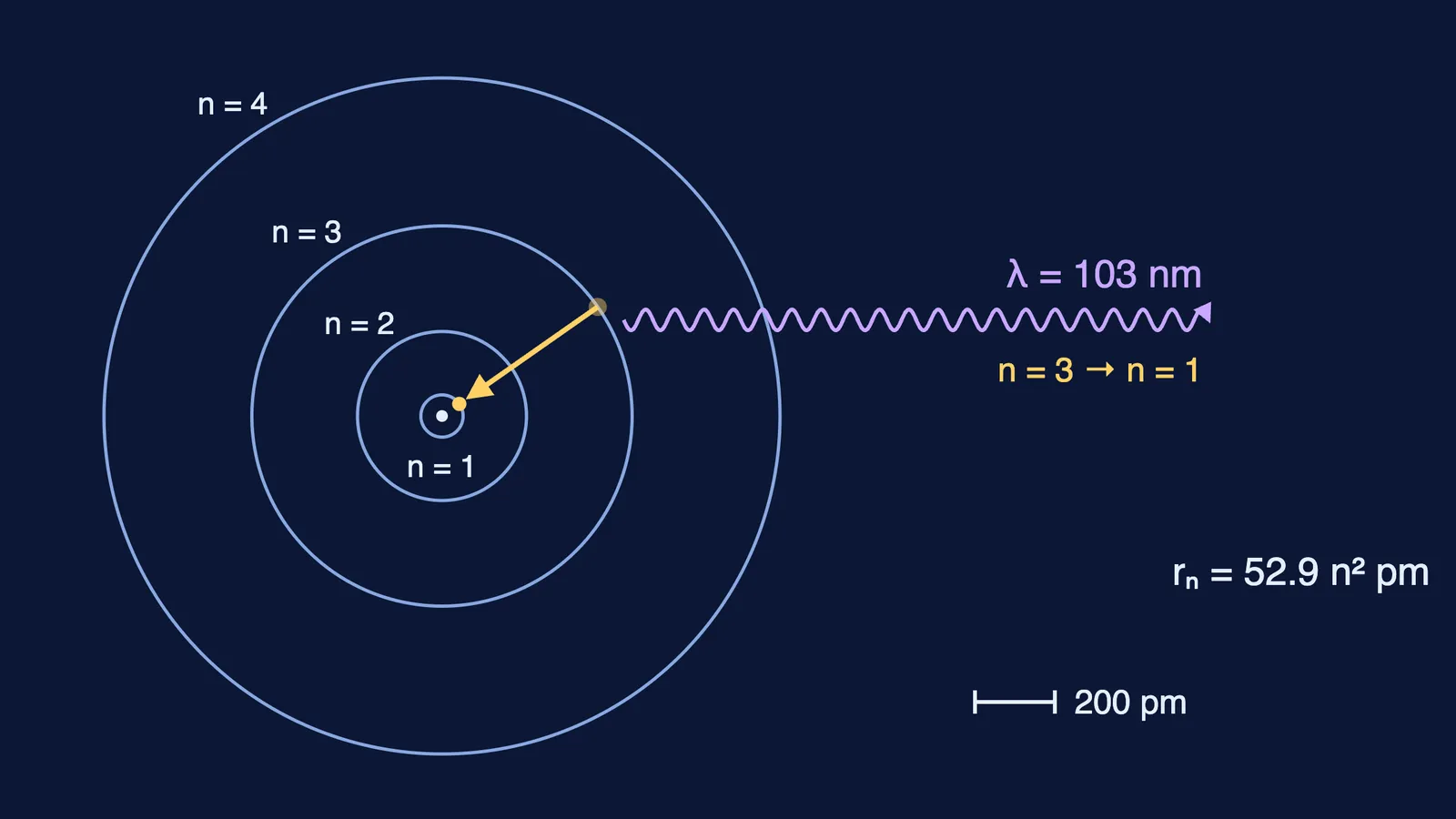
Bohr radius. rₙ = 52.9 n²/Z pm.
Bohr energy. Eₙ = –2.18 × 10⁻¹⁸ (Z²/n²) J. The minus sign means the electron is bound.
Hydrogen lines. ΔE = 2.18 × 10⁻¹⁸ J (1/nᵢ² – 1/n_f²), and the wavenumber is 1.09677 × 10⁷ (1/nᵢ² – 1/n_f²) m⁻¹ in magnitude. Lines ending at n = 2 form the Balmer series, in the visible region.
Dual behaviour. de Broglie: λ = h/mv. Heisenberg: Δx × Δp ≥ h/4π.
Quantum numbers. For a given n, l runs from 0 to n – 1; mₗ takes (2l + 1) values from –l to +l; mₛ is +½ or –½. An orbital has n – l – 1 radial nodes and l angular nodes.
Filling rules. Aufbau by the (n + l) rule (lower n + l first; if equal, lower n first), Pauli exclusion and Hund's rule. Cr is 3d⁵4s¹ and Cu 3d¹⁰4s¹: half-filled and full subshells are extra stable (symmetry, exchange energy).
How do you solve Structure of Atom numericals?
Our own numbers, with h = 6.626 × 10⁻³⁴ J s, c = 3.0 × 10⁸ m s⁻¹ and mₑ = 9.1 × 10⁻³¹ kg.
1. Be³⁺ in the n = 3 state. Z = 4. r₃ = 52.9 × 9/4 = 119 pm. E₃ = –2.18 × 10⁻¹⁸ × 16/9 = –3.88 × 10⁻¹⁸ J.
2. Hydrogen, n = 3 → n = 1 (the diagram). ΔE = 2.18 × 10⁻¹⁸ J × (1/9 – 1/1) = –1.94 × 10⁻¹⁸ J; the minus sign means energy is emitted. ν = 1.94 × 10⁻¹⁸ / 6.626 × 10⁻³⁴ = 2.92 × 10¹⁵ Hz, so λ = c/ν = 103 nm: ultraviolet, in the Lyman series.
3. Photoelectric effect. 250 nm light falls on a metal with ν₀ = 5.0 × 10¹⁴ Hz. hc/λ = 7.95 × 10⁻¹⁹ J and hν₀ = 3.31 × 10⁻¹⁹ J, leaving kinetic energy 4.64 × 10⁻¹⁹ J, so v = √(2 × 4.64 × 10⁻¹⁹ / 9.1 × 10⁻³¹) = 1.0 × 10⁶ m s⁻¹.
What board-style questions can you practise?
We wrote these. The mark labels are our suggestion, not CBSE's.
(1 mark) Is the set n = 2, l = 2, mₗ = 0 allowed? *No: l can be at most n – 1 = 1.*
(2 marks) Write the electronic configuration of the Cu⁺ ion (Z = 29) and give its number of unpaired electrons. *Cu is [Ar]3d¹⁰4s¹; losing the 4s electron leaves [Ar]3d¹⁰, with no unpaired electrons.*
(2 marks) How many radial and angular nodes does a 5f orbital have? *5 – 3 – 1 = 1 radial node and 3 angular nodes.*
(3 marks) Find the energy needed to remove the electron from a hydrogen atom in the n = 3 state. *0 – (–2.18 × 10⁻¹⁸/9) = 2.42 × 10⁻¹⁹ J.*
(3 marks) Find the wavelength of the hydrogen line for n = 6 → n = 2 and name its series. *Wavenumber 1.09677 × 10⁷ × (1/4 – 1/36) = 2.44 × 10⁶ m⁻¹, so λ = 410 nm, in the Balmer series (visible).*
(5 marks) State two limitations of Bohr's model and explain how dual behaviour and the uncertainty principle led to the quantum mechanical model.
How should you revise Structure of Atom for the school exam?
Write the seven results from a blank page in one session; spend a second on mixed numericals, labelling each lost mark as wrong unit, sign or formula.
If you also sit JEE Main, our Structure of Atom for JEE Main guide adds de Broglie and uncertainty numericals. Class 12 Physics returns to Bohr's model; see Atoms for the board exam.
If you are not sure where to start, Fermi's AI tutor can work out what you already know and build a plan for the session.