On this page
Board questions on Atoms are predictable: a postulate stated, a derivation in clean steps, an energy level read correctly. Here is how to prepare.
What is in the Atoms chapter for the 2026-27 board exam?
On page 12 of the CBSE Class XII Physics curriculum 2026-27, the marks table prints one cell, "12", across Unit–VII Dual Nature of Radiation and Matter and Unit–VIII Atoms and Nuclei. These three chapters share 12 of 70 theory marks. For Atoms it lists alpha-particle scattering, Rutherford's model, the Bohr model with the radius, velocity and energy in the nth orbit, and hydrogen line spectra, "qualitative treatment only".
Your textbook is NCERT Chapter 12, Atoms (Reprint 2026-27):
Alpha scattering. Roughly 0.14% of alpha particles turn through more than 1°, and roughly 1 in 8000 through more than 90°. Example 12.2 sets kinetic energy equal to potential energy at the turning point: d = 2Ze²/(4πε₀K).
Bohr's postulates. Non-radiating stable orbits; L = nh/2π; hν = Ei − Ef on a jump down.
Radius and energy. Coulomb force supplies the centripetal force, then mvr = nh/2π. This gives rn ∝ n² and En = −13.6/n² eV, with K = −E and U = 2E.
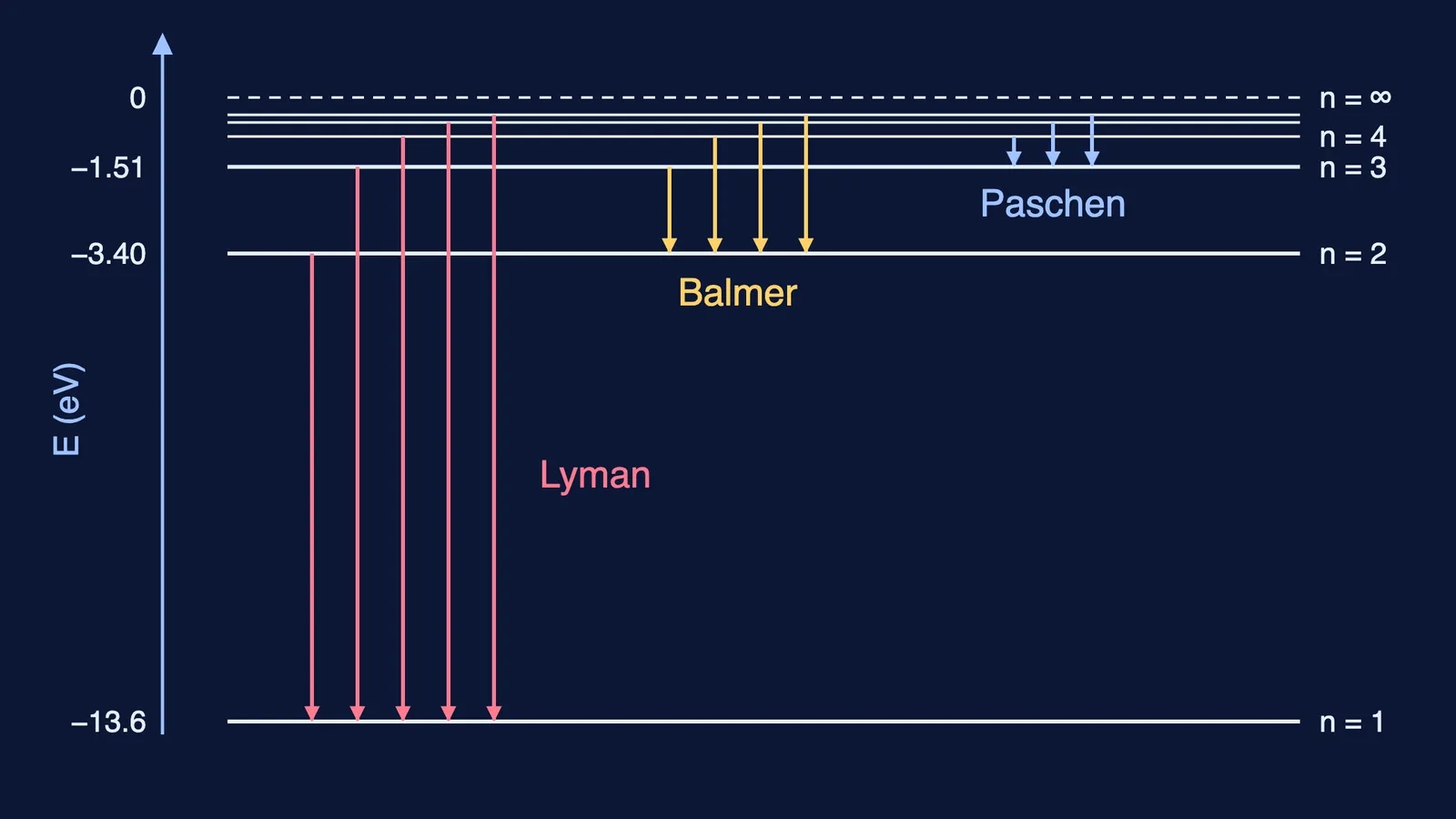
Spectral series. Fig. 12.5 labels the Lyman, Balmer and Paschen series. Know emission versus absorption; spectra are qualitative here.
de Broglie. A standing wave fits the orbit when 2πrn = nλ; with λ = h/mv this gives mvr = nh/2π.
Limits. One-electron atoms only, and no explanation of why some lines are brighter.
Harder numericals are in our Atoms and Nuclei for JEE Main guide.
How should you set out 2-, 3- and 5-mark answers?
The CBSE 2026-27 sample paper has 16 one-mark questions (four assertion-reason), five 2-mark, seven 3-mark, two 4-mark case studies and three 5-mark long answers. Calculators are not allowed.
2 marks. Question 21(B) asks for Bohr's quantisation condition and de Broglie's explanation. The marking scheme gives one mark for mvr = nh/2π, one for 2πr = nλ leading back to it.
3 marks. For the radius derivation, write three lines: force balance, quantisation, then eliminate v. Box the result.
5 marks. All three sample long answers come in parts (2 + 2 + 1 or 3 + 2). Number yours; draw a labelled level diagram: −13.6 eV at n = 1, 0 eV at n = ∞.
For step marks, follow how to write numericals in board exams.
A Bohr-model numerical, done twice
Question (3 marks). In hydrogen, E1 = −13.6 eV and r1 = 5.3 × 10⁻¹¹ m (NCERT values). For n = 2, find (a) the radius, (b) total, kinetic and potential energy, (c) energy to ionise it.
First pass, by scaling:
rn = n²r1, so r2 = 4 × 5.3 × 10⁻¹¹ = 2.12 × 10⁻¹⁰ m.
E2 = −13.6/4 = −3.4 eV; K = −E = +3.4 eV; U = 2E = −6.8 eV.
Ionisation needs 0 − (−3.4) = 3.4 eV.
Second pass, independent, from E = −e²/(8πε₀r):
e²/(4πε₀) = 9 × 10⁹ × (1.6 × 10⁻¹⁹)² = 2.304 × 10⁻²⁸ J m.
Divide by 2r2 = 4.24 × 10⁻¹⁰ m: 2.304/4.24 ≈ 0.543, so |E2| ≈ 5.43 × 10⁻¹⁹ J.
5.43/1.6 ≈ 3.4, so E2 ≈ −3.4 eV. It matches.
A final check: NCERT gives 10.2 eV to go from n = 1 to n = 2, and 10.2 + 3.4 = 13.6 eV.
Which assertion-reason and case-study traps cost marks?
True, but not the reason. In sample paper Question 13, the assertion (most alpha particles go straight through) and the reason (electrons are too light to deflect them) are both true, yet the answer is B: the reason is that the atom is mostly empty space.
Scale. Question 11 scales a nucleus to a 22 cm football; the atom is about 10⁵ times larger, so the orbit is about 22 km.
Orbit frequency is not line frequency. NCERT notes the line's frequency is the energy difference divided by h.
Arrow direction. Emission goes down, absorption up, and gaps shrink as n rises.
Case studies. Neither sample case study is on Atoms; one covers the photoelectric effect, from the same marks cell. Note the given values first.
If level jumps are hard to picture, the Fermi Simulation Lab has interactive simulations for the ideas that are easier to see than to read.
A seven-day revision plan for Atoms
Day 1: NCERT 12.1 to 12.3; explain scattering aloud.
Day 2: Example 12.2, then redo it without the book.
Day 3: the postulates and radius derivation, six minutes, timed.
Day 4: the energy derivation and level diagram from memory.
Day 5: de Broglie's explanation and the model's limits.
Day 6: NCERT exercises 12.3 to 12.7, set out as above.
Day 7: sample Questions 11, 13 and 21, then the marking scheme.
When a numerical goes wrong, the Fermi Problem Library has worked problems with a step-by-step solver that explains the reasoning rather than printing an answer.