On this page
Redox Reactions teaches you to track electrons, a skill you will need again in Class 12 electrochemistry. This guide is for the CBSE Class 11 school exam: what the 2026-27 curriculum lists, oxidation numbers, one reaction balanced by both methods, and practice questions.
How many marks is Redox Reactions in CBSE Class 11 for 2026-27?
The CBSE Chemistry curriculum for 2026-27 gives Unit 7, Redox Reactions, 4 marks out of 70 in the Class 11 theory paper. It is the lightest unit in the Class 11 table.
It lists four topics: the classical idea of redox, electron transfer, oxidation number, and electrode processes. The chapter sits in the rationalised NCERT Chemistry Part II, Unit 7 (Reprint 2026-27). Preparing for engineering entrances too? The Redox Reactions for JEE Main guide covers that exam.
How do you find oxidation numbers?
In NCERT's chapter, oxidation is an increase in oxidation number and reduction is a decrease. The key rules:
An element in its free state has oxidation number 0.
For a monatomic ion, the oxidation number equals its charge.
Oxygen is usually −2. It is −1 in peroxides, and it is positive when bonded to fluorine.
Hydrogen is +1, except in binary metal hydrides such as CaH₂, where it is −1.
The oxidation numbers in a neutral compound add up to zero. In an ion, they add up to the charge.
Four examples we wrote:
NH₂OH: x + 3(+1) + (−2) = 0, so N = −1.
H₃PO₃: 3(+1) + x + 3(−2) = 0, so P = +3.
VO₂⁺: x + 2(−2) = +1, so V = +5.
C₃H₈: 3x + 8(+1) = 0, so the average for C is −8/3.
How do you balance a redox equation by the oxidation-number method?
Take dichromate and tin(II) in acid: Cr₂O₇²⁻ + Sn²⁺ → Cr³⁺ + Sn⁴⁺ (unbalanced).
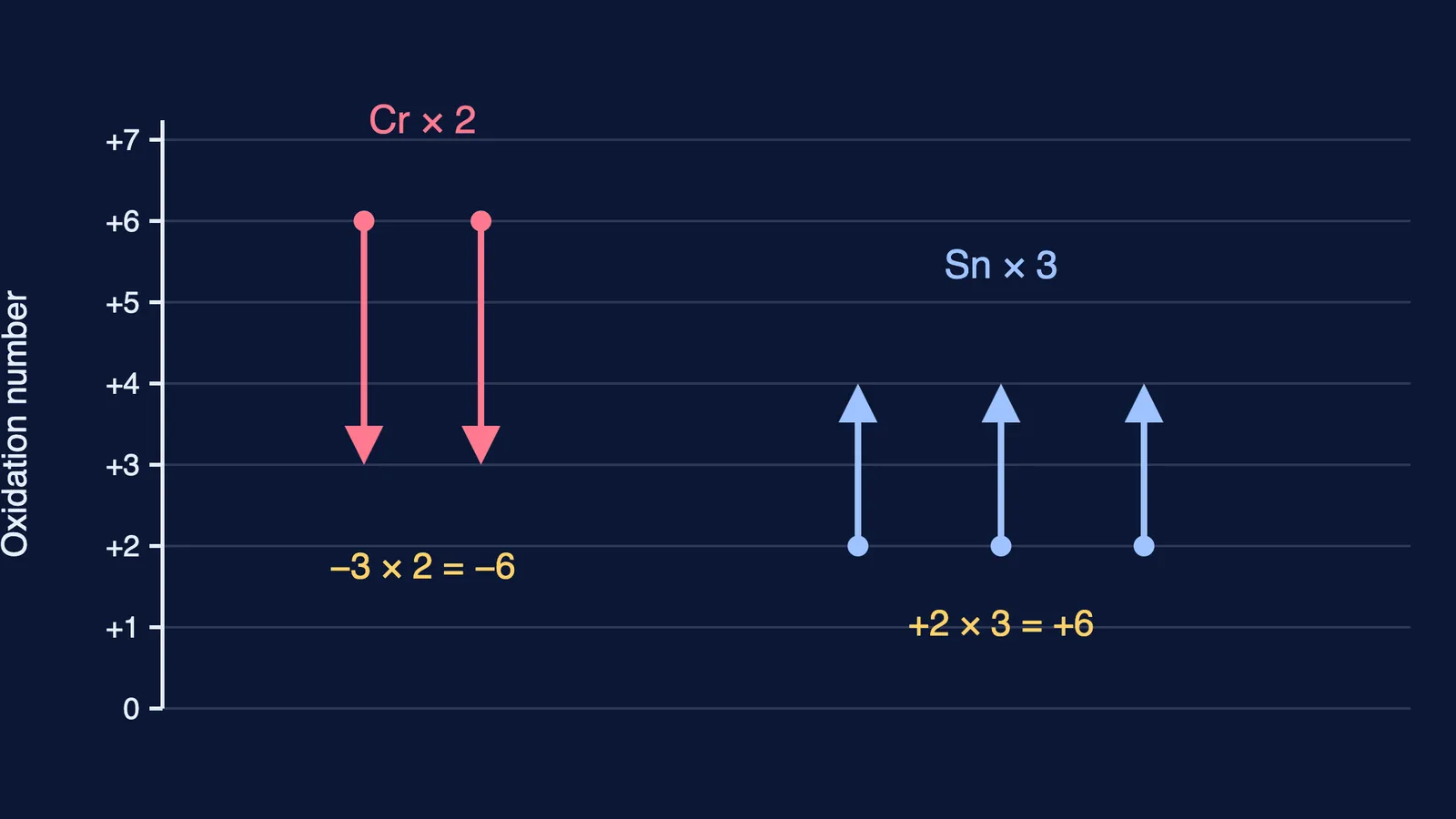
Assign oxidation numbers. Cr goes from +6 to +3, a fall of 3 per atom, and each Cr₂O₇²⁻ has two, so it falls by 6. Sn goes from +2 to +4, a rise of 2.
Make the total fall equal the total rise. One Cr₂O₇²⁻ falls by 6 and three Sn²⁺ rise by 6. This gives Cr₂O₇²⁻ + 3Sn²⁺ → 2Cr³⁺ + 3Sn⁴⁺.
Balance the charge. The left side has +4 and the right side has +18, so add 14H⁺ on the left.
Balance the hydrogen with water. Fourteen H on the left means 7H₂O goes on the right.
The result is Cr₂O₇²⁻ + 3Sn²⁺ + 14H⁺ → 2Cr³⁺ + 3Sn⁴⁺ + 7H₂O. Check: 7 O atoms, 14 H atoms and charge +18 on each side. Cr₂O₇²⁻ is the oxidising agent and Sn²⁺ is the reducing agent.
How does the ion-electron method give the same answer?
Balance each half-reaction in acid:
Reduction: Cr₂O₇²⁻ + 14H⁺ + 6e⁻ → 2Cr³⁺ + 7H₂O
Oxidation: Sn²⁺ → Sn⁴⁺ + 2e⁻
Multiply the oxidation by 3 so each half carries 6 electrons. Add them and cancel the electrons: the same equation appears.
In a basic medium, NCERT balances as if in acid, then adds one OH⁻ to both sides for each H⁺ and combines H⁺ and OH⁻ into water.
What else does the chapter cover?
Four types of redox reaction: combination, decomposition, displacement and disproportionation. In disproportionation, one element is oxidised and reduced in the same reaction.
Redox titrations: permanganate is its own indicator; dichromate needs diphenylamine.
Electrode processes, including redox couples such as Zn²⁺/Zn, the Daniell cell and the salt bridge. The hydrogen electrode is fixed at 0.00 V, and a more negative E° means a stronger reducing agent (NCERT Table 7.1). Our Class 12 electrochemistry board guide picks up from here.
Which practice questions should you try?
The mark labels below are our suggestion. They follow the question types in the CBSE 2026-27 Class 12 Chemistry sample paper, which uses 1, 2, 3, 4 and 5-mark questions, and your school's Class 11 paper may differ.
(1 mark) What is the oxidation number of Cl in NaClO₂? Answer: +3.
(2 marks) In SO₂ + 2H₂S → 3S + 2H₂O, name the species oxidised, the species reduced, the oxidant and the reductant. Answer: H₂S is oxidised (S goes from −2 to 0) and SO₂ is reduced (S goes from +4 to 0). SO₂ is the oxidant and H₂S is the reductant.
(2 marks) Show that 3HNO₂ → HNO₃ + 2NO + H₂O is a disproportionation reaction. Answer: N starts at +3 and goes to both +5 and +2.
(2 marks) Using NCERT's Table 7.1 (Ni²⁺/Ni −0.25 V, Cu²⁺/Cu 0.34 V), which metal is the stronger reducing agent? Answer: Ni.
(3 marks) Balance ClO⁻ + Fe(OH)₂ → Cl⁻ + Fe(OH)₃ in a basic medium. Answer: ClO⁻ + 2Fe(OH)₂ + H₂O → Cl⁻ + 2Fe(OH)₃. Charge is already −1 on each side, so only water is needed.
Not sure where to start? Fermi's AI tutor works out what you already know and builds a plan for the session, so you sit down to a clear next step.