On this page
Electrochemistry carries 9 of the 70 theory marks in the CBSE Class XII Chemistry curriculum for 2026-27, the highest of any unit. The same document says no chapter-wise weightage is provided in the question paper, so treat 9 as a guide.
This post is about board answers. For the entrance-exam version, read electrochemistry for JEE Main: how to prepare.
What is in the Class 12 electrochemistry syllabus?
The NCERT chapter Electrochemistry (lech102, Reprint 2026-27) covers what CBSE lists:
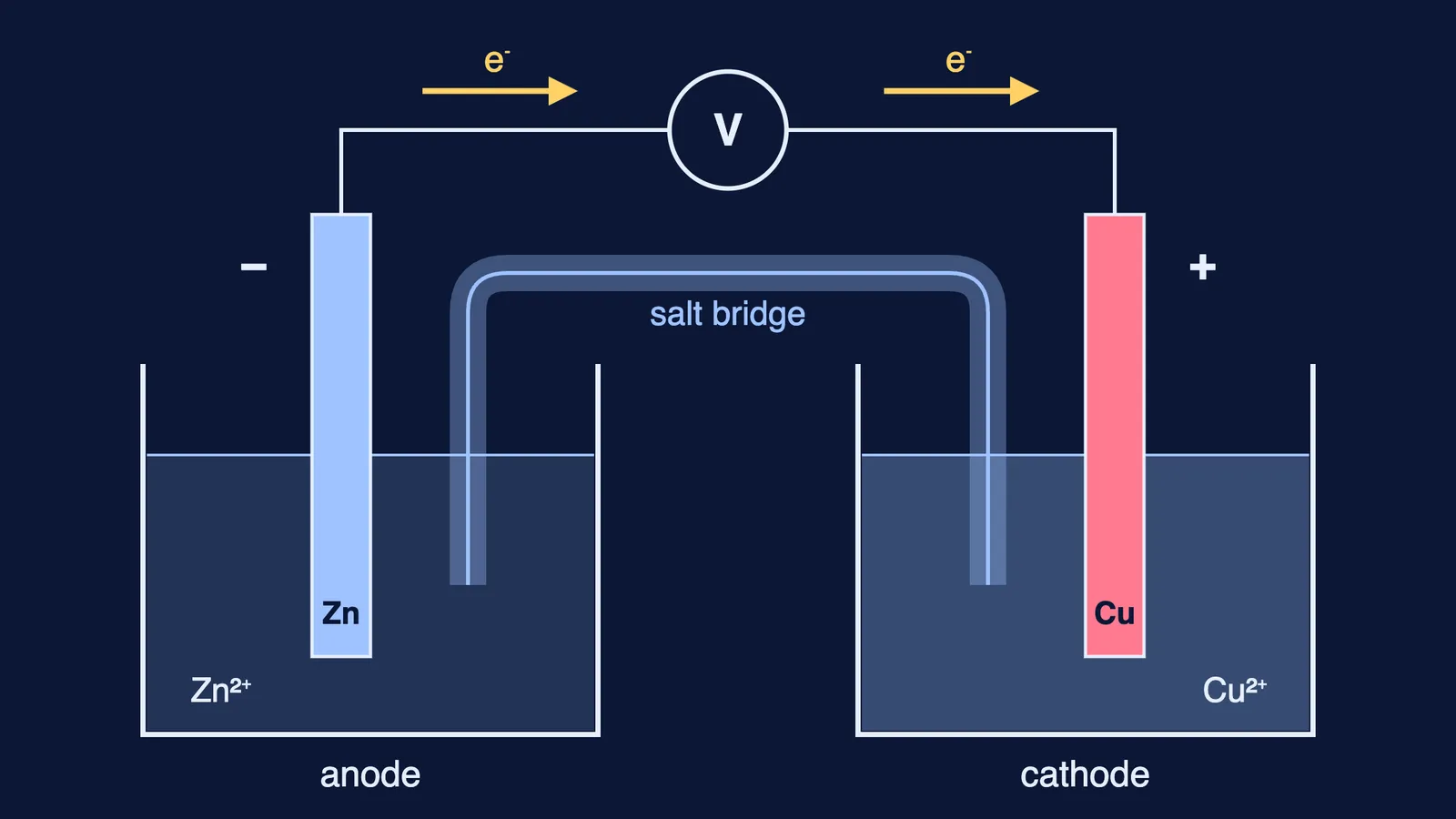
Galvanic cells: write the anode on the left. In a Daniell cell electrons flow from negative zinc to positive copper, and E° is 1.1 V.
Nernst and Gibbs energy: E(cell) = E°(cell) − (0.059/n) log Q at 298 K, and ΔrG° = −nFE°(cell).
Conductance: conductivity falls on dilution, molar conductivity rises, and Kohlrausch's law gives Λ°m for weak electrolytes.
Electrolysis: Faraday's two laws, Q = It, 1 F ≈ 96500 C mol⁻¹.
Batteries, fuel cells and corrosion: dry, mercury and lead storage cells, the H2–O2 fuel cell, and rusting as an electrochemical process.
How should you set out 2-, 3- and 5-mark answers?
The 2026-27 sample paper puts 2-mark answers in Section B, 3-mark in Section C, 4-mark case studies in Section D and 5-mark answers in Section E. Calculators and log tables are not allowed.
The marking scheme splits its Nernst calculation into half marks: equation, substitution, answer with unit, and a reason.
2 marks: a short reason, or a pair of equations. The sample corrosion question gives 1 mark for magnesium as a sacrificial anode and half a mark for each electrode reaction of molten MgCl2.
3 marks: formula, substitution with units, answer with unit and sign. For Λm = Λ°m − A√c, write one equation per concentration, subtract, solve.
5 marks: label parts (I), (II), (III) and finish each before the next. The sample long question mixes a Nernst calculation, a unit conversion and a lead storage battery fact.
More on layout: how to write CBSE Class 12 chemistry numericals, step by step.
Worked example: Nernst and ΔG°, done twice
Question: For Zn | Zn²⁺(0.2 M) || Cu²⁺(0.01 M) | Cu at 298 K, find E°(cell), ΔrG° and E(cell). Given E°(Cu²⁺/Cu) = +0.34 V, E°(Zn²⁺/Zn) = −0.76 V, F = 96500 C mol⁻¹, log 2 = 0.30.
Pass 1, the whole cell:
E°(cell) = E°(right) − E°(left) = 0.34 − (−0.76) = 1.10 V.
n = 2, so ΔrG° = −2 × 96500 × 1.10 = −212300 J mol⁻¹ = −212.3 kJ mol⁻¹.
Q = [Zn²⁺]/[Cu²⁺] = 0.2/0.01 = 20; log 20 = 1 + log 2 = 1.30.
E(cell) = 1.10 − (0.059/2) × 1.30 = 1.10 − 0.0295 × 1.30 = 1.10 − 0.038 = 1.06 V.
Pass 2, each electrode separately, as NCERT treats the Daniell cell:
Cathode: 0.34 − 0.0295 log(1/0.01) = 0.34 − 0.059 = 0.281 V.
Anode: −0.76 − 0.0295 log(1/0.2) = −0.76 − 0.0295 × 0.70 = −0.781 V, since log 5 = 1 − log 2.
E(cell) = E(right) − E(left) = 0.281 − (−0.781) = 1.062 V, which rounds to 1.06 V.
Work done: one mole of electrons through 1.10 V gives 106150 J, so two moles give 212300 J, matching ΔrG° = −212.3 kJ mol⁻¹.
Sense check: ΔrG° is negative, so the reaction is spontaneous, and E(cell) is below E°(cell) because Q is above 1.
Which assertion-reason and case-study traps cost marks?
Assertion-reason items are 1-mark questions with four fixed options. Judge A, then R, then the link. Three pairs built on NCERT facts:
A: Conductivity falls on dilution. R: Ions per unit volume fall. Both true; R explains A. The trap is answering for molar conductivity, which rises.
A: Λ°m of acetic acid cannot be found by extrapolation. R: Its Λm rises steeply at low concentration. Both true; R explains A.
A: Aqueous NaCl gives Cl2, not O2, at the anode. R: Water's oxidation has the lower E°. Both true, but R predicts the opposite; oxygen's overpotential is the reason.
The sample paper's case studies are on other units (phenols and carbohydrates), but its long electrochemistry question works like one: a table of Zn–Cu cell readings. It asks why the lowest [Zn²⁺] gives the highest EMF and why measured EMF differs from calculated; the scheme credits internal resistance. Also remember that a galvanic anode is negative but an electrolytic anode is positive, as our electrolytic vs galvanic cell explainer shows.
What is a good two-week revision plan?
Days 1-2: NCERT 2.1-2.3; draw the Daniell cell from memory.
Days 3-5: Nernst, ΔG° and Kc numericals by hand, two passes each.
Days 6-7: Conductance, the Λm against √c graph, Kohlrausch.
Days 8-9: Faraday's laws and electrode products.
Days 10-11: Battery, fuel cell and corrosion reactions until you can write them cold.
Days 12-14: The sample paper's electrochemistry questions, timed, marked against the scheme; redo every mistake.
If a numerical keeps going wrong at the method, the Fermi Problem Library has worked problems with a step-by-step solver that explains the reasoning rather than printing an answer.