On this page
Electrochemistry rewards students who calculate carefully. The usual slips are a wrong sign, a wrong n or a missing 1000, not hard ideas. Below: the syllabus, one worked problem of each type, the traps and a plan.
What does the JEE Main 2027 syllabus include in electrochemistry?
Electrochemistry sits in Unit 7, "Redox reactions and electrochemistry", of the NTA's Syllabus for JEE (Main) - 2027. The unit lists:
oxidation number and balancing redox reactions
electrolytic and metallic conduction, molar conductivity and its variation with concentration, Kohlrausch's law and its applications
electrolytic and galvanic cells, types of electrodes, standard electrode potentials, half-cell and cell reactions, emf, the Nernst equation, cell potential and Gibbs energy
dry cell, lead accumulator and fuel cells
Your textbook is Unit 2, Electrochemistry, of NCERT Class 12 Chemistry Part I. NCERT teaches Faraday's laws in its section on electrolytic cells and electrolysis, and has a section on corrosion. The NTA's Unit 7 text names neither Faraday's laws nor corrosion, though it does list electrolytic cells.
How do you calculate E°cell and ΔG for a galvanic cell?
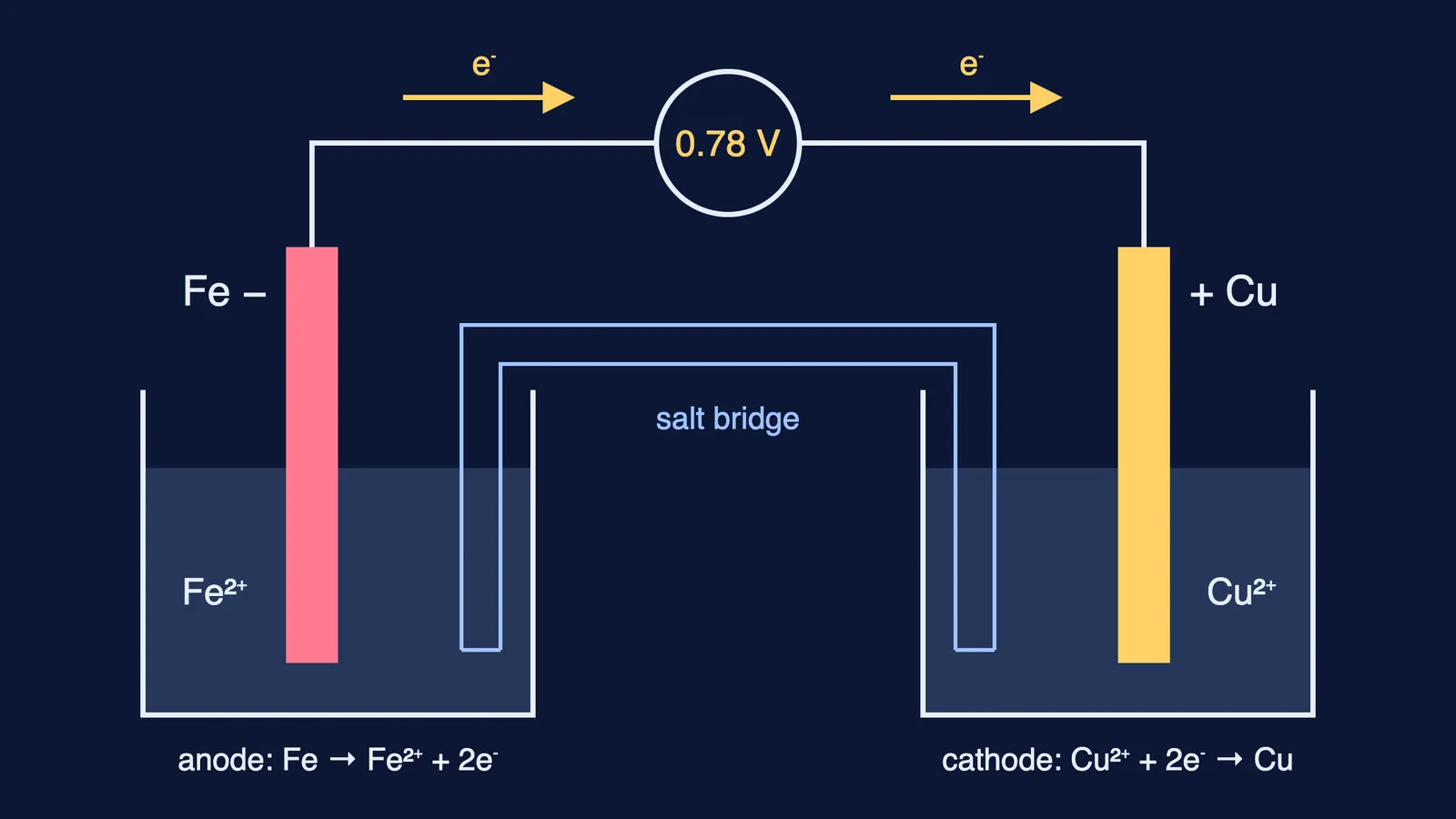
Take the cell Fe | Fe²⁺ || Cu²⁺ | Cu. From NCERT Table 2.1, E°(Cu²⁺/Cu) = +0.34 V and E°(Fe²⁺/Fe) = −0.44 V.
The higher reduction potential, copper, is the cathode; iron is the anode.
E°cell = E°cathode − E°anode = 0.34 V − (−0.44 V) = 0.78 V.
The reaction Fe + Cu²⁺ → Fe²⁺ + Cu transfers 2 electrons, so n = 2.
ΔG° = −nFE° = −2 × 96487 C mol⁻¹ × 0.78 V = −150,520 J mol⁻¹ ≈ −150.5 kJ mol⁻¹. (1 C × 1 V = 1 J).
Negative ΔG° means the reaction is spontaneous. Both potentials stay as reduction potentials; never flip a sign before subtracting. If you double the equation, E° stays 0.78 V while ΔG° doubles, as our post on why cell emf does not change when the equation is multiplied explains.
How do you apply the Nernst equation to a cell?
Run the same cell with [Fe²⁺] = 0.10 M and [Cu²⁺] = 0.0010 M at 298 K. At 298 K the Nernst equation in NCERT Unit 2 reduces to E = E° − (0.059 V/n) log Q, where Q is products over reactants, with solids left out.
Q = [Fe²⁺]/[Cu²⁺] = 0.10/0.0010 = 100, so log Q = 2.
E = 0.78 V − (0.059 V/2) × 2 = 0.78 − 0.059 = 0.721 V.
E falls because the product ion is concentrated and the reactant ion dilute. If your answer disagrees with the key, check n and Q first, as in our guide to checking a Nernst equation answer.
How do you solve conductivity and Faraday's law numericals?
Conductivity. A conductivity cell with cell constant G* = 1.20 cm⁻¹ shows a resistance of 400 Ω with a 0.050 mol L⁻¹ solution.
κ = G*/R = 1.20 cm⁻¹ / 400 Ω = 3.00 × 10⁻³ S cm⁻¹.
Λm = κ × 1000 / c = (3.00 × 10⁻³ S cm⁻¹ × 1000 cm³ L⁻¹) / 0.050 mol L⁻¹ = 60.0 S cm² mol⁻¹.
The 1000 converts litres to cm³; in SI units this is 60.0 × 10⁻⁴ S m² mol⁻¹, since 1 S cm² mol⁻¹ = 10⁻⁴ S m² mol⁻¹ (NCERT Unit 2).
Faraday's first law. A current of 2.50 A flows for 30.0 minutes through copper sulphate solution.
Q = I × t = 2.50 A × 1800 s = 4500 C. Time must be in seconds.
Moles of electrons = 4500 C / 96500 C mol⁻¹ = 0.0466 mol, using NCERT's approximate value of F.
Cu²⁺ + 2e⁻ → Cu, so moles of Cu = 0.0233 mol, and mass = 0.0233 × 63.5 g mol⁻¹ ≈ 1.48 g.
For the electrochemical-equivalent version, see our Faraday's law numerical for copper and silver.
Which electrochemistry mistakes should you avoid?
Flipping the anode's sign and then subtracting it again.
Using n from one half-reaction when the balanced equation transfers a different number of electrons.
Writing Q as reactants over products, or including solid electrodes in Q.
Dropping the 1000 in Λm, or mixing S cm² mol⁻¹ and S m² mol⁻¹.
Using minutes instead of seconds in Q = It.
How should you plan electrochemistry practice?
Day 1: read NCERT Unit 2 and write the five formulas from memory: E°cell, Nernst, ΔG° = −nFE°, Λm = κ × 1000/c, Q = It.
Day 2: ten E°cell and ΔG° problems from Table 2.1.
Day 3: Nernst problems; predict whether E rises or falls before calculating.
Day 4: conductivity and Kohlrausch's law, writing units on every line.
Day 5: Faraday's laws, plus dry cell, lead accumulator and fuel cell reactions.
Day 6: a timed mixed set; sort every error into the traps above.
When a mistake comes from the wrong method rather than arithmetic, the Fermi Problem Library has worked problems with a step-by-step solver that explains the reasoning rather than printing an answer.