On this page
You paste a Nernst equation numerical into a chatbot and get a tidy answer to three decimal places. Neat layout is not evidence. Wrong answers usually go wrong in one of three places: the value of n, the way Q is written, or the sign in front of log Q. A fourth test tells you whether the EMF should have gone up or down at all.
What does the Nernst equation actually say?
For a general cell reaction aA + bB → cC + dD, NCERT writes the Nernst equation as Ecell = E°cell − (RT/nF) ln Q, where Q = [C]^c[D]^d / [A]^a[B]^b (NCERT Class 12 Chemistry, Unit 2, Electrochemistry, equation 2.13).
The same chapter uses R = 8.314 J K⁻¹ mol⁻¹ and F = 96487 C mol⁻¹. Converting ln to log at 298 K, it writes the Daniell cell version as Ecell = E°cell − (0.059/2) log([Zn²⁺]/[Cu²⁺]) (NCERT, equation 2.12). We derive that number in where the 0.059 in the Nernst equation comes from.
For any cell at 298 K the general form is Ecell = E°cell − (0.0591/n) log Q, where n is the number of electrons transferred and Q contains the concentrations of dissolved species and partial pressures of gases in the overall cell reaction (LibreTexts Chemistry, Cell Potential Under Nonstandard Conditions/20%3A_Electrochemistry/20.06%3A_Cell_Potential_Under_Nonstandard_Conditions)).
Where does AI go wrong with n?
The trap is reading n off one half-reaction instead of the balanced cell reaction. NCERT uses the cell Ni | Ni²⁺ || Ag⁺ | Ag, whose reaction is Ni + 2Ag⁺ → Ni²⁺ + 2Ag, says the same number of electrons, n, must be used for both electrodes, and writes its Nernst equation with 2F and [Ag⁺]² (NCERT, section 2.3). The silver half-reaction alone, Ag⁺ + e⁻ → Ag, shows one electron, and that is the easy line to copy.
Your check: write both half-reactions, multiply until the electrons cancel, then count the electrons that cancelled. That number is n.
How should Q be written, and what if the AI flips it?
Q is products over reactants, each concentration raised to its coefficient, with pure solids left out. Watch for three slips:
Q written upside down (reactants over products).
A coefficient power dropped, such as [Ag⁺] instead of [Ag⁺]².
A solid electrode metal put into Q.
NCERT Example 2.1 shows why the power matters. For Mg + 2Ag⁺(0.0001 M) → Mg²⁺(0.130 M) + 2Ag with E°cell = 3.17 V, Q = 0.130/(0.0001)², log Q is about 7.11, and the answer is 2.96 V (NCERT, Example 2.1). Drop the square and log Q becomes about 3.11, giving roughly 3.08 V instead. For more on what Q tells you, see reaction quotient Q vs K.
Why does the sign of log Q matter so much?
Turn the minus sign before the log term into a plus and you get exactly the same wrong number as flipping Q, because log(1/Q) = −log Q. Make both mistakes together and they cancel, so the final number comes out right by accident. That is why you check the written lines, not just the answer. A related slip is using 0.059 with ln: 0.059 belongs with log to base 10, while ln needs RT/nF.
Worked check: a Daniell cell at 298 K
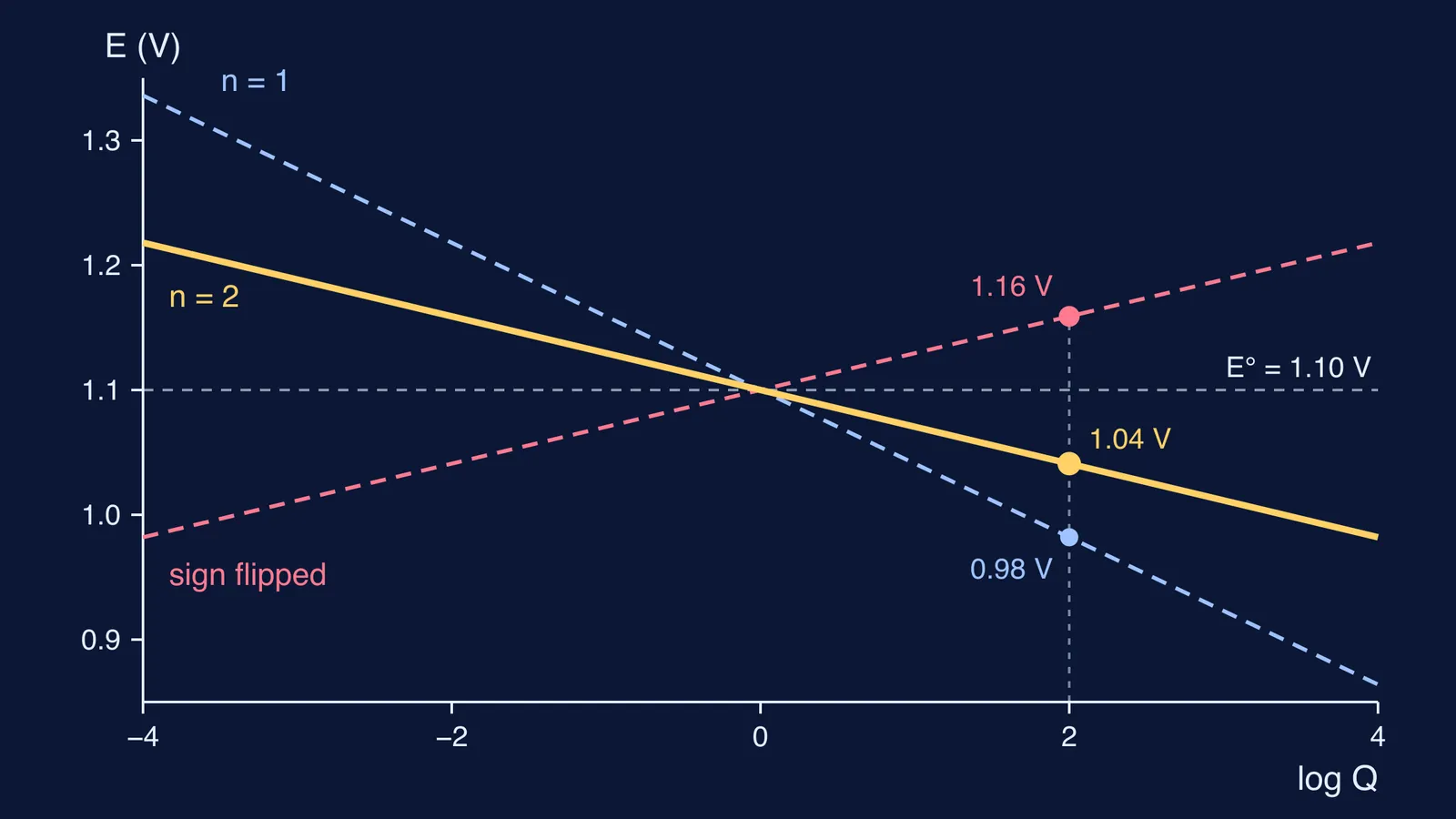
Take Zn | Zn²⁺(0.10 M) || Cu²⁺(0.0010 M) | Cu. NCERT gives E°cell = 0.34 V − (−0.76 V) = 1.10 V for the Daniell cell (NCERT, section 2.2).
Reaction: Zn + Cu²⁺ → Zn²⁺ + Cu, so n = 2.
Q = [Zn²⁺]/[Cu²⁺] = 0.10/0.0010 = 100, so log Q = 2.
Ecell = 1.10 − (0.059/2)(2) = 1.10 − 0.059 ≈ 1.04 V.
What each slip gives:
n = 1: 1.10 − 0.059 × 2 ≈ 0.98 V.
Q flipped, or the sign flipped: 1.10 + 0.059 ≈ 1.16 V.
0.059 used with ln 100 (about 4.61): 1.10 − 0.136 ≈ 0.96 V.
Should the EMF rise or fall? A ten-second sense test
NCERT states that the Daniell cell EMF increases as the concentration of Cu²⁺ increases and the concentration of Zn²⁺ decreases (NCERT, equation 2.11). In general:
Q greater than 1: Ecell is below E°cell.
Q less than 1: Ecell is above E°cell.
Q equal to 1: Ecell equals E°cell.
In our cell, Zn²⁺ is 100 times Cu²⁺, so the answer must be below 1.10 V. The 1.16 V answer fails at once. The 0.98 V answer passes the direction test, which is why you still check n. To see this as concentrations change, try the Nernst equation cell voltage simulation.
For practice where each line is explained, the Fermi Problem Library has worked problems with a step-by-step solver that explains the reasoning rather than printing an answer. If Q still feels shaky, the Fermi Concept Library gives each concept in chemistry its own lesson.
Next time an AI gives you a cell EMF, run the four checks before you copy the number.