On this page
When you change the concentrations in an equilibrium mixture, you don't have to guess which way it will move. Calculate one number, the reaction quotient Q, and compare it with K. Here is how to do that on paper, then test it in a simulation.
What is the reaction quotient Q?
For a reaction mA + nB ⇌ xC + yD, the reaction quotient is Q = [C]^x[D]^y / [A]^m[B]^n, using whatever concentrations are present at that moment (OpenStax Chemistry 2e, section 13.2).
The equilibrium constant K has exactly the same form, but it uses only equilibrium concentrations. So K is fixed at a given temperature, while Q changes every time you add, remove or squeeze something.
Pure solids and pure liquids are left out of Q, because their relative concentrations are taken as 1. So Q includes only gases and dissolved species (OpenStax).
Q vs K: which direction does the reaction go?
The rule, as given in OpenStax Chemistry 2e and LibreTexts/15%3A_Chemical_Equilibrium/15.06%3A_Applications_of_Equilibrium_Constants):
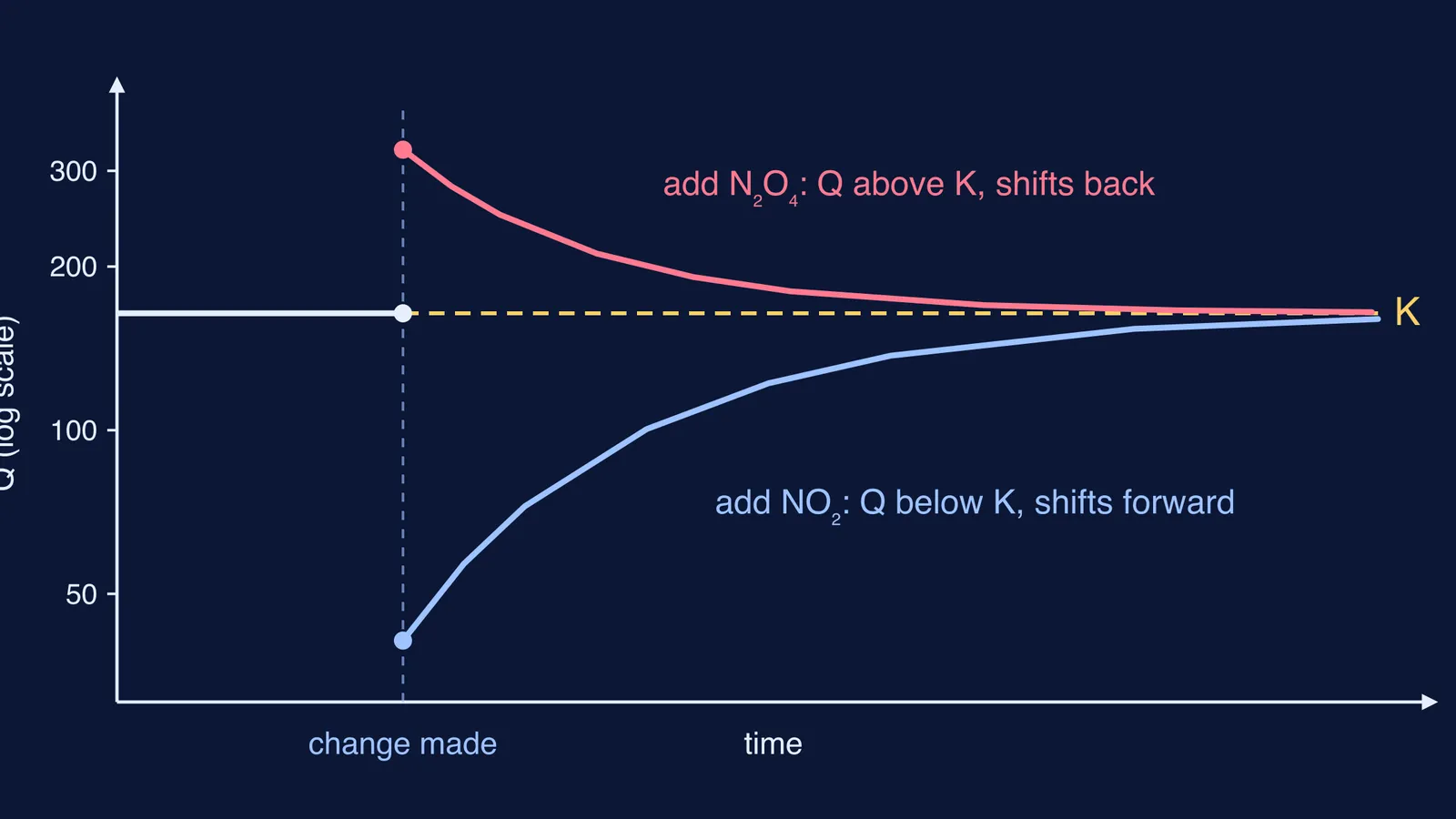
Q < K: the reaction goes forward, making more products.
Q > K: the reaction goes in reverse, making more reactants.
Q = K: the system is at equilibrium and the concentrations stay the same.
Here's why it works. Products sit on top of the fraction, so a small Q means not enough products yet, and the forward reaction wins until Q climbs to K. A large Q means too many products, so some turn back into reactants.
How do you predict a shift? A worked example
Take 2NO2 ⇌ N2O4. In a worked example in OpenStax Chemistry 2e, the equilibrium mixture has [NO2] = 0.016 M and [N2O4] = 0.042 M. That gives Kc = 0.042 / (0.016)² ≈ 164, which OpenStax rounds to 1.6 × 10². Now disturb that mixture in three ways. Each time, calculate Q at the instant after the change, before anything has reacted.
Double [NO2] to 0.032 M. Q = 0.042 / (0.032)² ≈ 41. Q < K, so the reaction goes forward. If you solve for the new equilibrium, [NO2] falls to about 0.0173 M and [N2O4] rises to about 0.0493 M. NO2 does not return to 0.016 M: the shift only partly undoes your change.
Double [N2O4] to 0.084 M. Q = 0.084 / (0.016)² ≈ 328. Q > K, so the reaction goes in reverse. The new equilibrium is about [NO2] = 0.0222 M and [N2O4] = 0.0809 M.
Halve the volume, so both concentrations double. Q = 0.084 / (0.032)² ≈ 82. Q < K, so the reaction goes forward, towards the side with fewer gas molecules. This matches Le Chatelier's principle, but here you got it from arithmetic.
To check each new equilibrium, put the final numbers into the Kc expression. You should get about 164 again.
Why not just use Le Chatelier's principle?
Le Chatelier's principle is a quick rule of thumb, but it can mislead you. In a 1995 study in the Journal of Research in Science Teaching, Juan Quílez-Pardo and Joan Josep Solaz-Portolés gave a written equilibrium test to 170 first-year university chemistry students and a related problem to 40 chemistry teachers. Among the sources of mistakes they identified were misapplying Le Chatelier's principle and making limited use of the equilibrium law (study abstract).
Here is a case where the rule of thumb fails. Take an equilibrium mixture of N2 + 3H2 ⇌ 2NH3 at constant temperature and constant total pressure, with 6 mol N2, 1 mol H2 and 1 mol NH3. Written with mole fractions, Q is proportional to n(NH3)² × n(total)² / (n(N2) × n(H2)³), which is 1 × 64 / 6 ≈ 10.7 at equilibrium. Add 1 mol of N2: the total becomes 9 mol, and the same expression becomes 81 / 7 ≈ 11.6. Q went up, so Q > K and the reaction runs in reverse, even though you added a reactant. Adding N2 also dilutes the H2, and here that effect wins.
How to practise: predict first, then watch
Commit to a prediction before you watch a simulation:
Write down the starting equilibrium concentrations and K.
Pick one change and calculate the new Q by hand.
Write your prediction: forward or reverse, and roughly how far.
Make the change in a simulation and watch which concentrations rise and fall.
If your prediction was wrong, find the step that went wrong, usually a missing power or a solid left in Q.
The Fermi Simulation Lab has interactive simulations for ideas that are easier to see than to read, and the same predict-first routine works whenever you open one. If you keep getting the Q expression wrong, the Fermi Problem Library has worked problems with a step-by-step solver that explains the reasoning rather than printing an answer.
Try the three NO2 disturbances above tonight, predicting each one before you check it.