On this page
You multiply a redox equation by 2 to balance it, then stop: does the cell emf double too? It does not, and the numbers show why.
Why does cell emf not change when the equation is doubled?
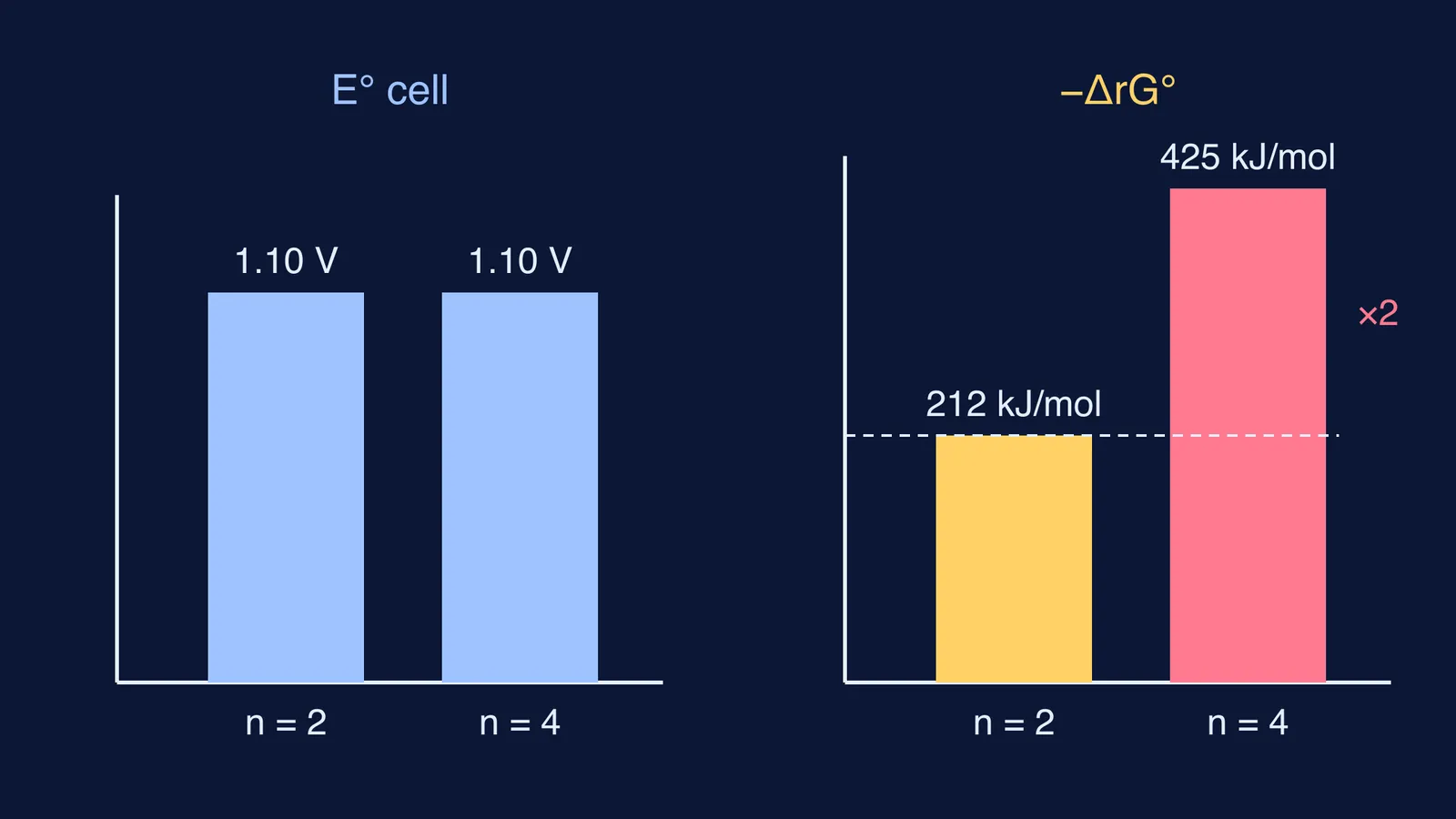
A cell potential is a voltage, which is energy per unit charge, so it does not depend on how much reaction you write down. NCERT's Class 12 chemistry textbook says it directly: E(cell) is an intensive parameter, while ΔrG is an extensive thermodynamic property whose value depends on n (NCERT Chemistry Part I, Unit 2: Electrochemistry).
The two are linked by ΔrG° = −nFE°cell, where n is the moles of electrons transferred in the equation as written and F is the Faraday constant, 96487 C mol⁻¹ in the same NCERT chapter. OpenStax gives the same relation with F = 96,485 C/mol (OpenStax Chemistry 2e on LibreTexts, section 17.4/17%3A_Electrochemistry/17.04%3A_Potential_Free_Energy_and_Equilibrium)).
Rearrange it and the answer falls out: E° = −ΔrG°/nF. Doubling the equation doubles ΔrG° and doubles n, so the ratio does not move.
Worked example: the Daniell cell, written once and twice
NCERT's table of standard electrode potentials gives +0.34 V for Cu²⁺/Cu and −0.76 V for Zn²⁺/Zn, so E°cell = 0.34 − (−0.76) = 1.10 V (NCERT Unit 2, Table 2.1 and section 2.2).
Written once, Zn(s) + Cu²⁺(aq) → Zn²⁺(aq) + Cu(s) transfers 2 electrons:
n = 2
ΔrG° = −2 × 96487 × 1.10 = −212,271 J mol⁻¹, about −212.3 kJ mol⁻¹
E° = 212,271 / (2 × 96487) = 1.10 V
Written twice, 2Zn(s) + 2Cu²⁺(aq) → 2Zn²⁺(aq) + 2Cu(s) transfers 4 electrons:
n = 4
ΔrG° = −4 × 96487 × 1.10 = −424,543 J mol⁻¹, about −424.5 kJ mol⁻¹
E° = 424,543 / (4 × 96487) = 1.10 V
NCERT works the single version as Example 2.3 and gets −212.27 kJ mol⁻¹. Only n and ΔrG° doubled.
Does the Nernst equation give the same emf for the doubled reaction?
Yes. NCERT gives the Nernst equation as E = E° − (RT/nF) ln Q, which at 298 K becomes E = E° − (0.059/n) log Q (NCERT Unit 2, section 2.3). Take [Zn²⁺] = 0.10 M and [Cu²⁺] = 0.010 M.
Single equation: Q = 0.10/0.010 = 10, log Q = 1, so E = 1.10 − (0.059/2)(1) = 1.10 − 0.0295 ≈ 1.07 V.
Doubled equation: Q = (0.10)²/(0.010)² = 100, log Q = 2, so E = 1.10 − (0.059/4)(2) = 1.10 − 0.0295 ≈ 1.07 V.
Squaring Q doubles log Q, and n doubled too, so the correction term is unchanged. If your answers differ, you updated only one of n or Q; our guide to checking n, Q and the sign in the Nernst equation walks through that slip.
The equilibrium constant tells the same story. From E° = (0.059/n) log K, NCERT gets log K = 37.288 for the single Daniell reaction. Doubling squares K, so log K becomes 74.576, and 0.059 × 74.576 / 4 = 1.10 V again. The rules for K itself are in equilibrium constant when a reaction is reversed or multiplied.
Should you ever multiply E° values?
Not for a cell. The classic trap is Cu(s) + 2Ag⁺(aq) → Cu²⁺(aq) + 2Ag(s). The silver half-reaction is doubled to balance electrons, so it is tempting to write 2 × 0.80 = 1.60 V and get 1.60 − 0.34 = 1.26 V. The correct working uses the table value as it is: E°cell = 0.80 − 0.34 = 0.46 V, which is the figure in NCERT's Example 2.2 (NCERT Unit 2).
Coefficients do matter in one case: adding two half-reactions to make a third half-reaction, where electrons do not cancel. Then go through ΔG°. Using NCERT's Table 2.1 values:
Fe³⁺ + e⁻ → Fe²⁺, E° = 0.77 V, so ΔG° = −1 × F × 0.77 = −0.77F
Fe²⁺ + 2e⁻ → Fe, E° = −0.44 V, so ΔG° = −2 × F × (−0.44) = +0.88F
Fe³⁺ + 3e⁻ → Fe: ΔG° = +0.11F, so E° = −0.11F / 3F ≈ −0.037 V
Adding the voltages would give 0.33 V: wrong size, wrong sign.
A 30-second check before you write E°
Did the electrons cancel? If yes, E°cell = E°cathode − E°anode, with no multiplying.
If electrons remain, convert each step with ΔG° = −nFE°, add, and divide by the new n and F.
Whatever factor you multiplied the equation by, apply it to n and ΔrG°, and use it as the power on Q and K.
Run Nernst for both versions of the equation. If the answers differ, n or Q is off.
To practise on more cells, the Fermi Problem Library has worked problems with a step-by-step solver that explains the reasoning rather than printing an answer, so you see where n changes and E° does not. If intensive and extensive properties still feel shaky, the Fermi Concept Library gives each chemistry concept its own lesson.