On this page
A familiar twist in Class 11 equilibrium problems: you are given two reactions with known constants and asked for the constant of a third. You don't need new data. You need three rules and the habit of checking which one you are using at each step.
All three come from one fact. For a reaction aA + bB ⇌ cC + dD, Kc = [C]^c[D]^d / [A]^a[B]^b, so every coefficient becomes an exponent. If that step is shaky, start with our guide on how to write a Kc expression from a balanced equation.
What happens to K when a reaction is reversed?
Reversing a reaction swaps the numerator and denominator, so the new constant is 1/K. In the words of Harvey's Analytical Chemistry 2.1 on Chemistry LibreTexts/06:_Equilibrium_Chemistry/6.03:_Manipulating_Equilibrium_Constants), "if we reverse a reaction's direction, the equilibrium constant for the new reaction is the inverse of that for the original reaction."
A real case: this Chemistry LibreTexts page uses HCO₃⁻ ⇌ H⁺ + CO₃²⁻ with K = 10^−10.3, so the reverse, H⁺ + CO₃²⁻ ⇌ HCO₃⁻, has K = 10^+10.3. A tiny K becomes a huge one, and that makes sense: a reaction that barely goes forward goes almost completely backward.
What happens to K when a reaction is multiplied by a number?
If you multiply every coefficient by n, every exponent in the expression is multiplied by n, so the whole expression is raised to the power n. The same LibreTexts page puts it this way: "Multiplying the coefficients by a common factor will raise K to the corresponding power."
This is an easy place to slip. Doubling an equation squares K; it does not double it. Halving an equation (n = ½) takes the square root of K; it does not halve it.
Why do you multiply K values when you add reactions?
When you add two equations, a species made in the first and used in the second cancels. Multiply the two K expressions and its concentration cancels too, top against bottom. That is why, as the same UC Davis LibreTexts page puts it, "the equilibrium constant for the sum of two or more reactions is the product of the equilibrium constants for each of the steps."
There is a second way to see it. Standard Gibbs energies add when reactions add, and ΔG° = −RT ln K, so ln K adds, which means K multiplies. Our post on calculating K from ΔG° covers that formula.
A worked chain: reverse, scale and add in one problem
The starting data are from the Chemistry LibreTexts example, both at 1200 °C:
CO(g) + 3H₂(g) ⇌ CH₄(g) + H₂O(g), K₁ = 9.17 × 10⁻²
CH₄(g) + 2H₂S(g) ⇌ CS₂(g) + 4H₂(g), K₂ = 3.3 × 10⁴
We have extended the question to use all three rules. Find K for: 2CS₂(g) + 2H₂O(g) + 2H₂(g) ⇌ 2CO(g) + 4H₂S(g).
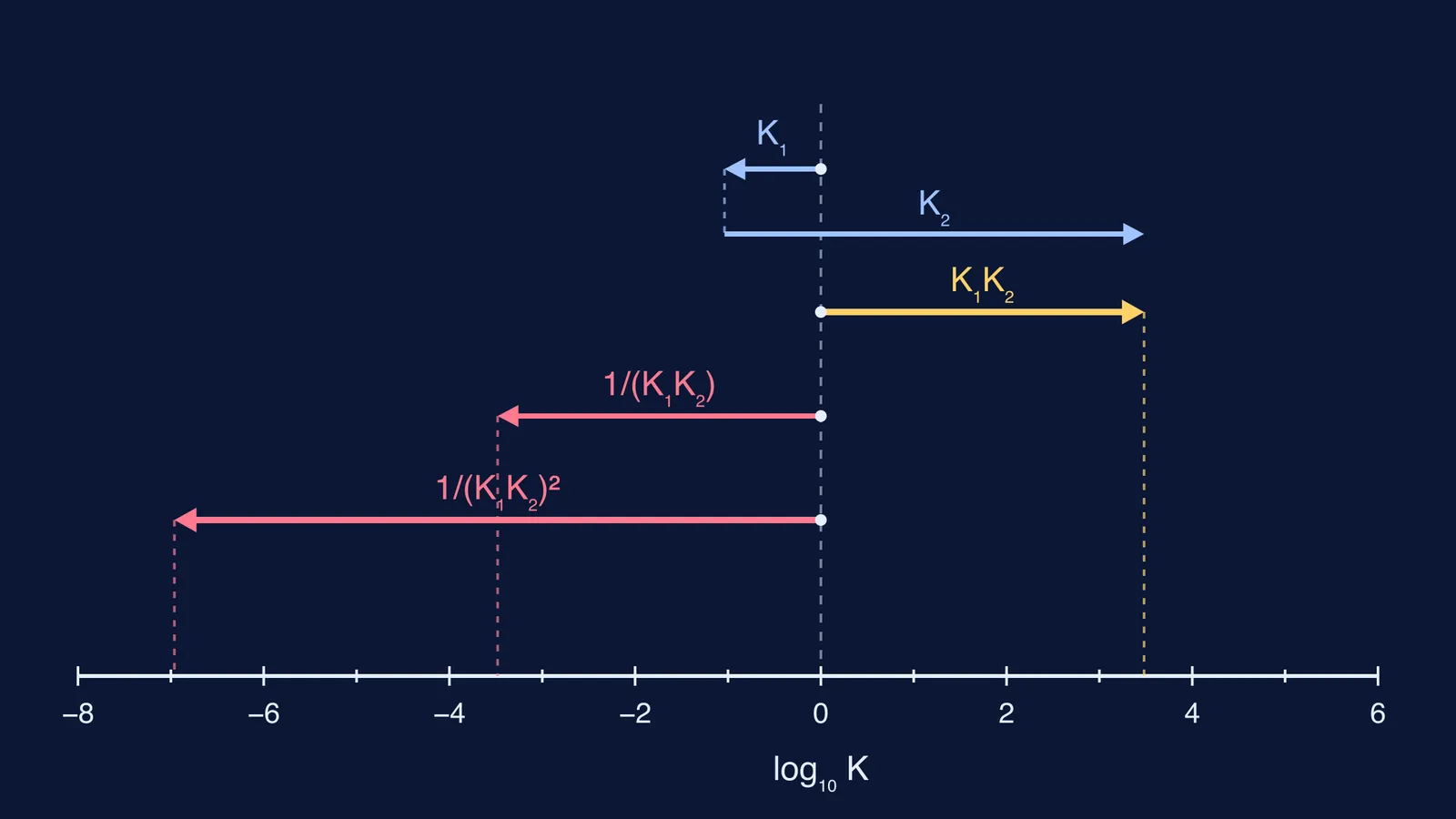
Step 1, add. Adding equations 1 and 2 gives CO + 2H₂S ⇌ CS₂ + H₂O + H₂. CH₄ cancels, and the 3H₂ on the left cancels three of the four H₂ on the right. K₃ = K₁ × K₂ = (9.17 × 10⁻²)(3.3 × 10⁴) = 3.03 × 10³, the answer LibreTexts gives.
Step 2, reverse. CS₂ + H₂O + H₂ ⇌ CO + 2H₂S has K = 1/(3.03 × 10³) = 3.30 × 10⁻⁴.
Step 3, double. Multiplying every coefficient by 2 gives the target, so K = (3.30 × 10⁻⁴)² = 1.09 × 10⁻⁷.
In one line, K = (K₁K₂)^−2. Two checks are worth doing. First, the size: a constant above 1, reversed, falls below 1, and squaring a number below 1 makes it smaller still, so an answer near 10⁻⁷ is sensible. Second, significant figures: K₂ has only two, so in an exam you would report 1.1 × 10⁻⁷.
Every constant in a chain must be at the same temperature. These rules change how you write K, but only temperature changes its value for a given equation, as our post on what changes the equilibrium constant explains.
A checklist for any combine-the-equations question
Find each target species in the given equations and note which side it sits on.
If a given equation has it on the wrong side, reverse it and write 1/K.
If the coefficients don't match the target, scale the equation by n and write Kⁿ.
Add the adjusted equations and cancel species by species until you get the target exactly.
Multiply the adjusted constants. Never add them.
Check the size: large or small, does it match the direction of the reaction?
If you keep picking the wrong rule at step 2 or 3, the Fermi Problem Library has worked problems with a step-by-step solver that explains the reasoning rather than printing an answer. If the gap is earlier, in why coefficients become exponents at all, the Fermi Concept Library gives each concept its own lesson.
Try the chain above again tomorrow without looking. If you get 1.1 × 10⁻⁷, the three rules are yours.