On this page
Pour concentrated ferric chloride into hot water and, as a Royal Society of Chemistry demonstration shows, you get a cherry-red liquid, not the brown precipitate that forms when the concentrated solution is simply heated on its own. That liquid is a sol, and every particle in it carries positive charge. The reason is not special to iron. It is one rule, and silver iodide lets you watch it work in both directions.
Why is ferric hydroxide sol positively charged?
The usual lab method is hydrolysis. The Virtual Labs experiment from IIIT Hyderabad writes it as FeCl₃ + 3H₂O → Fe(OH)₃ + 3HCl: heating the solution gives colloidal Fe(OH)₃ particles and hydrochloric acid.
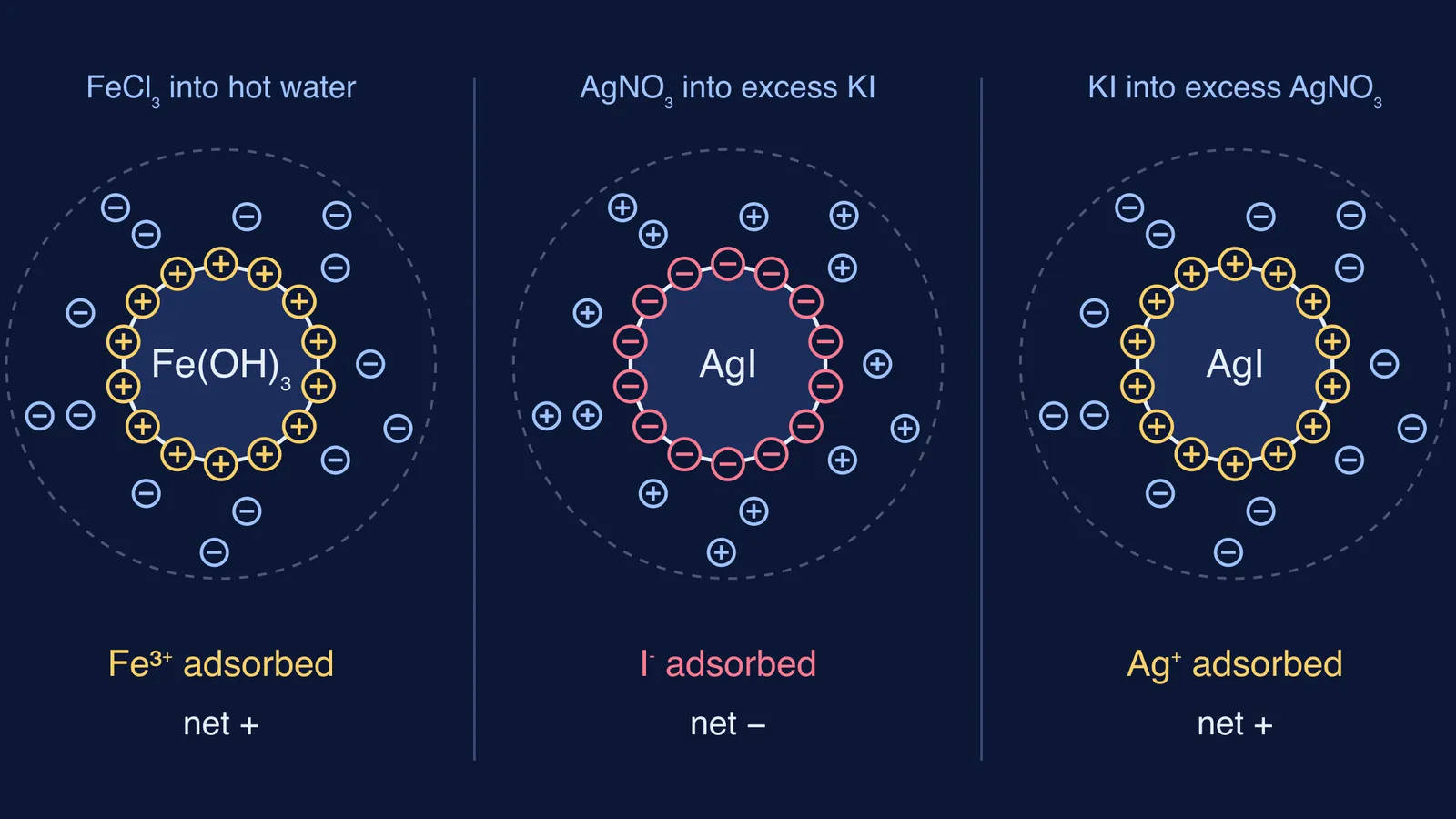
Each new particle is a tiny cluster of iron and hydroxide, sitting in a liquid that still holds plenty of Fe³⁺. Those Fe³⁺ ions belong to the particle's own lattice, so they fit onto its surface and stay there. The OpenStax Chemistry 2e textbook puts it this way: a colloidal iron(III) hydroxide particle "does not contain enough hydroxide ions to compensate exactly for the positive charges on the iron(III) ions."
So the surface ends up positive, and chloride ions gather loosely around it as a second, negative layer. That is why textbooks write the particle as [Fe(OH)₃]Fe³⁺.
Why not OH⁻, which is also part of the particle? The reaction makes HCl, so the liquid is acidic and has very few free OH⁻ ions to give. The lattice ion actually in excess around the particle is Fe³⁺.
Does AgI in KI and in AgNO₃ give opposite charges?
Yes. Silver iodide has two lattice ions, Ag⁺ and I⁻, so the sign depends on which one you leave in excess.
In a 2015 study in Advanced Materials Research, Daina Kalniņa and colleagues at Riga Technical University added 0.01 M AgNO₃ drop by drop to stirred 0.01 M KI, at iodide-to-silver ratios of 1.0, 1.8, 2.0 and 4.5.
At exactly 1:1, they got large, irregular AgI crystals of 0.2 to 2.0 micrometres, and the zeta potential could not be measured. With no ion in excess, no stable sol formed.
With excess iodide, they got rounded particles of 50 ± 10 nanometres, and the excess potassium iodide "imparted a negative charge."
The measured zeta potentials were 45 to 59 mV in size, and the authors note that a value above 45 mV means enough repulsion to stop particles clumping.
Now reverse it. With AgNO₃ in excess, Ag⁺ is the lattice ion left over, so it is the one that sticks: the sol becomes [AgI]Ag⁺, with nitrate ions outside. Mirnik and Pravdić, writing in Croatica Chemica Acta in 1958, found that the zero point of the zeta potential of AgI lies between pAg 5.1 and 6.2, a range where their measurements were irreproducible. That is a silver-ion concentration of only about 0.6 to 8 micromoles per litre, so a small tilt in the balance decides the sign.
How do you predict the charge on any sol?
Use three questions, in order:
What is the particle made of?
Which of its own ions is left over in the liquid?
That ion sits on the surface and sets the sign; its partner ion forms the outer layer.
Worked examples:
FeCl₃ into hot water: particle Fe(OH)₃, leftover Fe³⁺ (the liquid is acidic), so the sol is positive with Cl⁻ outside.
AgNO₃ added to excess KI: particle AgI, leftover I⁻, so the sol is negative with K⁺ outside.
KI added to excess AgNO₃: particle AgI, leftover Ag⁺, so the sol is positive with NO₃⁻ outside.
Equal moles of each: nothing left over, so no stable sol, as the Riga study found.
The usual exam trap is the wording. "A is added to B" often means B is in excess, but if the question gives amounts, trust the amounts over the order of mixing.
If adsorption or the idea of a double layer still feels shaky, the Fermi Concept Library gives each concept in chemistry its own lesson and its place in the map, so you can see what this topic rests on.
How can you check the sign of a sol in the lab?
A lab exercise from V. N. Karazin Kharkiv National University uses plain filter paper. It makes Fe(OH)₃ sol from 3 drops of saturated FeCl₃ in 100 mL of boiling water, then dips a paper strip into it. Cellulose capillaries are negatively charged, so negative particles rise with the water while positive particles are held back near the bottom.
The same exercise then coagulates the Fe(OH)₃ sol with K₂SO₄ and K₃[Fe(CN)₆], comparing divalent and trivalent anions under the Schulze–Hardy rule. Testing anions as the coagulating ions only makes sense because the particles are positive.
For practice, the Fermi Problem Library has worked problems with a step-by-step solver that explains the reasoning rather than printing an answer. Predict the sign with the three questions first, then check.