On this page
A crystal of common salt is colourless. Heat it in sodium vapour, cool it, and it comes out yellow. Potassium chloride treated the same way in potassium vapour turns violet. The colour comes from single electrons sitting where chloride ions should be.
What is a metal excess defect?
In a perfect NaCl crystal, every Na⁺ has a matching Cl⁻. In a metal excess defect, the crystal holds slightly more metal than halogen. According to Wikipedia's article on F-centres, a crystal with F-centres is chemically equivalent to a perfect crystal plus a stoichiometric excess of the alkali metal.
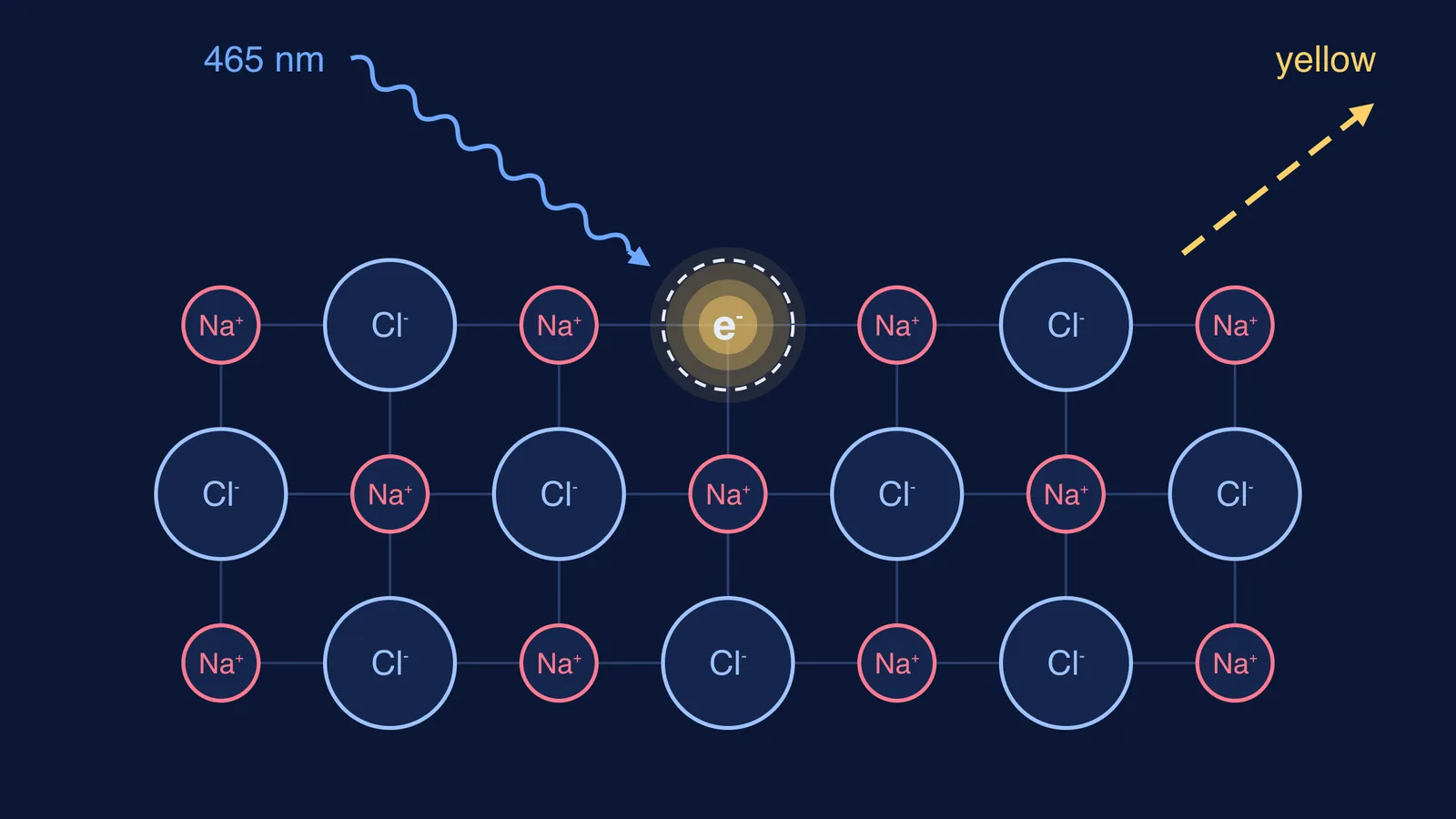
An F-centre is an anion vacancy occupied by an unpaired electron (Wikipedia). The name comes from the German *Farbzentrum*, where *Farbe* means colour.
Why does NaCl turn yellow when heated in sodium vapour?
The NCERT-style explanation, as set out in this worked answer to the textbook question, runs in four steps. For NaCl:
Sodium atoms from the vapour settle on the surface of the crystal.
Cl⁻ ions move out to the surface and combine with these sodium atoms, building new NaCl. Their old sites inside the crystal are left empty.
Each sodium atom becomes Na⁺ by losing an electron.
That electron moves into the crystal and gets trapped in an empty Cl⁻ site. This is the F-centre.
The positive Na⁺ ions around the empty site hold the electron in place, giving it allowed energy levels, much like an electron in an atom. It jumps up a level by absorbing a photon of the right energy. The UGC's e-PG Pathshala module on colour centres gives the main absorption band of F-centres in NaCl as about 4650 Å, which is 465 nm.
465 nm is blue light, and Wikipedia agrees that the NaCl band lies in the blue, giving a yellow tinge. White light that loses its blue looks yellow, the complementary colour.
Why is KCl violet and not yellow?
In a bigger lattice the box holding the electron is bigger, so its levels sit closer together and it absorbs longer-wavelength light. The Mollwo–Ivey relation says the F-centre absorption energy scales roughly as E = C × a⁻ⁿ, where a is the lattice constant. A fit to experimental data gives n = 1.81 ± 0.1, as reported by Tiwald and colleagues in Physical Review B (2015) (free preprint). Erich Mollwo first noticed a roughly 1/a² trend, and Henry Ivey generalised it in a 1947 Physical Review paper.
Can you predict the colour of KCl from NaCl?
Use the lattice constants: NaCl has a = 564.02 pm (Wikipedia, sodium chloride) and KCl has a = 629.2 pm (Wikipedia, potassium chloride).
Energy absorbed by NaCl, from the e-PG Pathshala band: E = hc/λ = 1240 eV nm ÷ 465 nm ≈ 2.67 eV.
Ratio of lattice constants: 564.02 ÷ 629.2 ≈ 0.896.
Scale the energy with the experimental n = 1.81: 2.67 × 0.896^1.81 ≈ 2.67 × 0.820 ≈ 2.19 eV.
Convert back: λ = 1240 ÷ 2.19 ≈ 567 nm.
So KCl should absorb near 567 nm, in the yellow-green. Take green-yellow out of white light and the red and blue ends are left, which together look purple. That is why the textbook answer for KCl is violet.
One honest caveat: references disagree on the exact shade. The NCERT-style answer says violet, Wikipedia says KCl turns lilac (and LiCl pink), and the e-PG Pathshala module says blue. Violet and lilac are close; in a school exam, write violet.
Some history: Robert Pohl's group at Göttingen studied these crystals from 1920, Nevill Mott and Ronald Gurney set out the vacancy model in 1940, and electron spin resonance gave conclusive evidence in 1957 (Wikipedia).
How do you write a full-marks answer?
For a two or three mark question:
Name the defect: metal excess defect due to anion vacancies.
Describe the process in order: metal atoms on the surface, Cl⁻ moving out, metal atoms ionising, electrons filling vacancies.
Define F-centre in one sentence.
Link to colour: the electron absorbs visible light and is excited; the crystal shows the complementary colour.
Give the example asked for: NaCl yellow, KCl violet.
Add one extra point if marks allow: the unpaired electrons make the solid paramagnetic.
The current 2026-27 reprint of NCERT Class 12 Chemistry opens with Solutions as Unit 1, not The Solid State, so confirm on your board's or exam's official syllabus page whether defects are still examined.
If the idea of a vacancy holding an electron still feels slippery, the Fermi Concept Library gives every chemistry and physics concept its own lesson and its place in the map, so you can go back to ionic crystals and energy levels first. To practise the reasoning, the Fermi Problem Library has worked problems with a step-by-step solver that explains the reasoning rather than printing an answer.
For practice, rerun the worked example with KBr and see where your prediction lands.