On this page
Most mistakes on this topic come from learning "anode is negative" as a fixed fact. It is true for only one kind of cell.
What is the difference between a galvanic and an electrolytic cell?
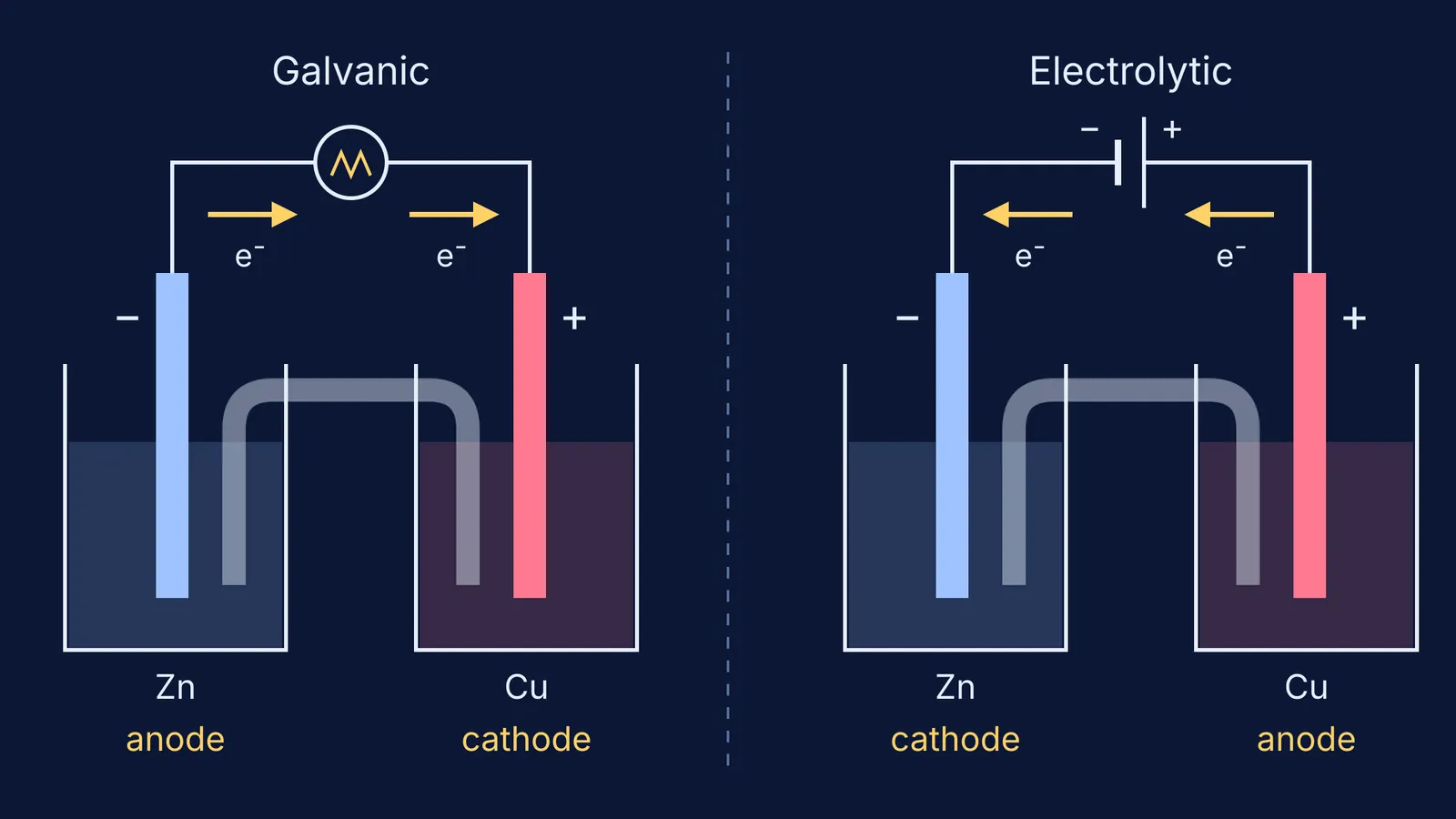
The NCERT Class 12 chemistry chapter Electrochemistry defines both. A galvanic (or voltaic) cell converts the chemical energy of a spontaneous redox reaction into electrical energy. An electrolytic cell is a device for using electrical energy to carry out non-spontaneous chemical reactions. The LibreTexts electrochemistry module/Electrochemistry/Electrolytic_Cells) compares energy, spontaneity, electron source and signs; the ΔG sign and the examples are from NCERT:
Energy direction: galvanic turns chemical energy into electrical energy; electrolytic turns electrical energy into chemical energy.
Spontaneity: the galvanic reaction is spontaneous (ΔG negative, E positive); the electrolytic reaction is non-spontaneous and needs an outside supply.
Where the electrons come from: in a galvanic cell, from the species being oxidised; in an electrolytic cell, from the external battery, entering at the cathode and leaving at the anode.
Anode: oxidation in both cells; negative in a galvanic cell, positive in an electrolytic cell.
Cathode: reduction in both cells; positive in a galvanic cell, negative in an electrolytic cell.
Examples: Daniell cell, dry cell; electrolytic refining of copper, extracting sodium or aluminium.
Why is the anode negative in a galvanic cell but positive in an electrolytic cell?
Anode and cathode are named for the reaction: oxidation at the anode, reduction at the cathode, in every cell. The sign tells you which way electrons are pushed.
In a galvanic cell, the anode makes electrons itself. NCERT says the anode "has a negative potential with respect to the solution" and the cathode a positive one, so electrons flow from the negative electrode to the positive one (NCERT, section 2.2).
In an electrolytic cell, the battery is in charge. Whichever electrode is wired to the battery's negative terminal gets electrons forced into it, so reduction happens there: it is the cathode, and it is negative. The electrode on the positive terminal has electrons pulled out of it, so oxidation happens there: it is the anode, and it is positive.
Can one cell be both galvanic and electrolytic?
Yes, as NCERT shows. In the Daniell cell, Zn(s) + Cu²⁺(aq) → Zn²⁺(aq) + Cu(s). The standard electrode potentials are +0.34 V for Cu²⁺/Cu and −0.76 V for Zn²⁺/Zn, so E°cell = 0.34 − (−0.76) = 1.10 V (NCERT, pages 32 to 35).
The same chapter gives ΔG° = −nFE°. With n = 2 and F = 96487 C mol⁻¹, ΔG° = −2 × 96487 × 1.1 J mol⁻¹ = −212.27 kJ mol⁻¹ (NCERT Example 2.3). A negative ΔG means the reaction is spontaneous, so this is a galvanic cell. For the link to K, see going from cell EMF to ΔG° and K.
Now apply an external voltage that opposes the cell. NCERT describes three stages. Below 1.1 V, zinc still dissolves and copper deposits. At exactly 1.1 V, no current flows and the reaction stops. Above 1.1 V, electrons flow from Cu to Zn, zinc is deposited at the zinc electrode and copper dissolves. The cell is now electrolytic.
The zinc rod is negative in both cases. In the galvanic cell it is the negative anode; in the electrolytic cell zinc ions are reduced on it, so it is the negative cathode. The sign stayed with the rod. The name moved, because the reaction moved.
One warning: NCERT's Fig. 2.2(c) prints "+ve" beside the zinc cathode and "−ve" beside the copper anode, yet the same figure shows electrons driven into the zinc. Go by the wiring.
How do you tell which cell a question is about?
Run these four checks in order:
Is there an external battery or DC source driving the reaction? If yes, it is electrolytic.
Is E°cell positive for the reaction as written (so ΔG is negative)? Then the reaction can run as a galvanic cell.
Find the electrode where oxidation happens. That is the anode, whatever its sign.
Only now give the sign: anode negative if galvanic, anode positive if electrolytic.
Two copper strips in copper sulphate with a DC supply are an electrolytic cell. Copper deposits at the cathode, which NCERT marks as negatively charged, and the anode copper dissolves. NCERT notes that sodium and magnesium are produced by electrolysing their fused chlorides, and aluminium by electrolysing aluminium oxide with cryolite (NCERT, section 2.5). A lead storage battery is galvanic while it powers a car; NCERT notes it is recharged by passing current in the opposite direction, so while charging it works as an electrolytic cell (NCERT, section 2.6.2). Our post on electrolysis and Faraday's laws works out the amounts deposited.
If you keep getting the sign wrong in longer problems, the Fermi Problem Library has worked problems with a step-by-step solver that explains the reasoning, so you can see where the anode was decided. To go over half-cells and electrode potentials from the start, the Fermi Concept Library has a lesson for each concept. Cell notation and the Nernst equation come next, in our guide to cell notation, EMF and the Nernst equation.