On this page
Redox is a bookkeeping chapter: electrons lost equal electrons gained. Below are the syllabus, one worked example of each type, the traps and a two-week plan.
What does the JEE Main 2027 syllabus say about redox reactions?
Redox opens Unit 7, "Redox reactions and electrochemistry", of the NTA's Syllabus for JEE (Main) - 2027. Its redox part lists electronic concepts of oxidation and reduction, oxidation number, the rules for assigning it, and balancing of redox reactions.
Your textbook is Unit 7, Redox Reactions, of NCERT Class 11 Chemistry. It teaches two balancing methods (oxidation number and half-reaction, or ion-electron), disproportionation and redox titrations, and ends with electrode processes; our guide to preparing electrochemistry for JEE Main picks up from there.
How do you find oxidation numbers without slipping?
Write the sum: oxidation numbers add up to the charge on the species. Then watch for the exceptions NCERT lists, above all oxygen at −1 in peroxides.
K₂MnO₄: 2(+1) + x + 4(−2) = 0, so Mn is +6.
Pb₃O₄: the average is +8/3, meaning two Pb at +2 and one at +4.
NH₄NO₃: N is −3 in NH₄⁺ and +5 in NO₃⁻. Never average them.
H₂SO₅: blind counting gives S = +8, impossible for sulphur. The molecule has one O–O link, so two oxygens are −1: 2 + x − 2 − 6 = 0, and S is +6.
How do you balance redox equations in acid and in base?
Ion-electron method, acidic solution. Permanganate oxidises nitrite to nitrate.
Reduction: MnO₄⁻ + 8H⁺ + 5e⁻ → Mn²⁺ + 4H₂O (charge +2 on each side).
Oxidation: NO₂⁻ + H₂O → NO₃⁻ + 2H⁺ + 2e⁻ (charge −1 on each side).
Multiply by 2 and 5 so 10 electrons cancel, then cancel water and H⁺: 2MnO₄⁻ + 5NO₂⁻ + 6H⁺ → 2Mn²⁺ + 5NO₃⁻ + 3H₂O.
Check: O is 18 on each side, H is 6, and charge is −1 on each side.
Oxidation number method, basic solution. Iodate oxidises chromium(III) hydroxide to chromate.
Cr goes from +3 to +6 (up 3); I goes from +5 to −1 (down 6). So 2 Cr(OH)₃ for each IO₃⁻.
2Cr(OH)₃ + IO₃⁻ → 2CrO₄²⁻ + I⁻. Charge is −1 on the left and −5 on the right, so add 4OH⁻ on the left.
Hydrogen: 10 on the left, so add 5H₂O on the right: 2Cr(OH)₃ + IO₃⁻ + 4OH⁻ → 2CrO₄²⁻ + I⁻ + 5H₂O.
Check: O is 13 on each side, H is 10, and charge is −5 on each side. In base, balance charge with OH⁻, never H⁺.
What is a disproportionation reaction, and how do you balance one?
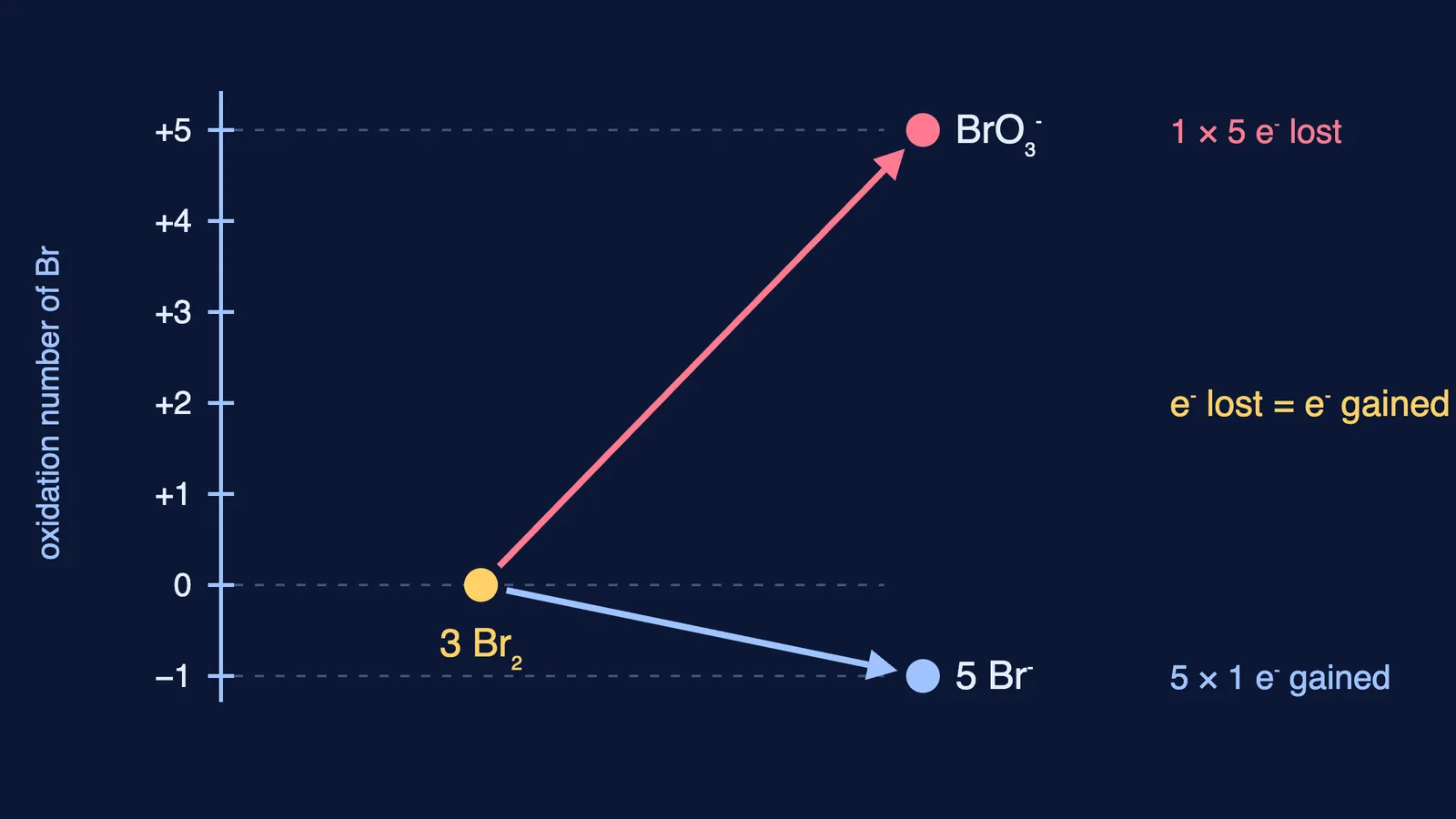
In a disproportionation reaction one element in one oxidation state is oxidised and reduced at the same time, so it needs at least three available states (NCERT Unit 7). Take bromine in hot alkali.
Reduction: Br₂ + 2e⁻ → 2Br⁻.
Oxidation: Br₂ + 12OH⁻ → 2BrO₃⁻ + 6H₂O + 10e⁻.
Multiply the reduction by 5, add, and divide by 2: 3Br₂ + 6OH⁻ → 5Br⁻ + BrO₃⁻ + 3H₂O.
Check: Br is 6 on each side, O is 6, H is 6, and charge is −6 on each side.
Do you need n-factor and equivalent weight for JEE Main?
Neither the NTA unit nor the NCERT chapter uses the terms n-factor or equivalent weight; NCERT's titration section defines the equivalence point by mole stoichiometry and leaves the rest to the balanced equation. Coaching books use n-factor, the electrons transferred per formula unit. Either way gives the same answer.
Example: what volume of 0.020 M KMnO₄ oxidises 25.0 mL of 0.10 M NaNO₂ in acid?
Moles method: NO₂⁻ = 0.0025 mol. The equation above gives MnO₄⁻ = 0.0025 × 2/5 = 0.0010 mol, so volume = 0.0010/0.020 = 0.050 L, or 50.0 mL.
Electron method: each NO₂⁻ gives 2e⁻, so 0.0050 mol of electrons. Each MnO₄⁻ takes 5e⁻ in acid, so 0.0010 mol. Same 50.0 mL.
Permanganate takes 5 electrons going to Mn²⁺, 3 to MnO₂ and 1 to MnO₄²⁻, so write the product first. If molarity feels shaky, revise the mole concept for JEE Main before this section.
How should you practise redox in two weeks?
Days 1-3: read the NCERT chapter; assign oxidation numbers in species of your own choosing, peroxides included.
Days 4-7: balance equations by both methods, alternating acid and base, checking atoms and charge.
Days 8-10: disproportionation and titration numericals, solved by moles and by electrons.
Days 11-14: past papers under time, using previous year questions the right way; log every error by type.
When an equation will not balance and you cannot see why, the Fermi Problem Library has worked problems with a step-by-step solver that explains the reasoning rather than printing an answer.