On this page
Equilibrium is where Class 11 chemistry becomes answers you must set out cleanly: an expression, a table, a value with units. This guide is for the CBSE school exam: four question types, one worked example each with our own numbers, and practice questions. For the entrance exam, our Equilibrium for JEE Main guide covers that paper.
How many marks is Equilibrium in Class 11 Chemistry?
In the CBSE Chemistry curriculum for 2026-27, Unit 6, Equilibrium, carries 7 of the 70 theory marks in Class XI, in its own row of the marks table.
The paper is balanced by skill: 28 marks for remembering and understanding, 21 for applying, and 21 for analysing, evaluating and creating, with no chapter-wise weightage.
The CBSE Class 12 Chemistry sample paper for 2026-27 uses 1-, 2-, 3-, 4- and 5-mark questions and allows no log tables or calculators. CBSE publishes sample papers for Classes 10 and 12 only, so we use that pattern as a guide.
What does the NCERT Equilibrium chapter cover?
The curriculum's Unit 6 topic list matches all thirteen sections of the current NCERT chapter, Unit 6 of Chemistry Part I (Reprint 2026-27). By question type:
Writing K: Kc, Kp, homogeneous and heterogeneous equilibria (sections 6.3 to 6.5).
Using K: direction with Q, equilibrium concentrations, ΔG° = −RT ln K (6.6 and 6.7).
Le Chatelier's principle: concentration, pressure, inert gas, temperature, catalyst (6.8).
Ionic equilibrium: acid–base concepts, Kw, pH, Ka and Kb, common ion effect, hydrolysis, buffers, Ksp (6.9 to 6.13).
How do you solve a Kc and Kp question for full marks?
Example 1. 0.40 mol of PCl₅ is heated in a 2.0 L flask at 450 K; at equilibrium 0.10 mol of Cl₂ is present. Find Kc and Kp for PCl₅(g) ⇌ PCl₃(g) + Cl₂(g).
Initial: [PCl₅] = 0.40/2.0 = 0.20 mol L⁻¹.
Change: [Cl₂] = 0.10/2.0 = 0.050 mol L⁻¹, so [PCl₃] = 0.050 mol L⁻¹ and [PCl₅] falls to 0.150 mol L⁻¹.
Kc = [PCl₃][Cl₂]/[PCl₅] = (0.050 × 0.050)/0.150 = 1.67 × 10⁻² mol L⁻¹.
Δn = 2 − 1 = 1, so Kp = Kc(RT) = 1.67 × 10⁻² × 0.0831 × 450 = 0.62 bar, with NCERT's R = 0.0831 bar L mol⁻¹ K⁻¹.
Mark points: expression, concentrations, value with units. Kc has units here because Δn is not zero. For trickier expressions, see how to write a Kc expression from a balanced equation.
How does Le Chatelier's principle appear in board answers?
In short, NCERT says a system shifts to counteract any change in the conditions that fix its equilibrium. Answer in three moves: the change, the direction, the reason.
Take Example 1 and raise [Cl₂] to 0.10 mol L⁻¹. Now Qc = (0.050 × 0.10)/0.150 = 3.3 × 10⁻², more than Kc, so the reaction runs backward until Qc = Kc. Compressing the mixture also shifts it backward, towards fewer gas molecules.
NCERT section 6.8 adds two more points: argon added at constant volume leaves the equilibrium undisturbed, and a catalyst does not change the equilibrium composition. Only temperature changes K; see does K change with concentration or pressure.
How do you calculate pH, buffer pH and Ksp in Class 11?
NCERT gives acetic acid Ka = 1.74 × 10⁻⁵ at 298 K (Table 6.6) and pKa = 4.76 (section 6.12.1) in the Equilibrium chapter.
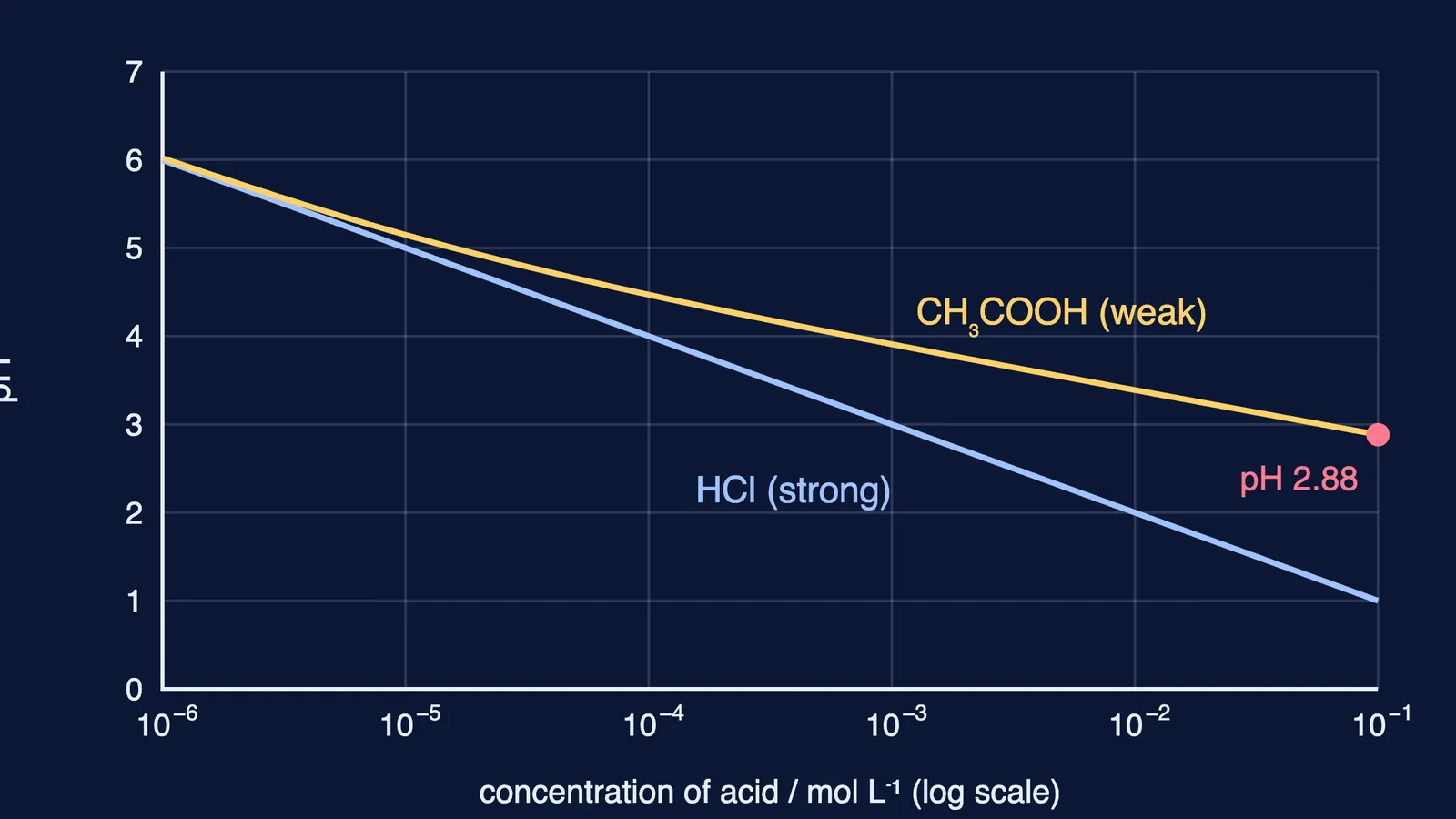
Weak acid: for 0.10 M acetic acid, [H⁺] ≈ √(cKa) = √(1.74 × 10⁻⁶) = 1.32 × 10⁻³ M, so pH = 2.88. It is about 1.3% ionised, so the approximation holds. The graph above compares it with HCl.
Buffer: 0.15 M acetic acid with 0.45 M sodium acetate. By the Henderson–Hasselbalch equation, pH = pKa + log([salt]/[acid]) = 4.76 + log 3 = 5.24.
Ksp: for a salt M₂X(s) ⇌ 2M⁺(aq) + X²⁻(aq), Ksp = (2S)²(S) = 4S³. If Ksp = 1.08 × 10⁻¹³, then S³ = 2.7 × 10⁻¹⁴, so S = 3.0 × 10⁻⁵ mol L⁻¹.
Practice questions on Equilibrium, with answers
(1 mark) Write Kp for NH₄HS(s) ⇌ NH₃(g) + H₂S(g). Answer: Kp = p(NH₃) × p(H₂S); the pure solid is left out.
(2 marks) Write the relation between Kp and Kc for 4HCl(g) + O₂(g) ⇌ 2Cl₂(g) + 2H₂O(g). Answer: Δn = 4 − 5 = −1, so Kp = Kc(RT)⁻¹.
(2 marks) Helium is added to an equilibrium mixture at constant volume. Does the equilibrium shift? Answer: No; partial pressures and concentrations are unchanged.
(3 marks) What ratio [CH₃COO⁻]/[CH₃COOH] gives an acetate buffer of pH 5.76? Answer: log(ratio) = 5.76 − 4.76 = 1, so the ratio is 10.
(3 marks) A salt MX has a solubility of 1.0 × 10⁻⁵ mol L⁻¹. Find Ksp. Does MX precipitate when [M⁺] = [X⁻] = 1.0 × 10⁻⁴ M? Answer: Ksp = 1.0 × 10⁻¹⁰; Qsp = 1.0 × 10⁻⁸ > Ksp, so yes.
If one question type keeps going wrong, Fermi's AI tutor can work out what you already know and build a plan for the session.