On this page
Equilibrium rewards method more than memory: many questions are short calculations that turn on a correct table and a safe approximation. Here is the official syllabus, five problem types with worked numbers, the traps, and a two-week plan.
What does the JEE Main syllabus include in Equilibrium?
In the official Syllabus for JEE (Main) - 2027 from NTA, Equilibrium is Unit 6 of Physical Chemistry. It has three parts:
Physical processes: dynamic equilibrium, solid-liquid, liquid-gas, gas-gas and solid-gas equilibria, and Henry's law.
Chemical processes: the law of chemical equilibrium, Kp and Kc, ΔG and ΔG°, factors affecting equilibrium, and Le Chatelier's principle.
Ionic equilibrium: strong and weak electrolytes, Arrhenius, Brønsted-Lowry and Lewis acids and bases, multistage ionisation, ionisation of water, pH, the common ion effect, salt hydrolysis, solubility products and buffer solutions.
Your textbook for all of it is Unit 6, Equilibrium, in NCERT Class 11 Chemistry. Read the whole chapter; its sections follow the syllabus closely. Study the ΔG° and K link alongside Thermodynamics.
How do you solve Kc and Kp problems?
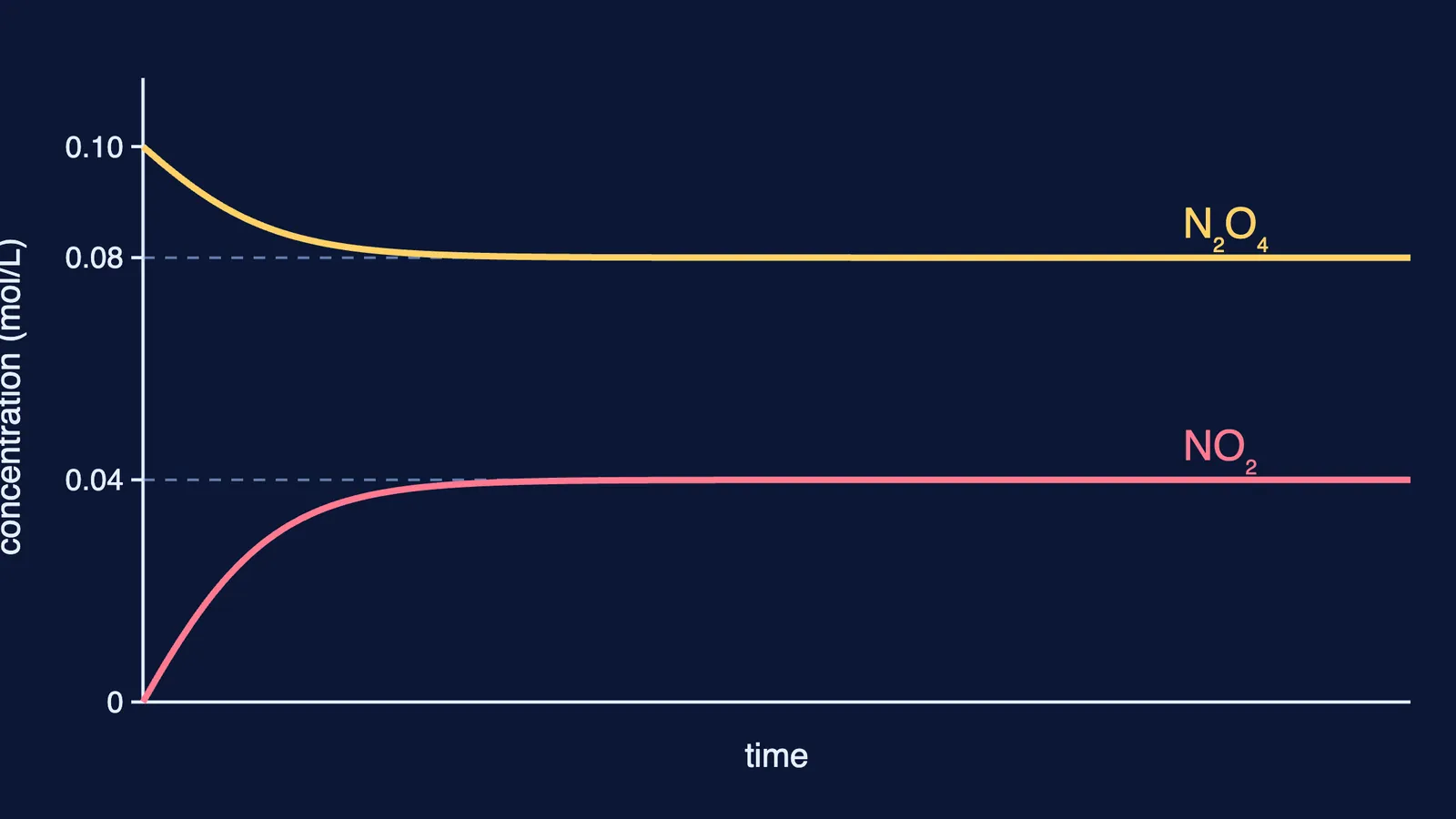
Use an ICE table (initial, change, equilibrium) every time. Take N₂O₄(g) ⇌ 2NO₂(g), suppose Kc = 0.020 mol/L at a fixed temperature, and start with 0.10 mol/L N₂O₄.
Change: N₂O₄ falls by x, NO₂ rises by 2x.
Set up (2x)²/(0.10 − x) = 0.020, which gives 4x² + 0.020x − 0.0020 = 0 and x = 0.020.
At equilibrium, [N₂O₄] = 0.080 mol/L and [NO₂] = 0.040 mol/L. Check: 0.040²/0.080 = 0.020.
To convert, NCERT Unit 6 gives Kp = Kc(RT)^Δn with R = 0.0831 bar L mol⁻¹ K⁻¹. Here Δn = 2 − 1 = 1, so at 400 K, Kp = 0.020 × 0.0831 × 400 ≈ 0.66 bar. The graph above shows this example settling where the ICE table says, with unequal concentrations.
How does Le Chatelier's principle work in numbers?
Halve the volume. Concentrations double, to 0.160 mol/L N₂O₄ and 0.080 mol/L NO₂. Now Q = 0.080²/0.160 = 0.040, which is more than Kc, so the reaction runs backward, towards fewer moles of gas.
Solving (0.080 − 2y)²/(0.160 + y) = 0.020 gives y ≈ 0.0108, so NO₂ settles at about 0.058 mol/L and N₂O₄ at about 0.171 mol/L.
Only temperature changes K. NCERT states that a catalyst does not affect the equilibrium composition. More in does K change with concentration or pressure.
How do you calculate pH for strong acids, weak acids and buffers?
NCERT gives the ionic product of water as Kw = 1.0 × 10⁻¹⁴ at 298 K (Unit 6). Practise these four cases:
Strong acid: 0.0040 M HCl gives [H⁺] = 0.0040 M and pH = 2.40.
Very dilute strong acid: 1.0 × 10⁻⁸ M HCl does not have pH 8. Include the H⁺ from water, as NCERT's own worked example does: solving [H⁺]² − 10⁻⁸[H⁺] − 10⁻¹⁴ = 0 gives [H⁺] ≈ 1.05 × 10⁻⁷ M and pH ≈ 6.98. Compare how diluting a strong acid ten times changes its pH.
Weak acid: 0.10 M HA with Ka = 1.6 × 10⁻⁵. [H⁺] ≈ √(KaC) ≈ 1.26 × 10⁻³ M, so pH ≈ 2.90. The degree of ionisation is about 1.3 per cent, small enough for the approximation to hold.
Buffer: 0.20 M HA with 0.10 M NaA. pKa = 4.80, so pH = pKa + log([A⁻]/[HA]) = 4.80 − 0.30 = 4.50. Add 0.010 mol of NaOH per litre (ignoring any volume change) and HA drops to 0.19 M while A⁻ rises to 0.11 M, giving pH ≈ 4.56. A rise of only 0.06 is what buffering looks like. Background: the Henderson-Hasselbalch equation.
If you keep losing marks at the same step, the Fermi Problem Library has worked problems with a step-by-step solver that explains the reasoning rather than printing an answer, so you can see where your method went wrong.
How do you solve solubility product (Ksp) questions?
For MX₂ ⇌ M²⁺ + 2X⁻, a solubility s gives Ksp = s(2s)² = 4s³. With Ksp = 3.2 × 10⁻¹¹, s³ = 8.0 × 10⁻¹² and s = 2.0 × 10⁻⁴ mol/L.
In 0.10 M NaX, the common ion fixes [X⁻] ≈ 0.10 M, so s = Ksp/(0.10)² = 3.2 × 10⁻⁹ mol/L, far lower than in pure water. The usual slip is forgetting to square 2s.
What is a two-week practice plan for Equilibrium?
Days 1-3: read NCERT Unit 6 to Le Chatelier's principle; write Kc and Kp for every reaction in it.
Days 4-5: ICE tables; predict each shift before calculating.
Days 6-8: pH of strong, weak and very dilute acids, then salt hydrolysis.
Days 9-10: buffers and Ksp, including the common ion effect.
Days 11-12: a timed mixed set from past JEE Main papers.
Days 13-14: redo every wrong problem and note the trap in one line.
If an idea such as multistage ionisation still feels shaky, the Fermi Concept Library covers every concept in physics, chemistry, biology, mathematics and computing, each with its own lesson.