On this page
Every student who works out the pH of a buffer uses an equation with two names, but the two scientists never wrote it together. Lawrence Joseph Henderson of the Laboratory of Biological Chemistry at Harvard Medical School published the first version on 2 March 1908 (Crossref record of the paper). Karl Albert Hasselbalch, a Danish physician, turned it into the logarithmic form eight years later.
Who wrote the Henderson-Hasselbalch equation first?
Henderson's paper, "Concerning the relationship between the strength of acids and their capacity to preserve neutrality", appeared in the American Journal of Physiology, volume 21, pages 173 to 179 (Crossref). His question came from physiology: how does blood stay close to neutral when the body keeps producing acid?
He saw how much buffering carbon dioxide provides and applied the law of mass action to it, writing [H⁺][HCO₃⁻] = K[CO₂][H₂O] (Acid-Base Tutorial by Alan W. Grogono).
Rearranged for any weak acid, Henderson's relation reads [H⁺] = Ka × [acid]/[salt]. It is correct, but it hands you tiny numbers that are awkward to compare.
How did Hasselbalch change the equation in 1916?
The missing piece came from Copenhagen. In 1909 the Danish biochemist S.P.L. Sørensen introduced the symbol pH as shorthand for the "hydrogen ion exponent" (Kragh, Foundations of Chemistry, 2025). We tell that story in Søren Sørensen and why pH counts in powers of ten.
Hasselbalch, born in 1874, was a pioneer of pH measurement in medicine alongside Christian Bohr (biography on Wikipedia). His paper in Biochemische Zeitschrift, volume 78, pages 112 to 144, showed how to calculate the hydrogen-ion number of blood from its free and bound carbon dioxide (History of Medicine catalogue). The bound volume is dated 1916 (scan of volume 78 on the Internet Archive), though some catalogues list the paper as 1917.
Hasselbalch applied it to the carbonic acid of blood, but the step is algebra you can repeat for any weak acid: take the negative logarithm of both sides. The product becomes a sum, [H⁺] becomes pH, and the ratio flips so the base sits on top: pH = pKa + log([base]/[acid]). As Grogono's tutorial puts it, Hasselbalch "combined Henderson's excellent equation with Sorensen's pH" (Acid-Base Tutorial).
How do you calculate buffer pH with the equation?
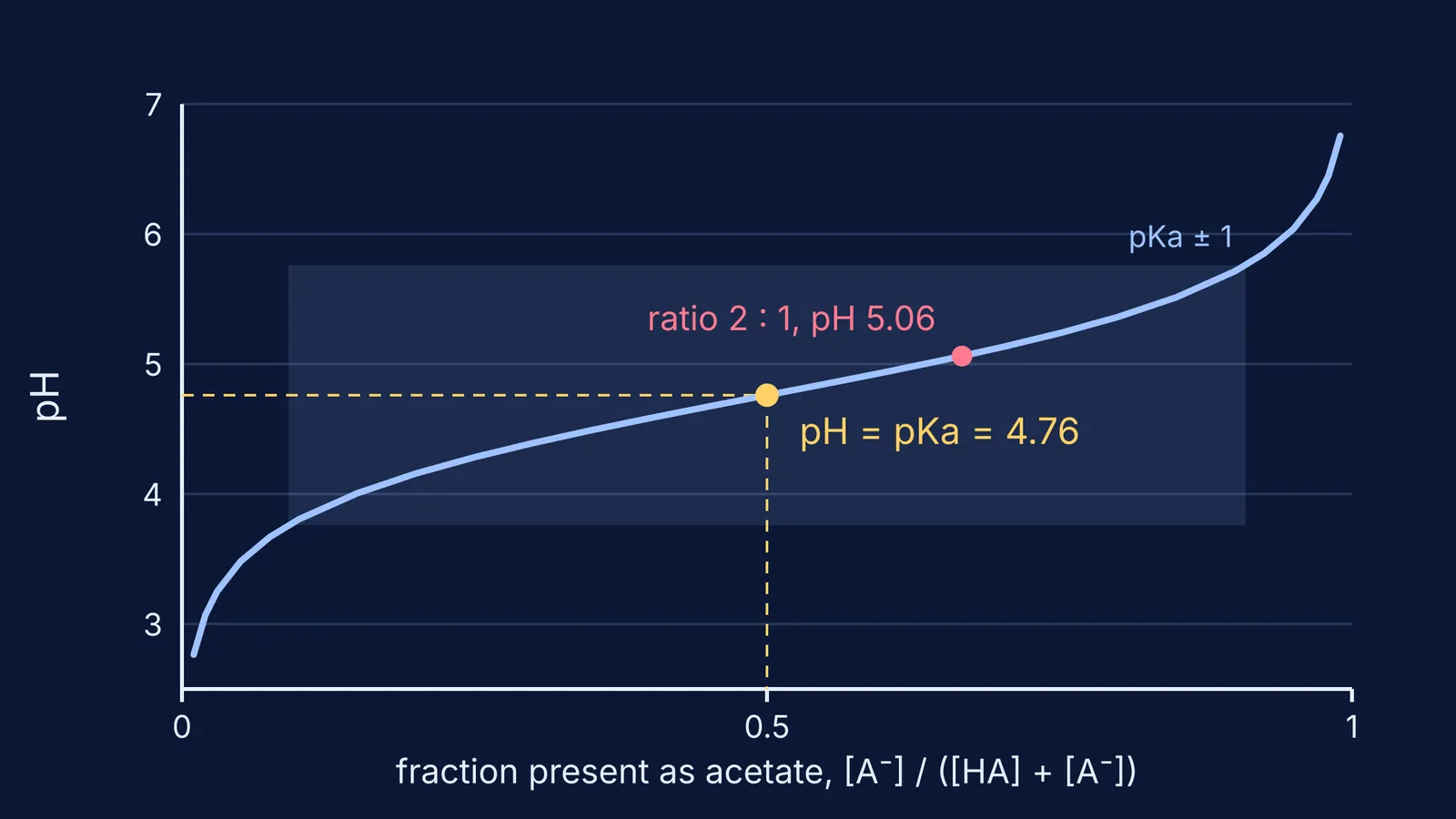
Take a buffer of 0.10 M acetic acid and 0.20 M sodium acetate. Acetic acid has a pKa of 4.76 at 25 °C (PubChem, citing the IUPAC data series). Solve it both ways and you see what the 1916 rewrite saves.
Henderson's 1908 route:
Ka = 10^(−4.76) = 1.74 × 10⁻⁵.
[H⁺] = Ka × [acid]/[salt] = 1.74 × 10⁻⁵ × (0.10/0.20) = 8.7 × 10⁻⁶ mol/L.
pH = −log(8.7 × 10⁻⁶) = 5.06.
Hasselbalch's 1916 route:
pH = 4.76 + log(0.20/0.10).
log 2 = 0.30, so pH = 4.76 + 0.30 = 5.06.
Same answer, with no powers of ten to handle. Three exam habits:
Base on top, acid below. If you flip the ratio, your answer moves the wrong way from pKa.
Equal amounts of acid and base mean log 1 = 0, so pH = pKa. That is the yellow point in the diagram above.
You can use moles instead of concentrations, because both parts share one volume and it cancels in the ratio.
For buffer design and capacity problems, see Henderson-Hasselbalch buffer problems: design, capacity and limits. If you keep getting the setup wrong, the Fermi Problem Library has worked problems with a step-by-step solver that explains the reasoning rather than printing an answer.
Why does blood pH stay near 7.4?
Blood was Hasselbalch's own subject, and the equation still describes it. For the bicarbonate buffer it is written pH = 6.1 + log([HCO₃⁻]/(0.03 × PCO₂)), where 0.03 mmol per mmHg is the solubility coefficient of carbon dioxide (LibreTexts pulmonary physiology/11:_Alkalosis_and_Acidosis/11.03:_The_Henderson-Hasselbalch_equation)). With a normal bicarbonate of 24 and a PCO₂ of 40 mmHg, the ratio is 20, so pH = 6.1 + 1.3 = 7.4, according to the same LibreTexts chapter.
The kidneys control the top of that ratio and the lungs control the bottom. Our post on how the bicarbonate buffer keeps blood pH at 7.4 goes further. This is the textbook model; reading a real blood report is a job for a doctor.
Where does the equation stop working?
The equation assumes that the acid and base you add stay at the amounts you put in. That holds for a weak acid with a fair amount of both forms present. It drifts when the solution is very dilute, when one form is almost absent, or when the acid is strong. For a fuller account, read Henry Po and N. M. Senozan's "The Henderson-Hasselbalch Equation: Its History and Limitations" in the Journal of Chemical Education (DOI 10.1021/ed078p1499).
If the curve makes more sense moving than on paper, the Fermi Simulation Lab has interactive simulations for ideas that are easier to see than to read. Next time you write pH = pKa + log, remember that it is Henderson's chemistry in Hasselbalch's notation.