On this page
Relations and Functions is Chapter 2 of NCERT Class 11 Mathematics. This guide maps it to the CBSE 2026-27 syllabus, works two original examples and ends with school-exam practice questions. For JEE, read our separate guide to Sets, Relations and Functions for JEE Main; this one sticks to the CBSE paper.
How many marks is Relations and Functions in Class 11?
The chapter has no marks of its own. In the CBSE Class XI Mathematics curriculum for 2026-27, Unit I, Sets and Functions, carries 23 marks of the 80-mark theory paper, and internal assessment adds 20 marks. Those 23 marks are shared with Sets and Trigonometric Functions. The curriculum adds: "No chapter/unit-wise weightage. Care to be taken to cover all the chapters."
The same document lists Composition of Functions as a topic "included in the syllabus but will be assessed only formatively", so it stays out of the summative paper.
What does the 2026-27 NCERT chapter cover?
The NCERT chapter (Reprint 2026-27) has three parts:
Cartesian products: ordered pairs, A × B, and the rule that if n(A) = p and n(B) = q, then n(A × B) = pq.
Relations: a relation from A to B is a subset of A × B, with its domain, range and codomain. Since every subset counts, there are 2^pq relations from A to B.
Functions: a relation in which every element of A has exactly one image; graphs of the identity, constant, polynomial, rational, modulus, signum and greatest integer functions; and the sum, difference, product and quotient of real functions.
The curriculum also names exponential and logarithmic functions, which this chapter does not graph; ask your teacher how your school covers them. Types of relations and one-one and onto functions belong to Class 12; our Class 12 relations and functions guide picks up from there.
How do you find the domain and range of a relation?
Worked example 1. Let A = {1, 2, 3} and B = {2, 4}.
A × B has 3 × 2 = 6 ordered pairs, so there are 2^6 = 64 relations from A to B.
Define R = {(x, y) : x < y, x ∈ A, y ∈ B}. Checking the six pairs gives R = {(1, 2), (1, 4), (2, 4), (3, 4)}.
Domain of R = {1, 2, 3}. Range of R = {2, 4}. Codomain = B = {2, 4}.
Is R a function from A to B? No. The element 1 has two images, 2 and 4.
How do you add, multiply and divide real functions?
Worked example 2. Let f(x) = x² − 4 and g(x) = x + 1.
(f + g)(x) = x² + x − 3, so (f + g)(3) = 5 + 4 = 9.
(f − g)(x) = x² − x − 5, so (f − g)(3) = 5 − 4 = 1.
(fg)(x) = x³ + x² − 4x − 4, so (fg)(3) = 5 × 4 = 20.
(f/g)(x) = (x² − 4)/(x + 1), defined only when x ≠ −1, so its domain is R − {−1}. At x = 3 it is 5/4 = 1.25.
Always write the quotient's condition, x ≠ −1.
Which graphs do you need to know?
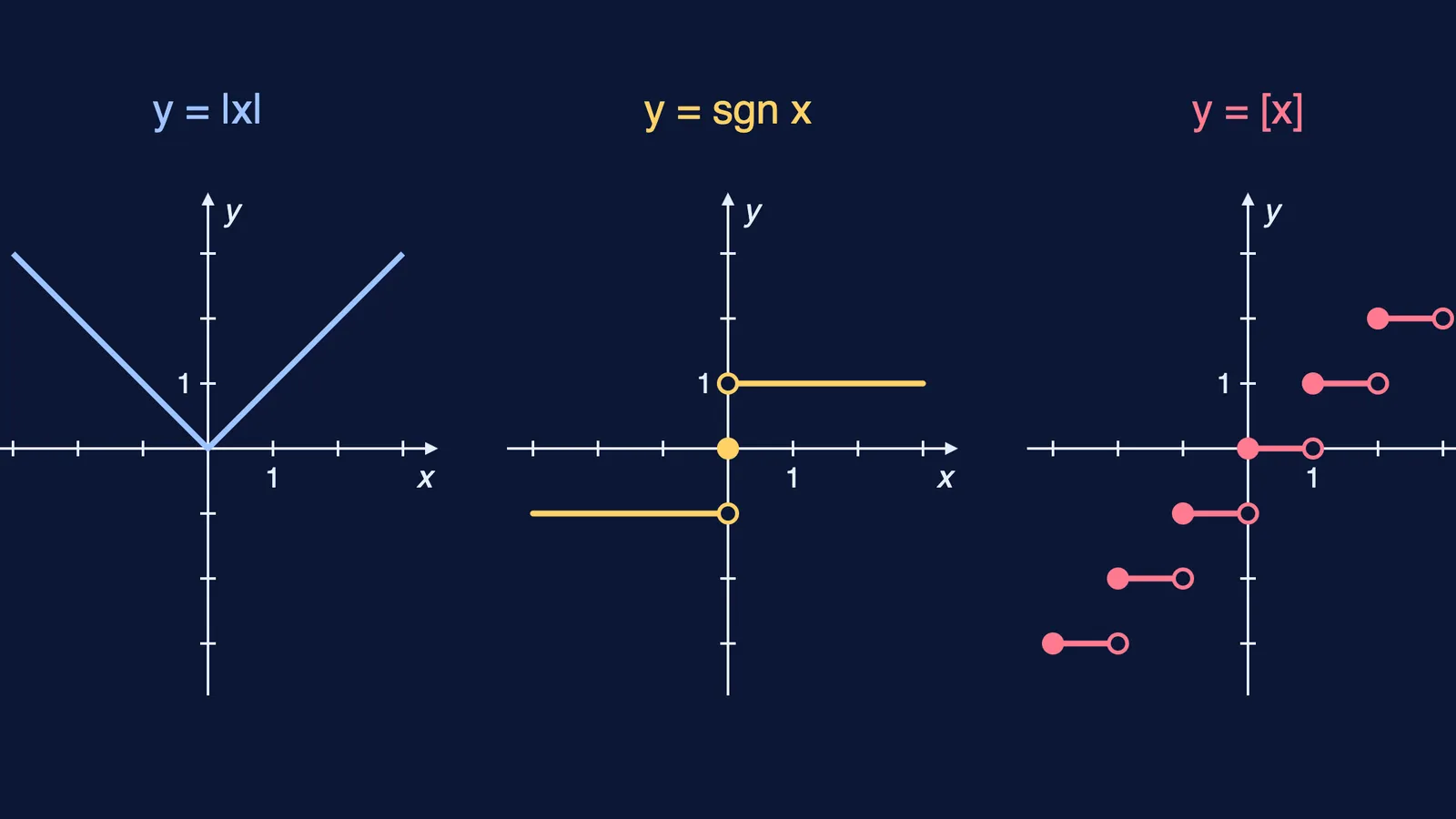
The diagram at the top shows three to know well: the modulus function |x|, a V with range [0, ∞); the signum function, with range {−1, 0, 1} and a filled dot at the origin; and the greatest integer function [x], whose steps have a filled dot on the left and an open dot on the right. Our explainer on identity, constant, modulus and signum functions has more graphs to practise on.
What questions can come in the school exam?
The CBSE Class XI question paper design in the same 2026-27 curriculum gives 44 marks to remembering and understanding, 20 to applying, and 16 to analysing, evaluating and creating, with 33% internal choices in all sections. The questions below are our own, and the mark labels are our suggestion, not CBSE's.
(1 mark) If n(A) = 3 and n(B) = 4, find n(A × B). Answer: 12.
(1 mark) If (2a − 1, b + 3) = (7, −2), find a and b. Answer: a = 4, b = −5.
(2 marks) If n(A) = 3 and n(B) = 3, how many relations are there from A to B? Answer: 2^9 = 512.
(3 marks) Find the domain and range of f(x) = 1/(x − 5). Answer: domain R − {5}, range R − {0}.
(3 marks) For f(x) = 3x − 2 and g(x) = x² + 1, find (f − g)(x), (fg)(−1) and (f/g)(2). Answer: −x² + 3x − 3, −10 and 4/5.
(5 marks) Draw the graph of f(x) = [x] for −2 ≤ x < 3 and state its range there. Answer: {−2, −1, 0, 1, 2}.
If you get stuck on a step, Fermi's AI tutor works out what you already know and builds a plan for the session, so you restart from the step you missed.