On this page
Class 11 gives you a short list of standard real functions to know by heart. Learn each one's domain, range and shape once; limits, continuity and derivatives keep reusing them.
Which real functions does NCERT Class 11 list?
The CBSE Class XI mathematics syllabus for 2026-27 lists constant, identity, polynomial, rational, modulus, signum, exponential, logarithmic and greatest integer functions, with their graphs, under Relations and Functions (CBSE Mathematics curriculum 2026-27). In the same document, that chapter sits in the Sets and Functions unit, which carries 23 of the 80 marks for the written paper.
In the NCERT textbook, Section 2.4.1, Some functions and their graphs, defines seven of these with a graph for each (NCERT Class 11 Mathematics, Chapter 2). NCERT calls a function a real function when both its domain and its range are R or subsets of R.
What are the domain and range of each standard function?
The rules come from NCERT Section 2.4.1 (NCERT Chapter 2); where NCERT draws a graph without stating the range, the range here is read off that graph.
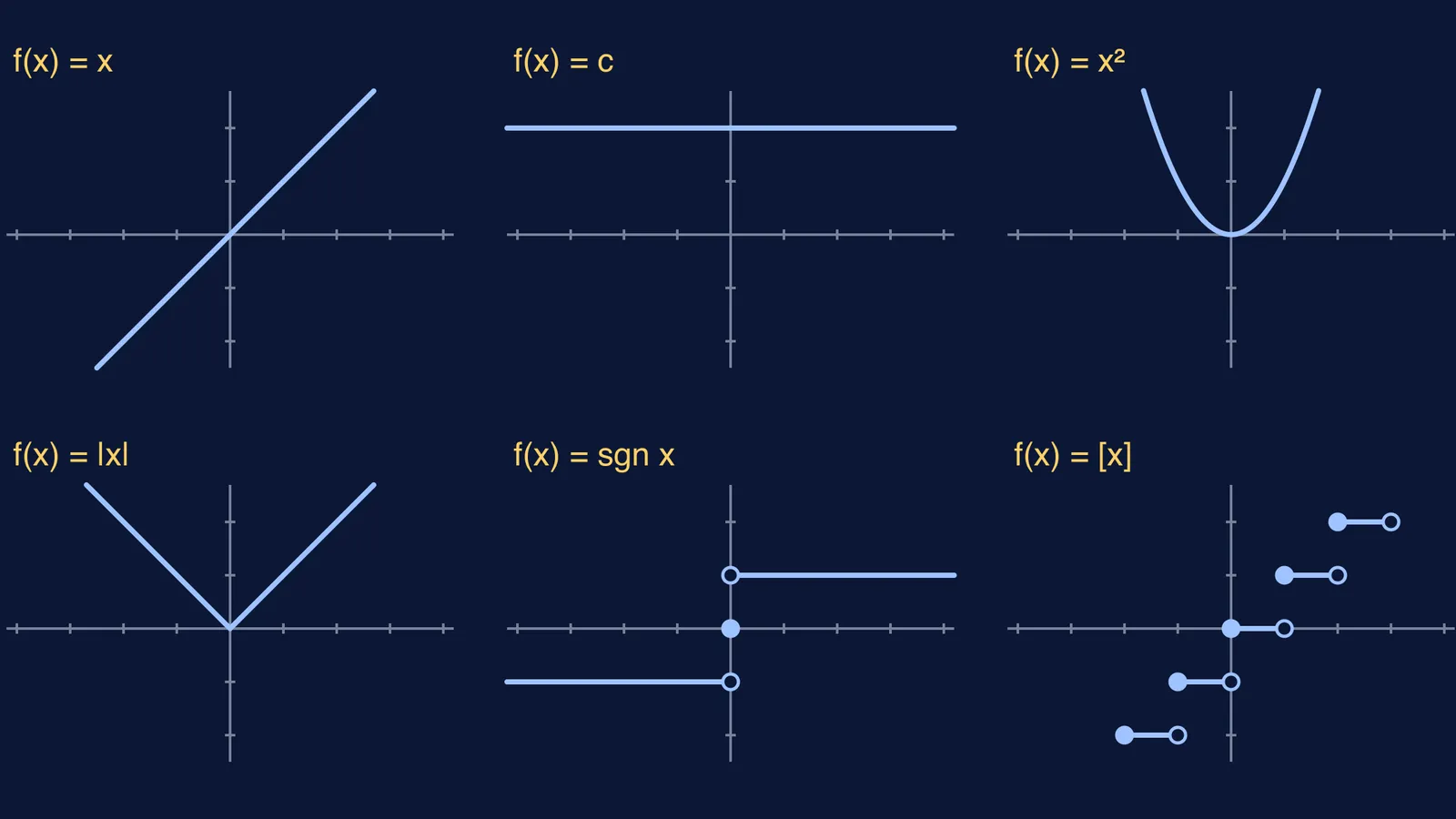
Identity function, f(x) = x: domain R, range R. A straight line through the origin.
Constant function, f(x) = c: domain R, range {c}, a set with one element. A line parallel to the x-axis; NCERT draws f(x) = 3.
Polynomial function, f(x) = a₀ + a₁x + a₂x² + … + aₙxⁿ, with n a non-negative integer: domain R. The range varies: x² gives [0, ∞), x³ gives R.
Rational function, f(x)/g(x) with both parts polynomials and g(x) ≠ 0. For f(x) = 1/x, NCERT gives the domain and the range as all real numbers except 0.
Modulus function, f(x) = |x|, equal to x for x ≥ 0 and −x for x < 0: domain R, range [0, ∞). A V with its corner at the origin.
Signum function, f(x) = 1 if x > 0, 0 if x = 0, −1 if x < 0: domain R, range {−1, 0, 1}. Two horizontal rays with hollow ends at x = 0, plus a solid point at the origin.
Greatest integer function, f(x) = [x], the greatest integer less than or equal to x: domain R, range the integers. A staircase: [x] = −1 for −1 ≤ x < 0, 0 for 0 ≤ x < 1, 1 for 1 ≤ x < 2.
For a closer look at one of these, read our post on the signum function's graph and properties.
How do you sketch these graphs without a long table of values?
NCERT builds some graphs, such as x² and 1/x, from a table of values. In an exam, use five steps:
Write the domain first. Usually only a denominator or a root removes points.
Find the breakpoints where the rule changes: 0 for |x| and signum, every integer for [x], zeros of the denominator for a rational function.
Work out the value at each breakpoint and just either side of it.
Draw solid dots for values the function takes and hollow dots for values it skips.
Project the graph sideways onto the y-axis. The part of the y-axis it covers is the range.
Worked example: what are the domain and range of f(x) = x + |x|?
This adds the identity and modulus functions, which NCERT Section 2.4.2 allows: (f + g)(x) = f(x) + g(x).
Domain: both parts accept every real x, so the domain is R.
Breakpoint: |x| changes rule at x = 0.
For x ≥ 0, |x| = x, so f(x) = 2x. For x < 0, |x| = −x, so f(x) = 0.
The graph runs along the negative x-axis, then rises from the origin with slope 2. No jumps, so no hollow dots.
Project onto the y-axis: the left half gives only 0, the right half every value from 0 upward. Range = [0, ∞).
Check: f(−3) = 0 and f(2) = 4. Both fit.
Try g(x) = x − [x] yourself; our post on greatest integer and fractional part functions works through it.
If the idea of range itself feels shaky, the Fermi Concept Library gives every concept in mathematics its own lesson and its place in the map, so you can step back one idea.
Which mistakes cost marks on these graphs?
Writing the range of |x| as R. The modulus is never negative.
Leaving out the solid point at the origin on the signum graph.
Getting [x] wrong for negatives. [−1.5] is −2, not −1, because −2 is the greatest integer less than or equal to −1.5.
Writing domain R for 1/x. Zero is excluded from both domain and range.
Calling x^(2/3) + 2x a polynomial. NCERT uses it as an example of one that is not.
Next come sums like |x − 1| + |x − 3|; our guide on graphing a sum of modulus functions shows how. For mixed practice, the Fermi Problem Library has worked problems with a step-by-step solver that explains the reasoning rather than printing an answer.