

On this page
The signum function is one of the simplest piecewise functions in mathematics, but it appears everywhere from integration to engineering. Also known as the sign function, its job is to strip away a number's magnitude and leave only its sign.
If you are preparing for exams like the JEE or simply building a foundation in calculus, understanding how the signum function behaves is essential for graphing and solving inequalities.
What is the signum function?
The signum function, denoted as sgn(x), is a mathematical rule that extracts the sign of a real number. The signum function is defined to output 1 for positive numbers, 0 for zero, and −1 for negative numbers, according to Wolfram MathWorld.
Written mathematically, the definition splits into three cases:
sgn(x) = 1 if x > 0 sgn(x) = 0 if x = 0 sgn(x) = −1 if x < 0
For any non-zero real number, the function can also be expressed using the absolute value as sgn(x) = x / |x|. Because it breaks real numbers down into just three possible states, it is frequently used to write compact piecewise expressions.
When you need to review mathematical definitions from first principles, the Fermi Concept Library covers every concept in physics, chemistry, biology, mathematics and computing, each with its own lesson and its place in the map.
What are the domain and range of the signum function?
Because you can plug any real number into the signum function—whether it is an integer, a fraction, or an irrational number like π—the domain is the set of all real numbers, ℝ.
The range, however, is strictly limited. No matter how large or small the input is, the output will only ever be one of three values. The range of the signum function is the discrete set {−1, 0, 1} (Wolfram MathWorld).
How do you draw the signum function graph?
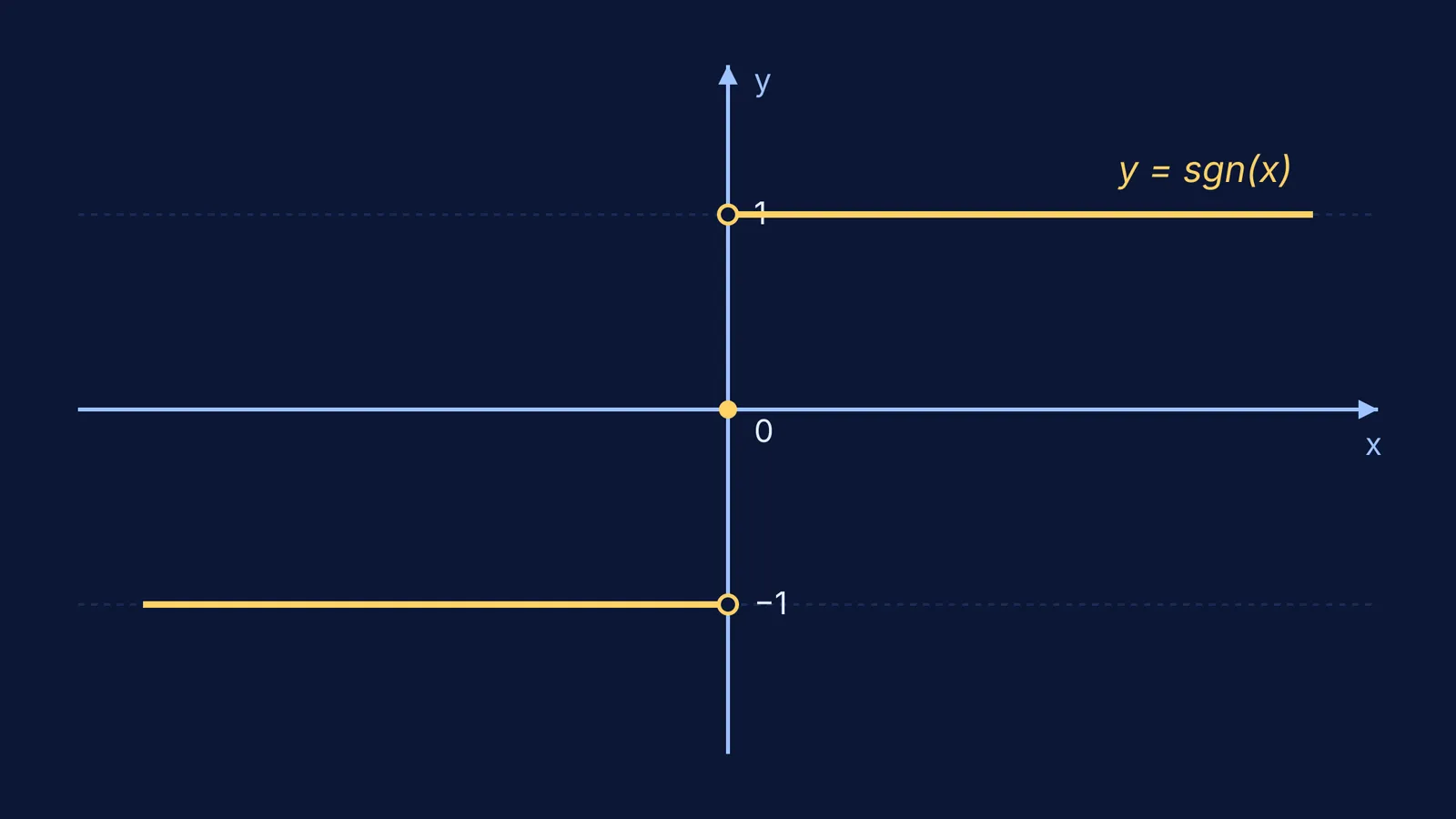
The graph of y = sgn(x) consists of three distinct parts:
A horizontal ray at y = 1 for all x > 0.
A horizontal ray at y = −1 for all x < 0.
A single isolated point at the origin (0, 0).
Because the function jumps from −1 to 1 as it crosses the y-axis, it has a jump discontinuity at x = 0. To represent this correctly on a graph, we draw open circles at (0, 1) and (0, −1) to show those points are excluded from the horizontal lines, and a solid dot at (0, 0) to show the actual value at zero.
What are the key properties of the signum function?
The signum function obeys several predictable algebraic rules that help simplify equations.
It is an odd function: The graph is symmetric about the origin, which means sgn(−x) = −sgn(x).
Multiplication rule: The sign of a product is the product of the individual signs, so sgn(x × y) = sgn(x) × sgn(y).
Absolute value relationship: Any real number can be written as the product of its magnitude and its sign, giving the identity x = |x| × sgn(x) (Wolfram MathWorld).
These properties are especially useful when tackling modulus equations and inequalities, where keeping track of negative signs is often half the battle.
How do you evaluate expressions like sgn(x² − 1)?
Exam questions rarely ask for just sgn(x). Instead, they ask you to evaluate the signum of a larger algebraic expression. To solve these, you do not need to calculate the exact numerical value of the inner expression—you only need to know when it is positive, negative, or zero.
Let us evaluate sgn(x² − 1). The output depends entirely on the sign of the inner quadratic expression.
When is it 1? The output is 1 when x² − 1 > 0. This occurs when x² > 1, which means x > 1 or x < −1.
When is it 0? The output is 0 when x² − 1 = 0. This happens exactly at the roots x = 1 and x = −1.
When is it −1? The output is −1 when x² − 1 < 0. This means x² < 1, which falls in the interval −1 < x < 1.
If you struggle to break down conditions like these, the Fermi Problem Library has worked problems with a step-by-step solver that explains the reasoning rather than printing an answer.
By mapping out the intervals where the inner expression changes sign, you can quickly evaluate composite signum functions without relying on complex calculations. For rational expressions, this method pairs well with techniques used for finding the range of a rational function.


