On this page
Sets is Chapter 1 of Class 11 maths; its notation returns in relations, functions and probability.
What does the CBSE 2026-27 syllabus include in Sets?
The CBSE Mathematics curriculum for 2026-27 puts Sets in Unit I, Sets and Functions, which carries 23 of the 80 theory marks. That 23 covers three chapters, Sets, Relations and Functions, and Trigonometric Functions, and the curriculum adds "No chapter/unit-wise weightage", so Sets has no figure of its own.
Listed topics: representations, the empty set, finite, infinite and equal sets, subsets, intervals, the universal set, Venn diagrams, union, intersection, difference, complement and its properties.
One topic is out of the written paper: the curriculum lists "Practical problems on Union and Intersection of two sets" among Class XI topics that "will be assessed only formatively to reinforce understanding without adding to summative assessments". So n(A ∪ B) counting problems stay out of the year-end paper.
The current NCERT Class 11 Mathematics chapter on Sets (Reprint 2026-27) runs from 1.1 Introduction to 1.10 Complement of a Set. It has no section on power sets, and the curriculum does not list them.
The question paper design gives 44 marks to remembering and understanding, 20 to applying and 16 to analysing, evaluating and creating. CBSE publishes no Class XI sample paper, so the mark labels below are our suggestion.
What are the key definitions in Class 11 Sets?
Roster and set-builder form. {2, 3, 5, 7} lists elements; {x : x is a prime number less than 10} states the property; no element is listed twice.
Empty set (φ). A set with no elements, such as {x : x is a natural number and x + 4 = 2}.
Equal sets. Exactly the same elements, in any order.
Subset and proper subset. A ⊂ B when each element of A belongs to B; proper means A ≠ B as well. A set with one element is a singleton.
Intervals. (a, b) leaves out both ends, [a, b] includes both, and [a, b) and (a, b] include one. The length of each is b − a. So {x : −2 < x ≤ 5} is (−2, 5], of length 7.
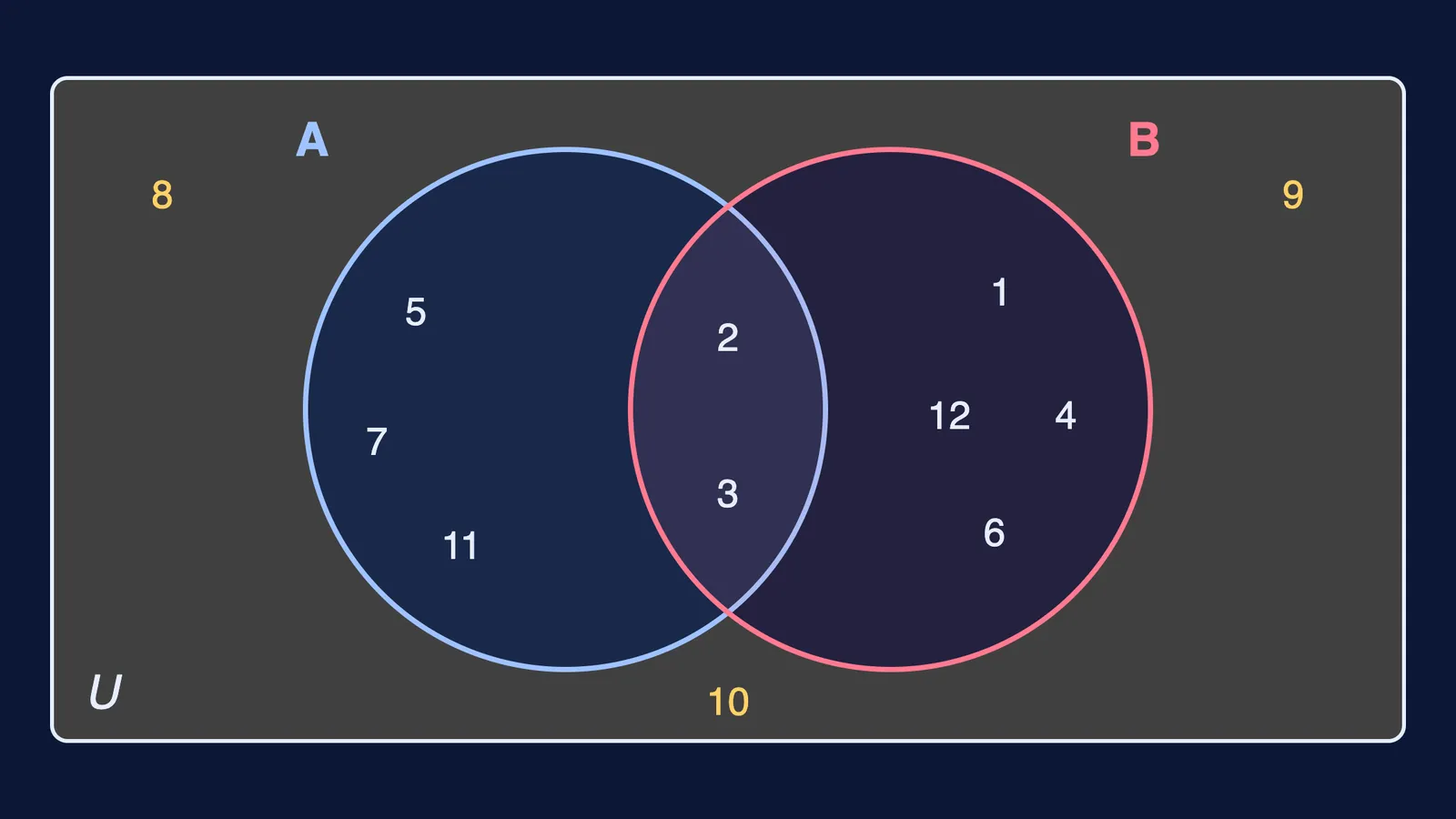
Universal set (U). Drawn as a rectangle in a Venn diagram, with subsets as circles.
How do you solve a set operations question?
Question (4 marks). U = {1, 2, …, 12}, A = {x : x is a prime less than 12}, B = {x : x is a factor of 12}. Find A ∪ B, A ∩ B, A − B, B − A, and verify De Morgan's laws.
Roster form: A = {2, 3, 5, 7, 11} and B = {1, 2, 3, 4, 6, 12}.
Union: A ∪ B = {1, 2, 3, 4, 5, 6, 7, 11, 12}, with 2 and 3 listed once.
Intersection: A ∩ B = {2, 3}.
Differences: A − B = {5, 7, 11}, B − A = {1, 4, 6, 12}, so A − B ≠ B − A.
Complements: A′ = {1, 4, 6, 8, 9, 10, 12} and B′ = {5, 7, 8, 9, 10, 11}.
First law: (A ∪ B)′ = {8, 9, 10} = A′ ∩ B′.
Second law: (A ∩ B)′ = U − {2, 3} = {1, 4, 5, 6, 7, 8, 9, 10, 11, 12} = A′ ∪ B′.
Check: A − B, A ∩ B and B − A are disjoint, and 3 + 2 + 4 = 9, the size of A ∪ B. The diagram above shades (A ∪ B)′.
What questions can you practise for the Class 11 exam?
(1 mark) Is {x : x is a natural number and x² < 2} a singleton or the empty set? *Only x = 1 works, so it is a singleton.*
(1 mark) Write (−1, 6] ∩ [2, 9) as an interval; give its length. *[2, 6], of length 4.*
(2 marks) Show that A − B = A ∩ B′. *x ∈ A − B means x ∈ A and x ∉ B, that is x ∈ A and x ∈ B′.*
(3 marks) With U = {20, 21, …, 30}, P = {x : x is a multiple of 4} and Q = {x : x is a multiple of 6}, verify (P ∩ Q)′ = P′ ∪ Q′. *P ∩ Q = {24}, P′ = {21, 22, 23, 25, 26, 27, 29, 30} and Q′ = {20, 21, 22, 23, 25, 26, 27, 28, 29}, so both sides are U − {24}.*
How should you revise Sets before the exam?
Give one session to notation (both forms, intervals on a number line) and one to operations, with a Venn diagram per answer.
If you also sit JEE Main, our Sets, Relations and Functions guide for JEE Main covers power sets and n(A ∪ B) counting. For Class 12, see our guide to relations and functions for the Class 12 board exam.
Not sure where to start? Fermi's AI tutor can work out what you already know and build a plan for the session.