On this page
Trigonometric Functions is Chapter 3 of the NCERT Class 11 Mathematics textbook, and it turns the triangle ratios you met in Class 10 into functions of any real number. Here is what CBSE 2026-27 keeps, how marks work, solved examples with our own numbers, and practice questions.
What does the Class 11 Trigonometric Functions chapter cover in 2026-27?
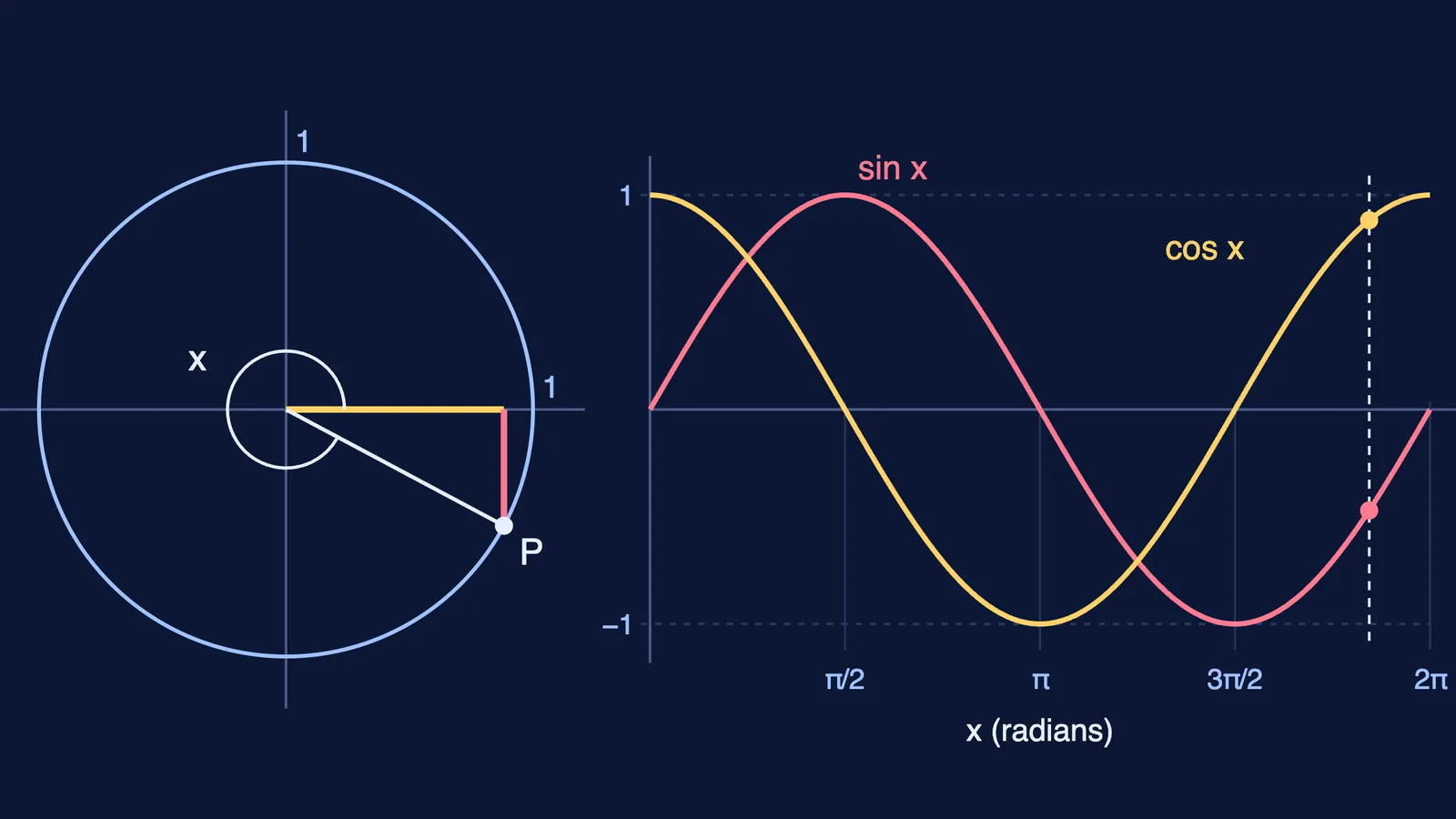
The CBSE 2026-27 Mathematics curriculum lists: positive and negative angles, degree and radian measure, trigonometric functions defined with the unit circle, sin² x + cos² x = 1, signs, domain, range and graphs, sin (x ± y) and cos (x ± y), the tan and cot sum formulas, the sum-to-product identities, and identities for sin 2x, cos 2x, tan 2x, sin 3x, cos 3x and tan 3x.
The current NCERT chapter (Reprint 2026-27) covers this in four sections; the last one builds the sum and difference formulas.
General solutions of equations like sin y = sin a are not in the rationalised NCERT chapter. The curriculum puts them in a Class XI list of topics that will be "assessed only formatively to reinforce understanding without adding to summative assessments". Learn them for class tests, not for the year-end paper.
How many marks is Trigonometric Functions in Class 11?
CBSE does not print a mark for this chapter. The curriculum gives 23 marks to Unit I, Sets and Functions, which this chapter shares with Sets and with Relations and Functions, out of an 80-mark theory paper plus 20 marks of internal assessment (CBSE curriculum). The same page adds: "No chapter/unit-wise weightage. Care to be taken to cover all the chapters."
Worked examples: radians, any angle and sum formulas
1. Arc length. A central angle of 75° in a circle of radius 12 cm. Convert: 75 × π/180 = 5π/12 radian. Then l = rθ = 12 × 5π/12 = 5π cm, about 15.7 cm.
2. Any angle. sin x = −8/17 and x lies in the fourth quadrant. Since cos² x = 1 − 64/289 = 225/289, cos x = ±15/17, and cosine is positive in the fourth quadrant, so cos x = 15/17. Then tan x = −8/15, cosec x = −17/8, sec x = 17/15, cot x = −15/8.
3. A large negative angle. sin (−1830°) = sin (−1830° + 5 × 360°) = sin (−30°) = −1/2, because sine repeats every 360° and is an odd function.
4. Sum formula. cos 105° = cos (60° + 45°) = cos 60° cos 45° − sin 60° sin 45° = (1/2)(1/√2) − (√3/2)(1/√2) = (1 − √3)/(2√2) = (√2 − √6)/4, about −0.259. Negative, as expected in the second quadrant.
How do you write proofs and multiple-angle answers?
For a proof, start from the more complicated side and name each identity you use.
Proof 1. Prove (cos 2x − cos 6x)/(sin 6x + sin 2x) = tan 2x.
Using the sum-to-product identities, cos 2x − cos 6x = −2 sin 4x sin (−2x) = 2 sin 4x sin 2x, and sin 6x + sin 2x = 2 sin 4x cos 2x. Cancel 2 sin 4x: sin 2x/cos 2x = tan 2x = RHS.
Example 5 (multiple angle). If tan x = 12/5 and π < x < 3π/2, find sin 2x, cos 2x and tan 2x.
In the third quadrant both sine and cosine are negative, so sin x = −12/13 and cos x = −5/13. Then sin 2x = 2 sin x cos x = 120/169, cos 2x = cos² x − sin² x = 25/169 − 144/169 = −119/169, and tan 2x = −120/119. Check with tan 2x = 2 tan x/(1 − tan² x) = (24/5)/(−119/25) = −120/119. The signs fit: 2x lies between 2π and 3π, in the second quadrant.
We checked every answer here by hand and with a short script.
What questions should you practise for the school exam?
CBSE's academic site lists sample papers for Classes X and XII only, so there is no official Class 11 pattern to copy. The mark labels below are our suggestion, not CBSE's.
(1 mark) Convert 5π/12 radian into degrees. Answer: 75°.
(2 marks) Given cos x = −7/25 with π < x < 3π/2, find the other five functions. Answer: sin x = −24/25, tan x = 24/7.
(3 marks) Prove that sin 2x/(1 + cos 2x) = tan x.
(5 marks) Using cos (2x + x), prove that cos 3x = 4 cos³ x − 3 cos x, and find cos 3x when cos x = 1/3. Answer: −23/27.
Where does this chapter lead next?
Results such as cos (π − x) = −cos x get more practice in trigonometric ratios of allied angles in Class 11. Domain and range build on sets and relations in Class 11, and in Class 12 these graphs return with restricted domains in inverse trigonometric functions for the board exam.
If you are not sure where to start, Fermi's AI tutor can work out what you already know and build a plan for the session, so you sit down to a clear next step.