On this page
Permutations and Combinations is Chapter 6 of the NCERT Class 11 Mathematics textbook (Reprint 2026-27). Its core habit, deciding whether order matters before picking a formula, returns in Binomial Theorem and Probability. For the entrance exam, see our Permutations and Combinations guide for JEE Main; this guide is for the CBSE school exam.
What does the CBSE 2026-27 syllabus include, and how many marks?
The CBSE Mathematics curriculum for 2026-27 puts this chapter in Unit II, Algebra: fundamental principle of counting, factorial n, permutations and combinations, derivation of the formulae for nPr and nCr and their connections, and simple applications.
In the Class 11 course structure, Algebra carries 25 of the 80 theory marks, shared by five chapters: Complex Numbers and Quadratic Equations, Linear Inequalities, this one, Binomial Theorem, and Sequence and Series. Under the table it adds: "*No chapter/unit-wise weightage. Care to be taken to cover all the chapters." There is no separate figure for this chapter.
It also lists Class 11 topics with this note: "The following topics are included in the syllabus but will be assessed only formatively to reinforce understanding without adding to summative assessments." Permutations and Combinations is not on that list, so the whole of the current NCERT chapter counts for the year-end exam.
What does the NCERT chapter cover?
Fundamental principle of counting (6.2): m ways followed by n ways give m × n outcomes in that order.
Permutations (6.3): nPr = n!/(n − r)! without repetition, nʳ with repetition, and n!/(p₁! p₂! … pₖ!) when some objects are alike.
Combinations (6.4): nCr = n!/(r!(n − r)!), the link nPr = nCr × r!, nC0 = 1, nCn−r = nCr, and nCr + nCr−1 = n+1Cr.
The current text has no circular arrangements. If nC0 = 1 feels odd, read why 0! is defined as 1.
When do you use nPr and when nCr?
Ask: if I swap two chosen items, is the outcome different? Yes means arranging (nPr); no means selecting (nCr).
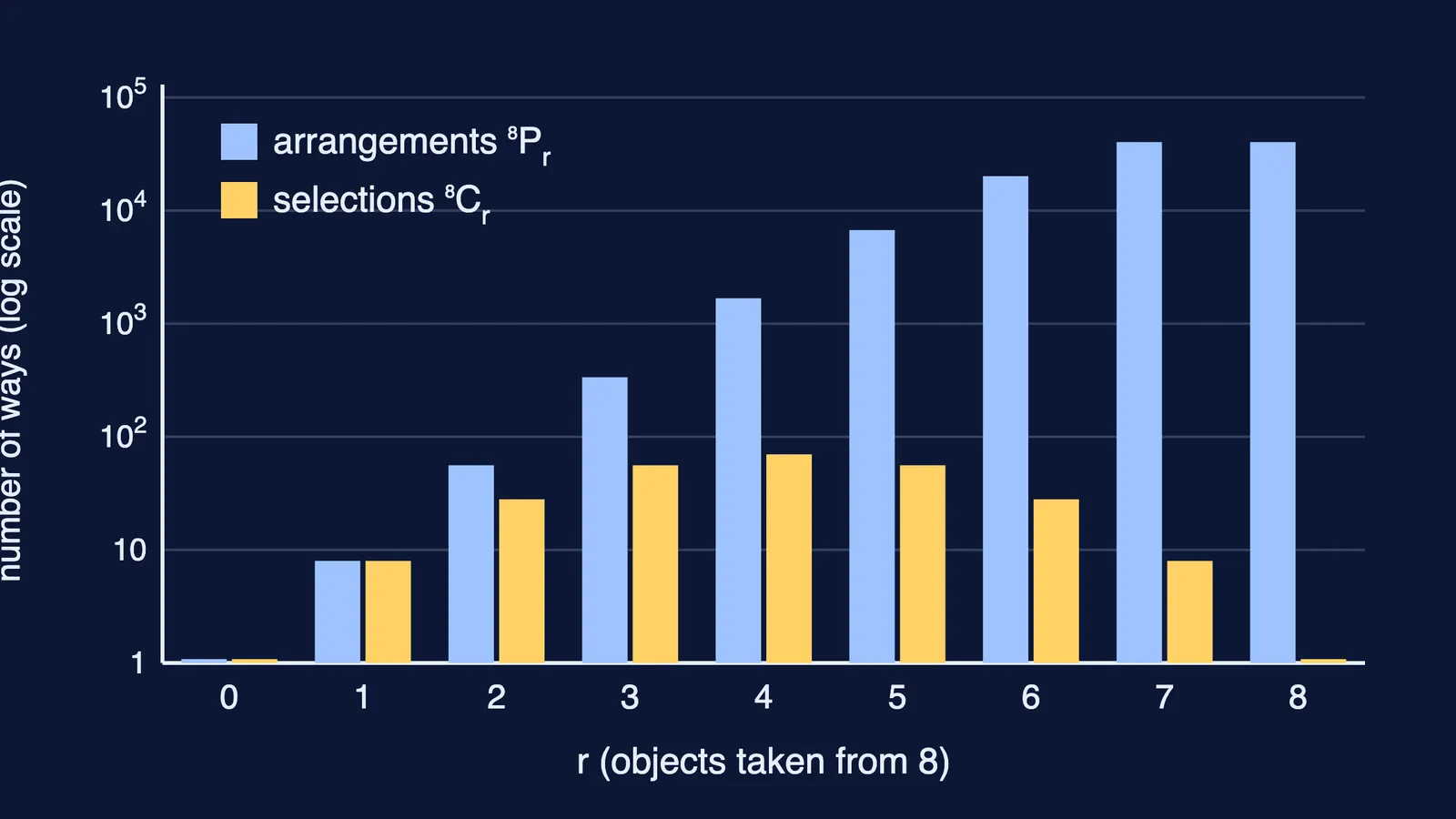
The chart above shows the gap. Each selection of r objects can be ordered in r! ways, so ⁸P₃ = 336 is exactly 3! = 6 times ⁸C₃ = 56.
How do you solve permutations and combinations word problems?
We checked each answer by hand and by listing every case in Python.
1. Counting principle. With 5 snacks, 3 drinks and 2 desserts, one of each gives 5 × 3 × 2 = 30 meals. A playlist of 4 different songs, in order, from 7 songs: 7 × 6 × 5 × 4 = 840. If a song may repeat: 7⁴ = 2401.
2. Order matters, or not. For eight runners, gold, silver and bronze go in ⁸P₃ = 8 × 7 × 6 = 336 ways. A relay squad of 3 has no order: ⁸C₃ = 336 ÷ 3! = 56.
3. Alike letters. AGARTALA has 8 letters with four As: 8!/4! = 40320 ÷ 24 = 1680 arrangements. Starting with T: the other 7 letters give 7!/4! = 210.
4. A panel with a condition. From 6 seniors and 4 juniors, choose a panel of 4.
Exactly 1 junior: ⁴C₁ × ⁶C₃ = 4 × 20 = 80.
At least one junior: all panels minus all-senior ones, ¹⁰C₄ − ⁶C₄ = 210 − 15 = 195. By cases (1 to 4 juniors): 80 + 90 + 24 + 1 = 195.
5. Geometry. Joining two of a decagon's 10 vertices gives ¹⁰C₂ = 45 segments; 10 are sides, so 35 are diagonals.
What questions can you practise for the school exam?
These are our own questions. The curriculum sets no per-question marks for this chapter, so the mark labels are our suggestion, not a CBSE pattern.
(1 mark) If nC2 = 66, find n.
(2 marks) How many 4-digit even numbers can be made from 2, 3, 5, 7 and 8 with no digit repeated?
(3 marks) How many arrangements of the letters of SUCCESS are there? In how many are the two Cs together?
(5 marks) A team of 6 is chosen from 5 teachers and 8 students, with at least 2 teachers. How many teams are possible? In how many is one particular student included?
Answers: (1) n(n − 1)/2 = 66, so n(n − 1) = 132 = 12 × 11 and n = 12. (2) Last digit 2 or 8, then 4 × 3 × 2: 48. (3) 7!/(3! × 2!) = 420; treat CC as one unit, so 6 units with three Ss: 6!/3! = 120. (4) ¹³C₆ − ⁸C₆ − 5 × ⁸C₅ = 1716 − 28 − 280 = 1408; with the student fixed, 5 more from 12 the same way: 792 − 21 − 175 = 596.
When a problem will not come out, Fermi's AI tutor works out what you already know and builds a plan for the session, so you start from the step where you are stuck.