

On this page
Eccentricity sorts every conic into its family and then tells you how stretched the curve is. Read e, and you can sketch the curve before solving anything.
What is the eccentricity of a conic?
The cleanest definition uses a focus and a directrix. Wolfram MathWorld defines a non-circular conic as the path of a point P for which the distance from a fixed point F (the focus), divided by the distance from a fixed line (the directrix), is a positive constant e, the eccentricity.
So e is a ratio: PF = e × PD, where PD is the distance from P to the directrix.
PF always smaller than PD (e < 1): the curve closes into an ellipse.
PF always equal to PD (e = 1): a parabola.
PF always larger (e > 1): the curve opens into a hyperbola.
A circle is the special case e = 0 (MathWorld, Ellipse): then c = ae = 0, so both foci sit at the centre. Our post on the directrix of an ellipse and a hyperbola shows where the line in PF = e × PD actually sits.
What does each value of e mean?
MathWorld's eccentricity entry gives the four ranges:
e = 0: circle
0 < e < 1: ellipse
e = 1: parabola
e > 1: hyperbola
For an ellipse or a hyperbola, e = c/a, where c is the centre-to-focus distance and a is the semi-major (or semi-transverse) axis.
The two formulas you will use most in board exams and JEE Main are e = √(1 − b²/a²) for an ellipse (MathWorld) and e = √(1 + b²/a²) for a hyperbola (MathWorld). The minus and plus signs are the whole difference, and our post on why c² = a² − b² for an ellipse but a² + b² for a hyperbola explains where they come from.
What does a larger eccentricity look like?
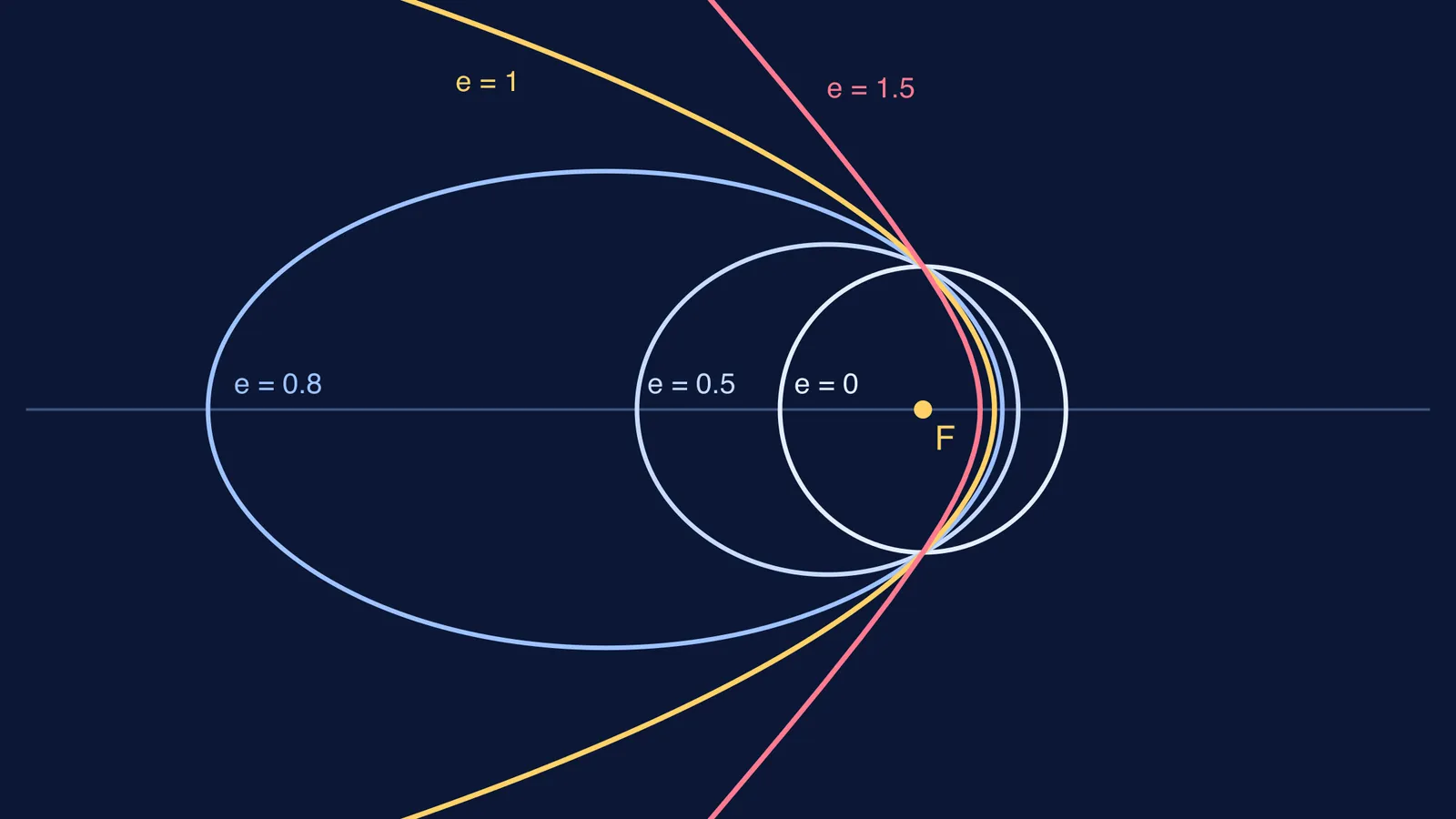
Rearrange the same formulas and e turns straight into a shape. For an ellipse, b/a = √(1 − e²), so the short axis shrinks as e grows:
e = 0.5: b/a ≈ 0.87, still nearly round
e = 0.8: b/a = 0.6, clearly oval
e = 0.95: b/a ≈ 0.31, a long, thin cigar
For a hyperbola, the asymptotes have slope ±b/a (MathWorld), and b/a = √(e² − 1). If φ is the angle each asymptote makes with the transverse axis, then cos φ = 1/e:
e = 1.2: φ ≈ 33.6°, narrow arms
e = √2 ≈ 1.41: φ = 45°, the rectangular hyperbola, whose asymptotes are perpendicular
e = 2: φ = 60°, wide arms
very large e: φ approaches 90°, and each branch flattens towards a straight line
The diagram at the top draws five cases around one focus F from MathWorld's polar form r = pe/(1 + e cos θ), keeping the semi-latus rectum pe fixed.
How do you find e from an equation?
Work these three in order, using the formulas above.
Ellipse x²/25 + y²/16 = 1. Here a² = 25 and b² = 16, so e = √(1 − 16/25) = √(9/25) = 0.6. Then c = ae = 3, so the foci are at (±3, 0), and b/a = 0.8: visibly oval, not flat.
Hyperbola x²/16 − y²/9 = 1. Here e = √(1 + 9/16) = √(25/16) = 1.25. The foci are at (±5, 0), the asymptotes are y = ±(3/4)x, and cos φ = 1/1.25 = 0.8, so each asymptote is about 36.9° from the x-axis.
Parabola y² = 8x. Every parabola has e = 1. The 8 changes its size, not its eccentricity.
A common trap is the ellipse x²/16 + y²/25 = 1, whose major axis lies along y. The larger denominator is always a², so e is still 0.6. Taking a² = 16 by habit gives √(1 − 25/16), the root of a negative number: a sign you swapped them.
Our walkthrough of finding eccentricity from ellipse conditions covers problems where e hides inside a condition. The Fermi Problem Library has worked problems with a step-by-step solver that explains the reasoning rather than printing an answer.
Where do you see eccentricity in real orbits?
To a good approximation, planets and comets move on conics with the Sun at a focus, so e describes their paths too.
Earth's orbit has e = 0.0167, according to NASA's Earth Fact Sheet: so close to a circle that you could not tell the difference by eye.
Comet 1P/Halley has e = 0.968 in NASA JPL's Small-Body Database: a long, thin ellipse, but still a closed one, so the comet keeps coming back.
'Oumuamua (A/2017 U1) has e = 1.2 in the same database: a hyperbola, so its path is open and it swung past the Sun once without being captured.
If the link between the focus-directrix definition and these formulas still feels shaky, the Fermi Concept Library gives every mathematics concept its own lesson and its place in the map.


