

On this page
Coordinate geometry questions often ask you to find the eccentricity of an ellipse without giving you its full equation. Instead, they provide a word puzzle—a mathematical condition that links two distinct parts of the ellipse together.
Turning a phrase like "the latus rectum equals half the minor axis" into an algebra equation is a standard test of your mathematical fundamentals. Examiners use these questions because they test two skills at once: your memory of conic section properties and your ability to algebraically manipulate ratios. Once you accurately set up the initial equation, finding the eccentricity (e) is simply a matter of careful substitution.
What are the standard formulas?
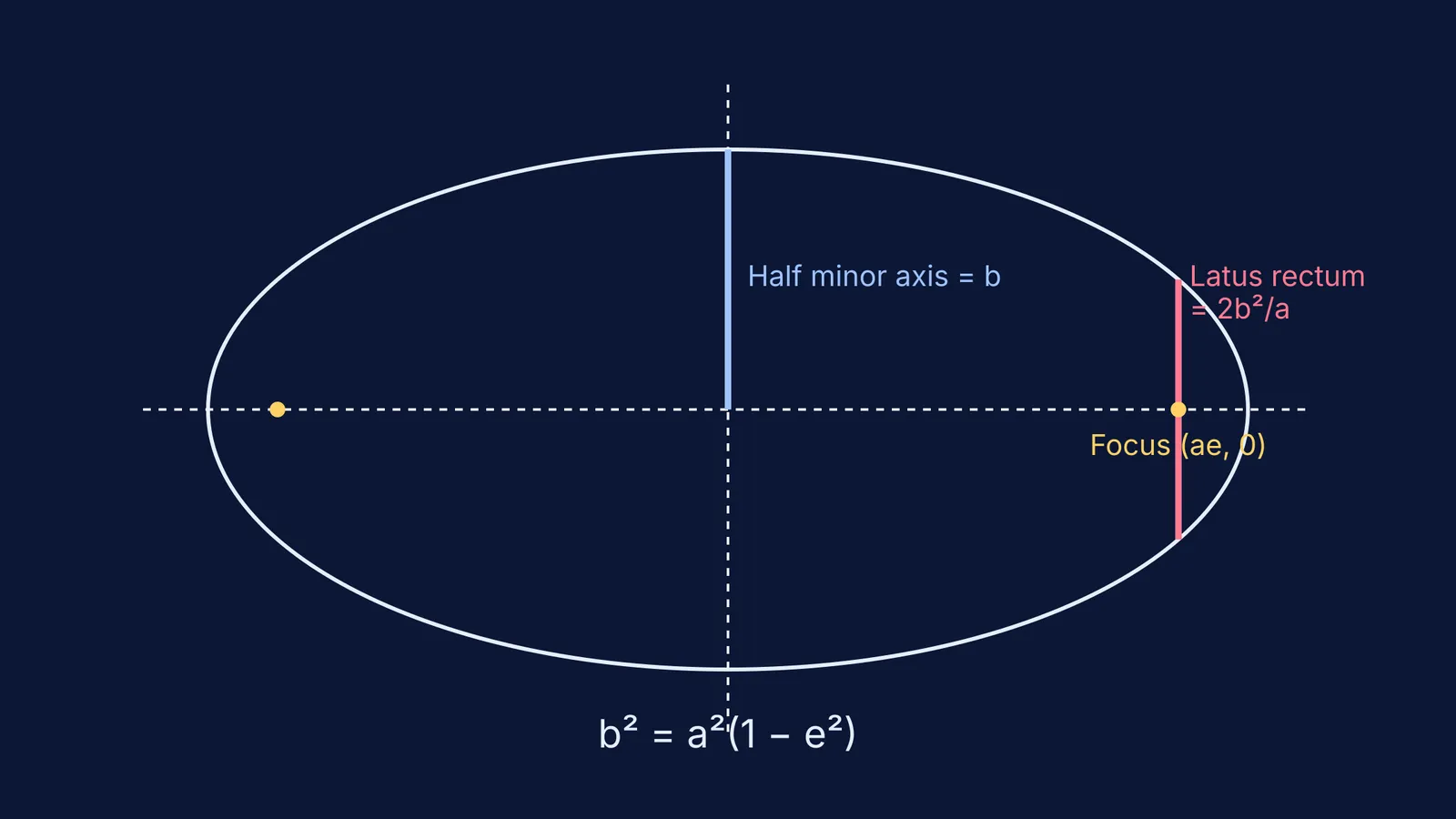
To correctly translate the English words into maths, you need to be perfectly familiar with the standard definitions taught in the NCERT Class 11 Mathematics syllabus. For a standard ellipse centered at the origin with a horizontal major axis (where a > b):
Major axis length: 2a
Minor axis length: 2b
Latus rectum length: 2b²/a
Distance between foci: 2ae
Every ellipse for JEE and standard school exam problem relies on one central relationship tying these physical dimensions to the eccentricity:
b² = a²(1 − e²)
This formula acts as your bridge. Whenever an exam question gives you a verbal condition, your ultimate goal is to algebraically find the ratio b/a (or b²/a²) and then substitute it into this bridge equation.
How do you solve "latus rectum equals half the minor axis"?
Let's break down one of the most common exam questions step by step. Suppose you are asked to find the eccentricity of an ellipse where the latus rectum is equal to exactly half of its minor axis.
Step 1: Write the condition as an equation The problem states: Latus Rectum = 1/2 × Minor Axis. Using our latus rectum lengths and axis formulas from above, we write: 2b²/a = 1/2 × (2b)
Step 2: Simplify to find the ratio of b to a First, simplify the right side of the equation: 2b²/a = b
Divide both sides by b (since the minor axis b cannot be zero): 2b/a = 1
Rearrange the equation to isolate b/a: b/a = 1/2
Step 3: Substitute into the eccentricity formula Now we bring in the bridge formula: b² = a²(1 − e²)
Divide both sides of this formula by a² to reveal the ratio: (b/a)² = 1 − e²
Substitute the value b/a = 1/2 that we found in Step 2: (1/2)² = 1 − e² 1/4 = 1 − e²
Rearrange to solve for the unknown e²: e² = 1 − 1/4 e² = 3/4
Finally, take the square root. Since eccentricity is always a positive ratio representing distance, we only take the positive root: e = √3 / 2
Another example: distance between foci equals the minor axis
Let's look at another variation you might encounter on a test paper. Find the eccentricity if the distance between the foci is equal to the length of the minor axis.
Step 1: Write the condition as an equation Distance between foci = 2ae Minor axis = 2b So, the starting condition is: 2ae = 2b
Step 2: Simplify to find the ratio Divide both sides by 2: ae = b
Divide by a to isolate the ratio: b/a = e
Step 3: Substitute into the bridge formula Take our standard bridge formula: b² = a²(1 − e²)
Divide by a² to get our working form: (b/a)² = 1 − e²
Substitute b/a = e: e² = 1 − e²
Move e² to one side of the equation: 2e² = 1 e² = 1/2
Take the square root: e = 1 / √2
By following the exact same checklist, a completely different English sentence transforms into a simple algebraic solution.
A checklist for eccentricity word problems
You can apply this exact logical flow to any similar geometry condition, no matter how complex it sounds.
Identify the two parts: Read the exam question carefully and write down the algebraic formula for each physical part mentioned in the text.
Equate and simplify: Set up the equation according to the word problem and simplify it algebraically until you isolate a ratio, usually b/a or b²/a².
Use the bridge: Plug your isolated ratio into b²/a² = 1 − e² and solve for the final value of e.
If you find yourself getting tangled in the algebra of conic sections, the Fermi Problem Library has worked problems with a step-by-step solver that explains the reasoning rather than printing an answer. For a deeper review of the properties of an ellipse, you can explore the Concept Library, where every concept in physics, chemistry, biology, mathematics and computing has its own lesson and its place in the map. When you are stuck translating an English sentence into a maths equation, Fermi's AI tutor can hold a line of reasoning across a session, noticing where you are stuck and helping you set up the formula step by step.


