

On this page
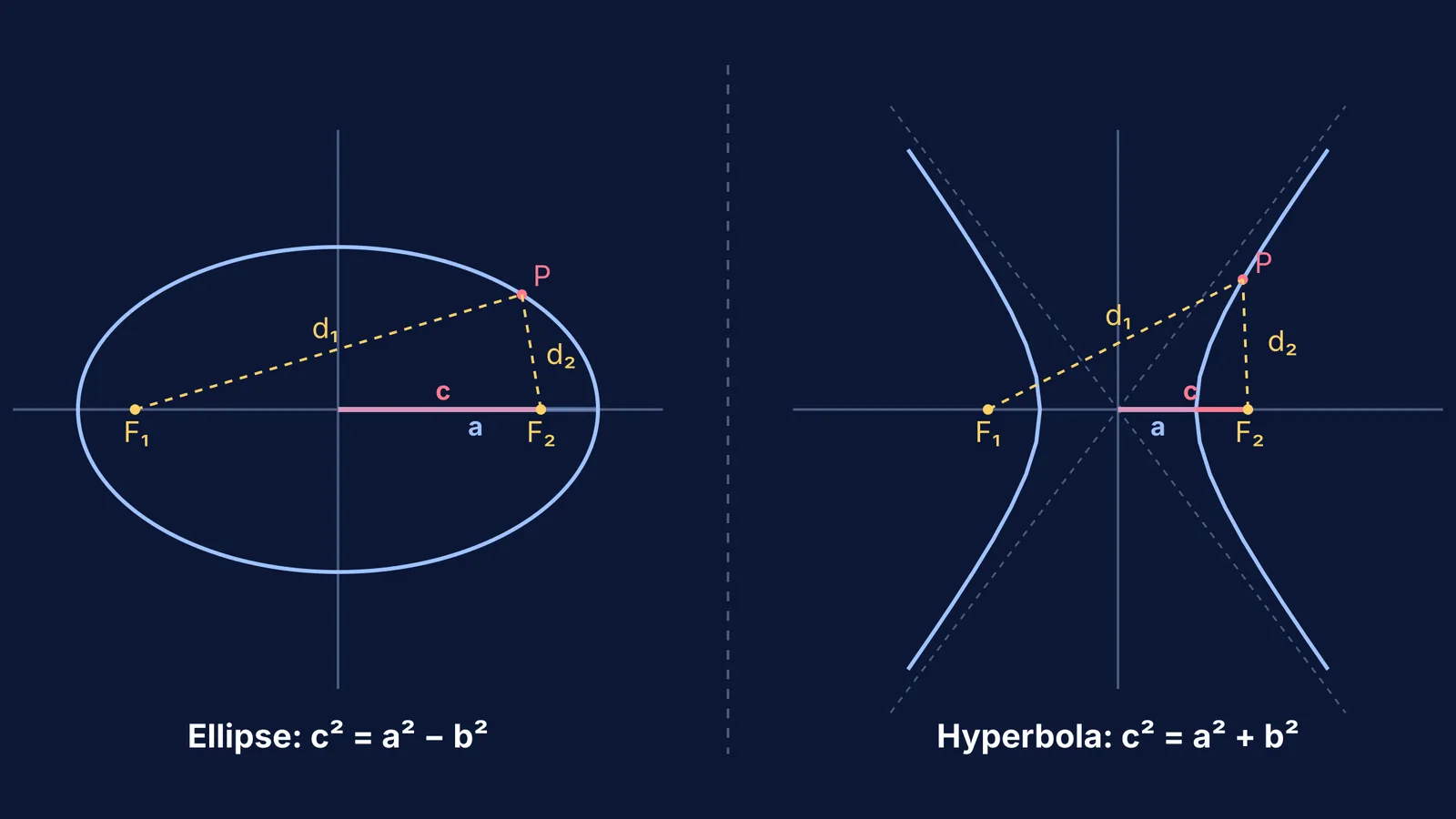
For an ellipse, the distance from the center to a focus is given by c² = a² − b², according to the OpenStax Precalculus textbook. For a hyperbola, the formula is c² = a² + b². This difference comes directly from how each curve is defined: an ellipse is built on a sum of distances, while a hyperbola is built on a difference.
When you first study conic sections for the JEE or school exams, the formulas can blur together. The equation for the focal length c is a classic trap. You might find yourself staring at an exam paper wondering whether you need to add or subtract b².
The trick is not to memorise the letters, but to look at what the geometry is actually doing.
Why does c squared equal a squared minus b squared for an ellipse?
An ellipse is a closed, bounded curve. By definition, it is the set of all points where the sum of the distances to two fixed points (the foci) is a constant. According to the OpenStax Precalculus textbook, if you add the distance d₁ to the first focus and d₂ to the second focus, you always get 2a, which is the length of the major axis (OpenStax).
Because the ellipse is closed, its foci lie inside the curve. The distance from the center to the outer edge (the vertex) is a, and the distance from the center to the focus is c. Therefore, the focus must be closer to the center than the vertex is. Mathematically, this means c must be less than a.
To keep c smaller than a, the formula must subtract the semi-minor axis squared: c² = a² − b². If you try to add them, c would become larger than a, pushing the focus outside the ellipse.
If you are struggling to picture why these distances behave this way, the Fermi Concept Library covers every concept in physics, chemistry, biology, mathematics and computing, each with its own lesson and its place in the map.
When is c squared equal to a squared plus b squared?
The plus sign belongs to the hyperbola. A hyperbola is defined as the set of all points where the difference between the distances to the two foci is a constant. OpenStax confirms that for any point on a hyperbola, the absolute difference between distances to the foci is |d₁ − d₂| = 2a (OpenStax).
Unlike an ellipse, a hyperbola is an open curve that bends outward. Its foci sit on the outside of the two branches, further away from the center than the vertices are. Because the focus distance c is strictly greater than the vertex distance a, the formula must add the two values: c² = a² + b².
How can you choose the right formula in an exam?
When you sit down to solve a coordinate geometry problem, follow this simple framework to ensure you never use the wrong equation:
Check the standard equation: If the main equation has a plus sign (like x²/a² + y²/b² = 1), it is an ellipse. To find c², do the opposite and subtract: c² = a² − b².
Check the hyperbola: If the main equation has a minus sign (like x²/a² − y²/b² = 1), it is a hyperbola. To find c², do the opposite and add: c² = a² + b².
Verify the lengths: Calculate your value for c. For an ellipse, check that your result for c is smaller than a. For a hyperbola, check that c is larger than a.
This rule of opposites (the curve's equation sign is the opposite of its c² equation sign) is a reliable way to check your work.
If you make a mistake in a practice problem and apply the wrong formula, Fermi's AI tutor notices where you are stuck and helps you work out the correct geometry, rather than just printing the answer.
To see how these lengths affect the rest of the shape, you can also explore how to calculate the eccentricity of an ellipse when a latus rectum condition is given, or how to write an ellipse equation from its foci and vertices.


