

On this page
When coordinate geometry problems in Class 11 or competitive exams like JEE Main ask for the equation of an ellipse, students often dread lengthy formulas. Whenever a question gives the foci and vertices, the curve is fixed by three pieces: the orientation of the major axis, the semi-major axis a, and the focal distance c. Reading these values directly and applying b² = a² − c² lets you write the equation in just a few direct steps.
How do you identify the orientation and centre of the ellipse?
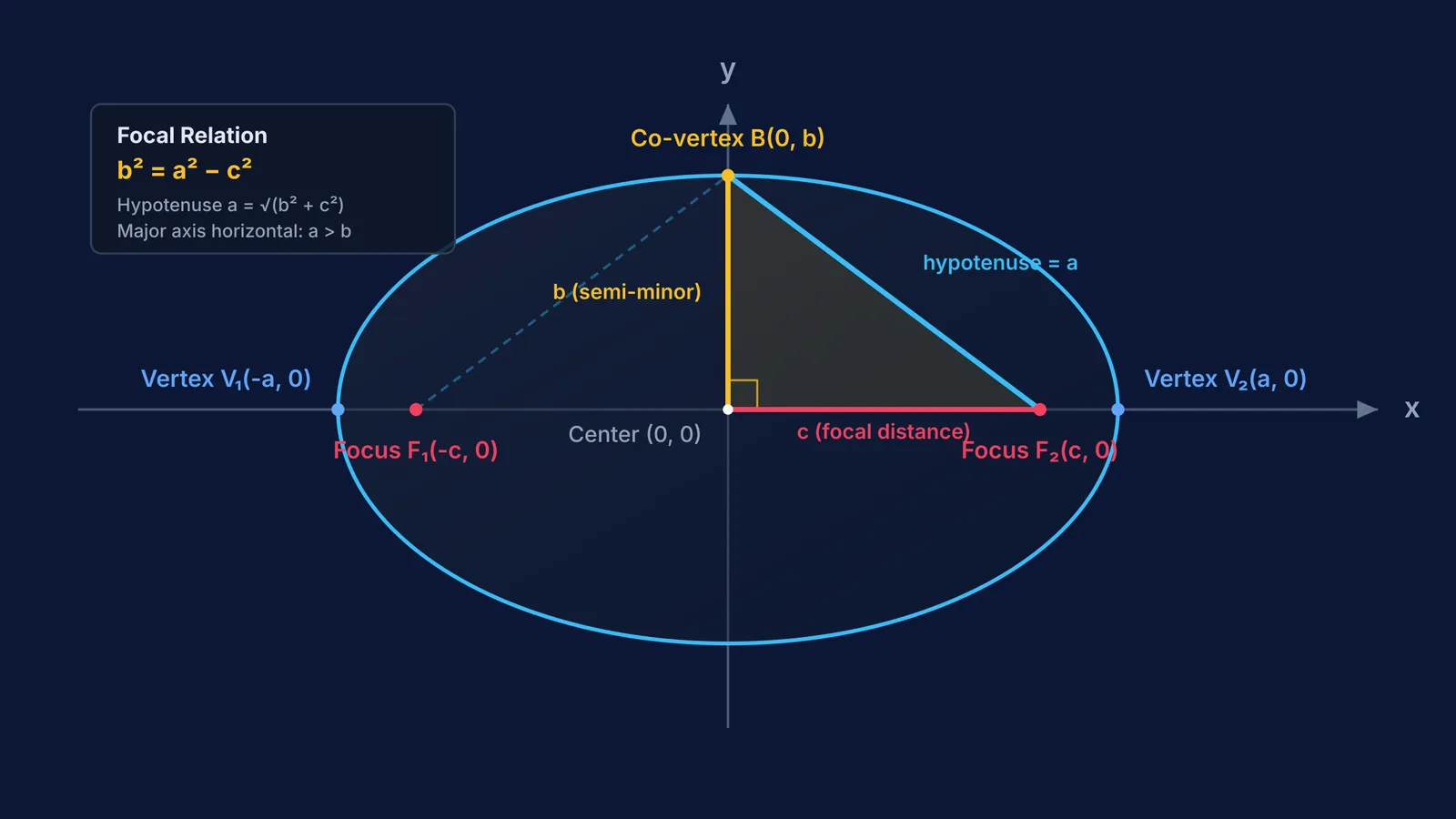
Every ellipse has a major axis of length 2a and a minor axis of length 2b. The foci and vertices always lie along the major axis, so checking which coordinate changes reveals the orientation:
Horizontal: If coordinates lie on the x-axis—vertices (±a, 0) and foci (±c, 0)—the major axis is horizontal.
Vertical: If coordinates lie on the y-axis—vertices (0, ±a) and foci (0, ±c)—the major axis is vertical.
The centre (h, k) is the midpoint of the vertices. When symmetric about the origin, the centre is (0, 0). According to OpenStax Precalculus, the standard equation for a horizontal ellipse centered at (0, 0) is x²/a² + y²/b² = 1, while for a vertical ellipse it is x²/b² + y²/a² = 1, where a > b > 0. The larger denominator sits under the major axis variable, which also connects to understanding why the sum of focal distances equals 2a.
How do you find a, c, and b² from the given coordinates?
With orientation identified, find a and c by measuring distances from the centre:
Semi-major axis a is the distance from the centre to either vertex.
Focal distance c is the distance from the centre to either focus.
Because foci lie inside vertices on the major axis, a > c > 0. As documented in Wolfram MathWorld's ellipse analysis, the semi-minor axis b satisfies c² = a² − b², which rearranges to: b² = a² − c²
What is the step-by-step method with a worked example?
Suppose a problem asks for the equation of an ellipse with vertices at (±5, 0) and foci at (±4, 0). Solve it in four steps:
Identify orientation: Both vertices (±5, 0) and foci (±4, 0) lie on the x-axis, so the major axis is horizontal and the centre is (0, 0).
Read a and c: Distance from (0, 0) to each vertex gives a = 5 (a² = 25). Distance to each focus gives c = 4 (c² = 16).
Compute b²: Using the focal relation, b² = a² − c² = 25 − 16 = 9.
Assemble the equation: Because the major axis is horizontal, place a² under x² and b² under y²:
x²/25 + y²/9 = 1.
This yields major axis 2a = 10, minor axis 2b = 6, and latus rectum length 2b²/a = 2(9)/5 = 3.6, as detailed in our guide on calculating the length of the latus rectum.
When practicing coordinate geometry, the Fermi Problem Library provides worked problems with a step-by-step solver that explains the reasoning rather than printing an answer, helping you verify denominator placement.
What happens when the ellipse is vertical or shifted off-centre?
If vertices lie at (0, ±6) and foci at (0, ±2√5), both pairs sit on the y-axis. The major axis is vertical, with a = 6 (a² = 36) and c = 2√5 (c² = 20). Computing b² = a² − c² yields 36 − 20 = 16. Because the major axis is vertical, the larger value a² sits under y², giving x²/16 + y²/36 = 1.
For an ellipse translated away from the origin, the midpoint formula gives the centre (h, k). As explained in Paul's Online Math Notes, if vertices are (1, 7) and (1, −1), their midpoint is (1, 3). The vertical span is 8, so 2a = 8 and a = 4. With foci at (1, 6) and (1, 0), the distance is 2c = 6, giving c = 3. Then b² = 16 − 9 = 7 yields: (x − 1)²/7 + (y − 3)²/16 = 1.
How do you check your answer and avoid common exam mistakes?
Before moving on, verify your result with these checks:
Confirm a > c > 0: If c exceeds a, you may have confused a vertex with a co-vertex.
Verify denominator placement: The larger denominator must sit under the variable of the major axis.
Test a vertex: Plugging (5, 0) into x²/25 + y²/9 = 1 yields 25/25 + 0 = 1, confirming the equation.
Check signs: Ellipses use a plus sign in the equation and b² = a² − c², unlike hyperbolas. Applying a systematic five-step method for conic sections keeps these signs straight under exam pressure.
To review conics systematically, the Fermi Concept Library covers every concept in mathematics with its own lesson, while Fermi's AI tutor can work out what you already know and build a plan for the session, writing on a board and checking understanding as you work through problem setups.


