On this page
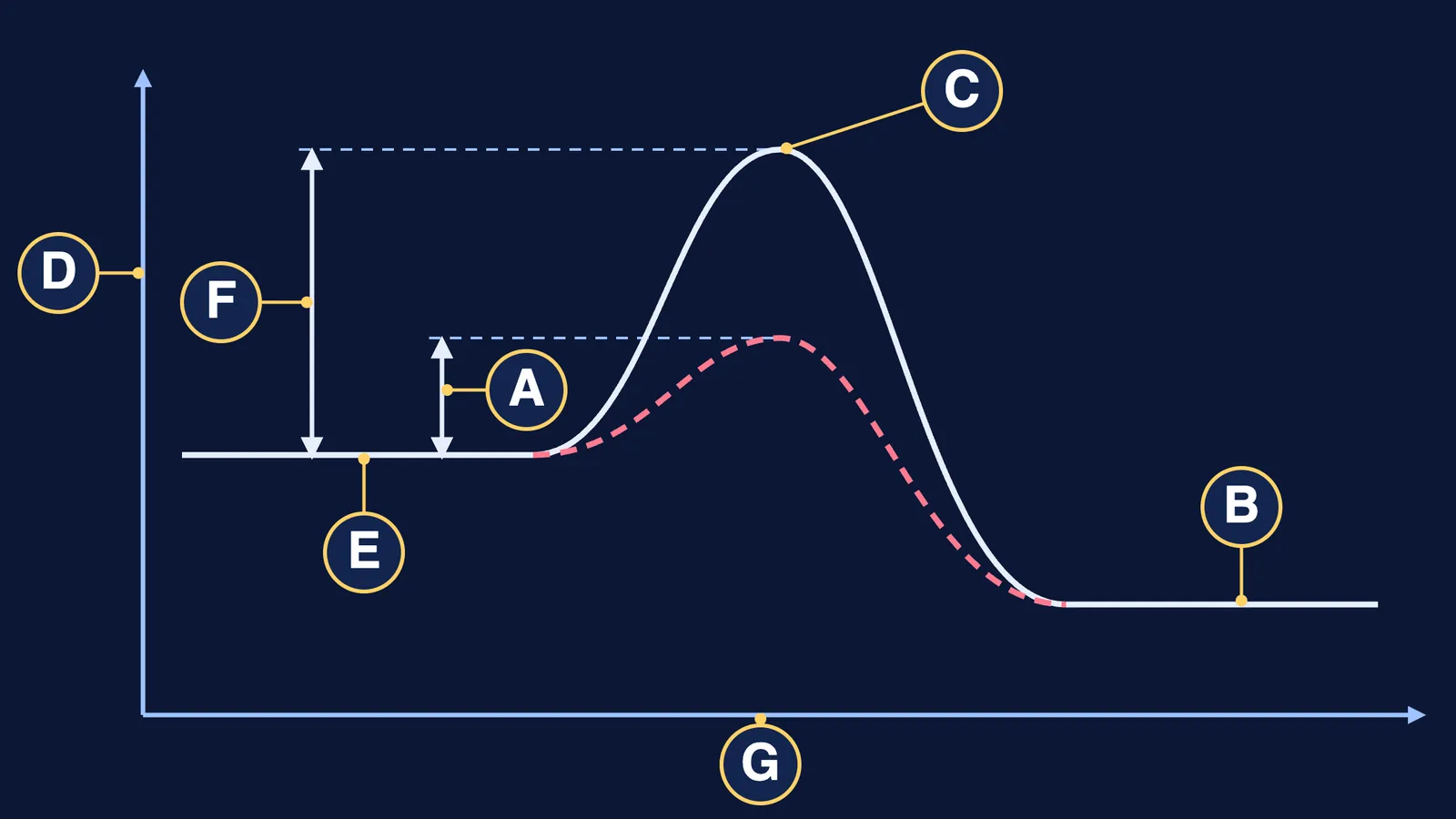
The graph above shows a substrate becoming product, with seven parts lettered A to G. Q1 to Q6 use the letters; Q7 to Q13 describe the chapter's other figures in words.
Which NEET syllabus unit covers Biomolecules?
The NEET (UG) 2026 syllabus notice lists chemical constituents of living cells, enzymes included, in Biology Unit 3, Cell Structure and Function.
Every answer reason comes from NCERT Class 11 Biology, Chapter 9 (Reprint 2026-27); only its five numbered figures and amino acid drawing are used. All 13 items are original practice, not predictions.
How do you read an energy graph with letters on it?
Before reading any option:
Name both axes: what is measured, and what is changing.
Find the two flat stretches: what goes in, and what comes out.
Read each double-headed arrow as a gap between two levels, and name both levels.
If two humps share a start and a finish, only the climb differs.
Which letter is which on the activation energy graph?
How to attack: label all seven letters on rough paper first.
Q1. Which letter marks the high-energy structure the substrate must pass through to become product? (1) E (2) B (3) C (4) A
Q2. Match the letters with what they show. List-I: A; B; D; G List-II: I. Progress of reaction; II. Activation energy with enzyme; III. Potential energy; IV. Product (1) A-II, B-IV, D-I, G-III (2) A-IV, B-II, D-III, G-I (3) A-II, B-III, D-IV, G-I (4) A-II, B-IV, D-III, G-I
Q3. Statement I: Height F is the energy gap between level E and peak C. Statement II: The lower hump is the path without an enzyme. (1) I correct, II incorrect (2) I incorrect, II correct (3) Both correct (4) Both incorrect
Q4. Height A is smaller than F. In NCERT's terms, the enzyme has (1) raised level E (2) brought down the energy barrier between S and P (3) lifted B above E (4) removed the transition state
Q5. What does axis G track? (1) Structural change from substrate, through the transition state, to product (2) Temperature (3) Enzyme concentration (4) pH
Q6. Statement I: Every state between E and B, other than substrate and product, is stable. Statement II: Axis D gives the potential energy of each state. (1) I correct, II incorrect (2) I incorrect, II correct (3) Both correct (4) Both incorrect
Answer key for the lettered diagram
A: activation energy with enzyme. B: product (P). C: transition state. D: potential energy. E: substrate (S). F: activation energy without enzyme. G: progress of reaction.
Q1: (3). Section 9.8.2: the path from S to P must pass the transition state.
Q2: (4). All four are Figure 9.4 labels.
Q3: (1). Activation energy is the gap from S to the transition state; the lower hump is the enzyme path.
Q4: (2). Section 9.8.2: enzymes lower the energy barrier, easing S to P.
Q5: (1). NCERT's x-axis is the progress of the structural transformation.
Q6: (2). NCERT calls the other intermediate states unstable; the y-axis is potential energy.
Which other Biomolecules figures turn up as word questions?
How to attack: picture the figure from the stem and decide before reading options; wrong ones often borrow a label from another panel.
Q7. NCERT's chart of small organic compounds writes palmitic acid as CH3(CH2)14COOH. How many carbons in all? (1) 14 (2) 15 (3) 16 (4) 18
Q8. Match each compound in that chart with its group. List-I: A. Cholesterol; B. Ribose; C. Serine; D. Uridine List-II: I. Sugars (carbohydrates); II. Fats and oils (lipids); III. Nucleosides; IV. Amino acids (1) A-II, B-IV, C-I, D-III (2) A-II, B-I, C-IV, D-III (3) A-I, B-II, C-IV, D-III (4) A-III, B-I, C-IV, D-II
Q9. NCERT draws one amino acid in three forms, the middle one zwitterionic. Why do the forms differ? (1) The R group changes (2) Peptide bonds form (3) A sugar is added (4) –NH2 and –COOH ionise differently at different pH
Q10. NCERT draws part of glycogen as a branched cartoon. Which statement fits it? (1) It is the animal variant of starch (2) It is a fructose polymer (3) It is built from amino-sugars (4) It forms plant cell walls
Q11. Statement I: In the protein-structure figure, the secondary panel shows an alpha-helix and a beta-pleated sheet. Statement II: The tertiary panel marks a hydrogen bond and a disulphide bond. (1) I correct, II incorrect (2) I incorrect, II correct (3) Both correct (4) Both incorrect
Q12. Which result of the tertiary fold lets an enzyme catalyse? (1) A free N-terminal end (2) Pockets where the chain criss-crosses, one being the active site (3) Subunits stacking into a cube (4) An extended rigid rod
Q13. In the substrate-concentration panel of NCERT's enzyme-activity figure, velocity climbs, then flattens at Vmax. Why does it flatten? (1) Extra substrate denatures the enzyme (2) Every enzyme molecule is already bound, so added substrate finds none free (3) Product turns back into substrate (4) The optimum pH shifts
Answers.
Q7: (3). One CH3, fourteen CH2 and one COOH; NCERT counts 16 with the carboxyl carbon.
Q8: (2). Figure 9.1 groups them this way.
Q9: (4). Section 9.1: these groups ionise, so structure shifts with pH.
Q10: (1). Section 9.5; inulin is the fructose polymer.
Q11: (3). Both pairs of labels are on Figure 9.3.
Q12: (2). Section 9.8: the active site is one of the pockets the fold makes.
Q13: (2). Section 9.8.4: enzyme molecules are outnumbered by substrate, and once saturated none are free.
How should you follow up on a wrong answer?
Q1 to Q6: sketch both humps again without looking, then compare with Figure 9.4.
Q7 to Q9: work through Figure 9.1 group by group.
Q10 to Q13: reread sections 9.5, 9.7 and 9.8.
Prefer items without a figure? Try our Biomolecules statement and match-the-list set or eight worked Biomolecules MCQs for NEET. For that figure's pH and temperature panels, read how to read the enzyme activity graph.
Not sure which part of Chapter 9 to revise first? Fermi's AI tutor works out what you already know and builds a plan for the session.