On this page
Doctors on the ground track a crew member's health partly by weight. In orbit that is a problem: stand on a bathroom scale on the space station and it reads zero. The fix is a piece of Class 11 physics. Strap the astronaut to a chair held by springs, let it swing, and time the swing. The period of a spring and mass depends on mass, not on weight, so the clock works where the scale does not.
Why does a bathroom scale read zero on the space station?
A scale measures the push it has to give you to hold you still. On the station you and the scale are both falling around the Earth together, so the scale does not need to push at all. That is why astronauts feel weightless, as explained in why astronauts feel weightless in orbit.
Gravity has not switched off. At a height of about 400 km, g is still about 0.89 of its value at the surface, because g falls as 1/r² and r has grown only from 6,371 km to 6,771 km. So an astronaut still has weight in the strict sense. What has gone is the normal reaction from the floor, and that is what a scale reads.
Mass is different. It is the body's inertia: how hard it is to speed up or slow down. That does not change in orbit, and it is what a crew doctor really wants to track.
How does a spring chair measure mass?
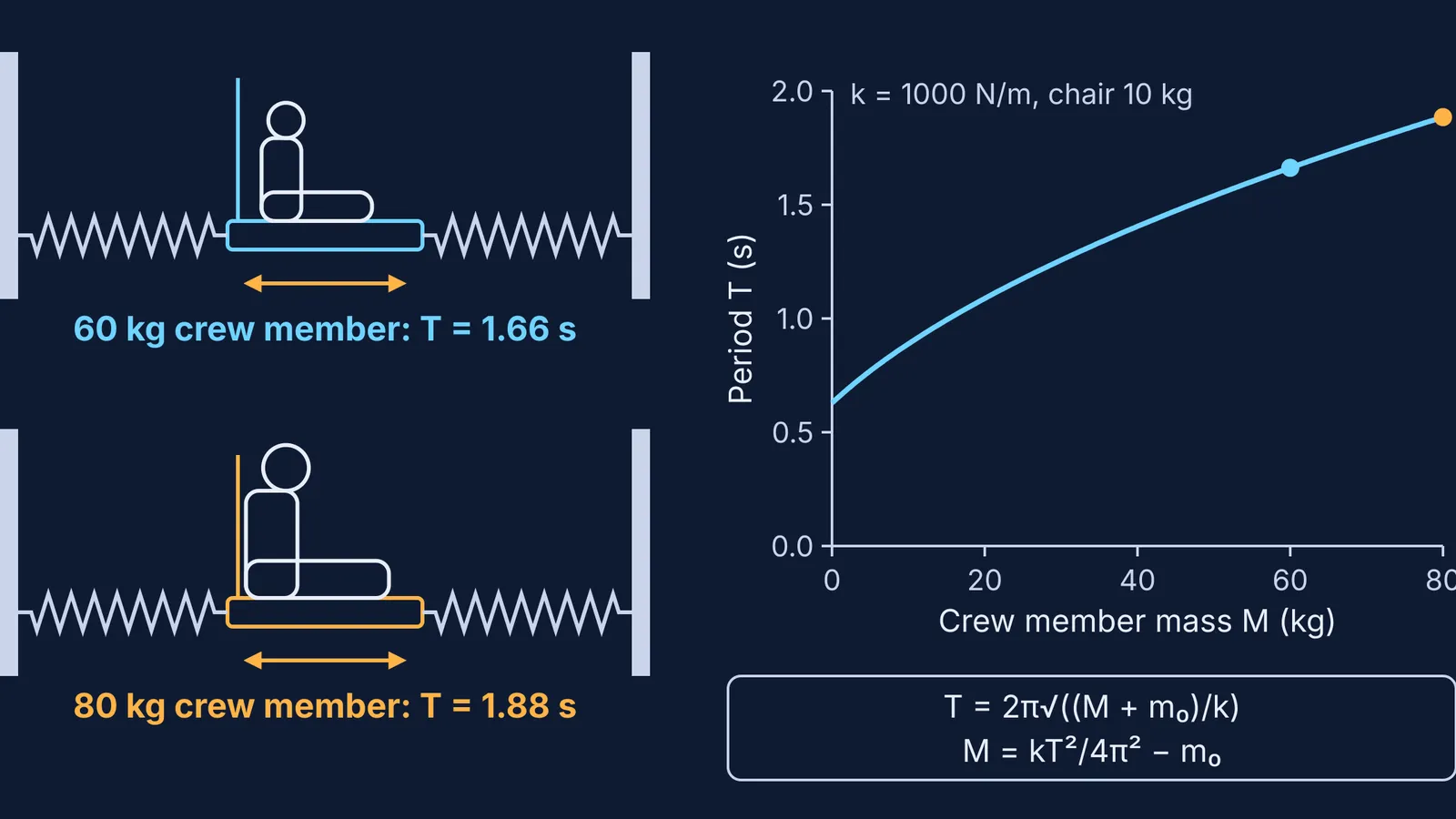
A chair of mass m₀ is held between springs of total spring constant k. Pull it to one side and let go, and it oscillates in simple harmonic motion with period
T = 2π√((M + m₀)/k)
where M is the mass of the person strapped in. There is no g in this formula. A spring and mass have the same period on Earth, on the Moon and in free fall, which is shown in why a spring-block's period does not depend on g. The spring force pulls the chair back; the person's inertia carries it past the centre. A heavier person moves more slowly, so the period gets longer.
Square both sides and solve for M:
M = kT²/4π² − m₀
So if you know k and m₀, a stopwatch is a balance.
NASA flew exactly this idea. On Skylab in 1973 and 1974, experiment M172 was an oscillating chair, a spring and mass device constrained to move in a straight line, used to track the crew's mass through the missions (Thornton and Ord, NASA Technical Reports Server; NASA Goddard's Skylab page). The device on the International Space Station today, called SLAMMD, works differently: it pulls the crew member with springs of known force and measures the acceleration, then uses F = ma (NASA). Both methods measure inertia, not weight.
Worked example: timing a 70 kg astronaut
Take a chair with k = 1,000 N/m and a moving mass m₀ = 10 kg. These are round illustrative values, not the specification of any real device.
Empty chair. T = 2π√(10/1000) = 0.628 s.
60 kg crew member. T = 2π√(70/1000) = 1.662 s.
70 kg crew member. T = 2π√(80/1000) = 1.777 s.
80 kg crew member. T = 2π√(90/1000) = 1.885 s.
How sensitive is it? Near 70 kg, each extra kilogram adds about 11.1 ms to the period. From dT/dM = π/√(k(M + m₀)) = π/√(1000 × 80) = 0.0111 s per kg.
Going backwards. Someone swings with a measured T = 1.80 s. Then M = 1000 × 1.80²/(4π²) − 10 = 82.07 − 10 = 72.1 kg.
Check the units: k in N/m is kg/s², so kT² is in kg. Good.
How accurate does the timing have to be?
Differentiate T² ∝ (M + m₀). The fractional error in the total moving mass is twice the fractional error in the period:
Δ(M + m₀)/(M + m₀) = 2ΔT/T
In the example, a 1 ms error on a single 1.80 s swing gives 2 × 0.001/1.80 × 82.07 = 0.091 kg, about 90 grams. That sounds small, but a doctor watching for slow mass loss over weeks wants better. The fix is to time many swings and divide. Twenty swings of a 70 kg person take 35.5 s; if the stopwatch is still out by 1 ms over the whole run, the error per period is 20 times smaller, and so is the mass error, about 5 grams.
How do you find k and m₀ without a datasheet?
You calibrate with known masses, which in orbit means objects whose mass was measured on the ground. Time the empty chair, then the chair with a known mass added.
Empty chair: T₀ = 0.628 s, so T₀² = 4π²m₀/k.
Add a 20 kg calibration mass: T₁ = 1.088 s, so T₁² = 4π²(m₀ + 20)/k.
Subtract: T₁² − T₀² = 4π² × 20/k, so k = 4π² × 20/(1.088² − 0.628²) ≈ 1,000 N/m.
Then m₀ = kT₀²/4π² ≈ 10 kg.
Calibration also absorbs real-world details, such as the springs' own mass. A spring is not massless, and about a third of its mass behaves as if it rode on the chair; the reason is covered in the m/3 correction for a spring's own mass. Measuring m₀ directly folds that correction in automatically.
Why must the astronaut hold still?
The formula assumes a rigid mass. A person is not rigid. Blood, organs and soft tissue can lag behind the frame as it reverses, so part of the body moves out of step with the chair. NASA's own account of Skylab notes that any internal motion, even breathing, could affect the oscillation of the chair (NASA Goddard). So the crew member pulls in tight against the seat and keeps still during the timing. A loose body shifts mass back and forth during each swing and spoils the clean link between T and M.
If you want to see how the period stretches as mass is added, the Simulation Lab has interactive simulations for ideas that are easier to see than read, and the Concept Library covers simple harmonic motion from the start.
Quick checklist
A scale reads the normal force, which is zero in free fall; mass is still there.
At about 400 km, g is still about 0.89 of its surface value.
Spring chair: T = 2π√((M + m₀)/k), with no g in it.
Solve for mass: M = kT²/4π² − m₀.
Fractional error in (M + m₀) is twice the fractional error in T, so time many swings.
Find k and m₀ by calibrating with known masses.
Skylab used an oscillating chair; the ISS device uses F = ma instead.